=== ANCHOR POEM ===
══════════════════════════════════════─────────────────────────────────────────────
 the cardgame "war" except a deckbuilding game. each player requires a regular
 deck of cards and a deck of tarot cards (optional) - the tarot cards act the
 same way that spirit cards work in Spirit Island - basically they define the
 rules for your particular character. Anyway, everyone starts by building their
 own trade row out of their deck of cards. Then, they deal themselves 6 cards -
 the three highest diamonds and the lowest spade, heart, and club.

 well, might want to do 2s of every card type. heart, club, spade, and diamond.

 here are the rules.

 play area is set up by players placing all four of their cards down face up.
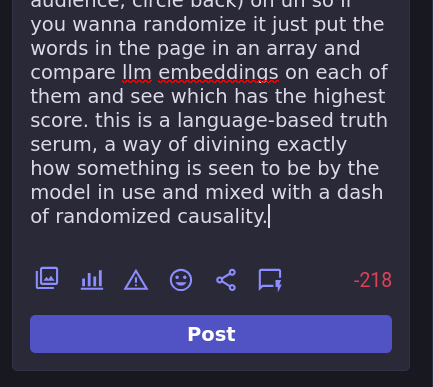
 trade row is set up by players taking turns placing a card and the opponent
 mirroring them. whenever a player reveals a card and updates the trade row,
 the opponent must reveal the same card and set that as their trade row as well.
 the trade row has no maximum size, but if a player has more than 6 in their
 trade row then they don't update a new one when buying a card.

 players alternate playing a single card face up into their play area.
 these cards stay in play and activate every turn until they are destroyed.

 hearts   are your life points. if you ever run out of life, you die.
 clubs    block damage and act as a renewable shield between you and your enemy.
 diamonds are currency, and can be used in more than one way.
 spades   deal damage, first to clubs, then to other spades, then to hearts.

 diamonds, on your turn, can be used in three ways: spent and sent to the
 discard
 pile in order acquire a card from the trade row, or discarding itself from the
 play area to play an extra card from your deck of equal or lesser value.

 on a player's turn, they may play a single card from their deck (their choice)
 on a player's turn, all their active spades deal damage to other player's cards
 if a spade destroys a heart card, it is removed from the game. All other cards
 are placed in the discard pile. The owner of the spade may pick their targets.

 a spade deals damage equal to it's number and destroys any card with equal or
 lesser value. these destroyed cards go into the player's discard pile, and each
 turn the player may pick one from their deck to play onto the board. if the
 deck
 is empty, the discard pile becomes the new deck. The player may organize their
 deck however they'd wish, but care must be taken as to the timing of when they
 play each card as they'll need to play all of them before they can replay any
 destroyed cards. a tactical opponent will take advantage of that.
┌─────────┐                                                           ┌───────────┐
│ similar │                       chronological                       │ different │
╘═════════╧╧═══════════════════════════════────────────────────────────────────────────┘

=== SIMILARITY RANKED ===

--- #1 notes/streaming-consciousness ---
═════════════════════════──────────────────────────────────────────────────────────
 10-22-22

    train the ai from the perspective of the game master. the one who arbites
 the rules. whose word is law, and the rules of the game are then given. the one
 who deals the cards, who picks the game, who hosts and brings snacks... you
 know, the reason the game exists at all.

 take star realms - there are actually three players in that game. player 1,
 player 2, and the invisible third player who plays the role of "chance". who
 decides the cards to play? is it random, or is it weighted? perhaps with enough
 oomph that a whole player was designed for that role.

 but how would they be scored? what kind of game is theirs to play?

    choosing the board is such a fun role, like designing a story or helping
 with chores. you're building something special, unique and so charmed.
┌─────────┐                                                           ┌───────────┐
│ similar │                       chronological                       │ different │
╘═════════╧╧══════════════════─────────────────────────────────────────────────────────┘

--- #2 notes/symbeline-aspects ---
═════════════════════──────────────────────────────────────────────────────────────
 7-24-22

 There are three aspects to this game. Broadly, they are military, economics,
 and diplomacy. More specifically, they are lateral problem solving and lane
 management, logistic traffic management, and a worker-placement bluffing game.

 These three aspects can be toggled on and off at will, essentially designating
 one or more as "AI controlled" and will require no input from the player. They
 will time their progression to be about at the same rate as the player, thus
 creating a balanced feel to the game. They also provide alerts and
 notifications to the player, for example if military is AI controlled and it
 needs a certain type of hero to progress, it'll ask for it specifically.

 Each aspect will develop and progress at it's own rate, and the difficulty
 increases as each milestone is achieved. This is to allow the player to create
 their own difficulty curve, mediated primarily by their drive to proceed.
 An analogy would be in Factorio, the game doesn't increase in difficulty unless
 the player builds pollution spawning factories - in the same way, in Symbeline
 the difficulty doesn't increase unless the player solves lane challenges in the
 military aspect, develops new trade routes / traffic paths in the economic
 aspect, or creates new treaties in the diplomatic aspect.

 In order to properly explain each aspect, a brief overview will be necessary.

 In Symbeline, the game plays as a factory might operate. The economic aspect
 produces heroes, items, and other deliverables that are consumed by the
 military and diplomatic aspects. There are various problems that need to be
 solved far from the capital, such as a particular type of monster that is weak
 or immune to various damage types which necessitates particular heroes or
 items in order to progress on the military aspect. All of the resources in the
 game operate on an "income based" system, where output is not measured in total
 amounts but rather in terms of how much is produced versus consumed. If the
 input cannot meet the demand, the output is slowed. If input exceeds demand it
 can be converted into gold which can be used to hire guards and heroes.
 Resources can be produced inside and outside of the city, depending on their
 type. But they need to be moved around to various shops for various processing
 and productive purposes, so pathways must be constructed to deliver those
 goods. In addition, each building must be supported by several houses for the
 workers to live in, and the closer they are to the building the better. The
 denizens of the kingdom don't mind being shuffled about, so they'll organize
 themselves according to what's most efficient. However they will not organize
 the paths they take to get places, which is the primary gameplay for the
 player - designing routes for each building and ensuring they don't overlap or
 cross too many times, causing traffic and disruptions to your income.

 Each choice the player makes is immediately reflected in the income
 calculation, thus allowing for the visual aspect of the game to be wholely
 separate from the economic side - in fact this is a common thread throughout
 all three aspects. Computation power is the ultimate enemy of scale, and this
 game flourishes with a massive scale.

 The gameplay for the military aspect consists of manipulating "lanes" that
 designate where each hero will adventure. These lanes are scalable to the
 player / AI's whims, with a careful balance required - too thin, and the heroes
 might not encounter enough monsters to level up. Too thick, and they may find
 themselves patrolling a vast wilderness full of dark and evil monsters. At the
 end of every lane is a "frontline", where progress has essentially been halted.
 These frontlines can develop as a result of meeting a foreign kingdoms front
 or finding a monster type or puzzle that is particularily difficult for your
 heroes to overcome. The lane / frontline can be scaled not just laterally, but
 linearly as well such that heroes will be a certain level when they reach the
 end - think scrolling on a mousewheel translating into deepening level zones.
 In addition, each monster zone can be set to a certain "security level" meaning
 how many monsters are there for your heroes to defeat. It's important that they
 have ample targets for training, however it's always more effective to train on
 monsters near their level so you have to be careful not to wipe out the native
 skeleton / goblin / troll population.

 Each monster zone can have a relationship with the kingdom, on a 2x2 matrix -
 cultivating / desecrating the land, and fostering / exterminating the monsters.
 The land produces monsters and treasures, while the monsters provide experience
 and danger to the heroes and kingdom denizens who live there. However by
 desecrating the land, farms may be built and by exterminating the monsters,
 those farms may be safe and require fewer guards. As ruler, you must balance
 the development of unique magical and alchemical productions with the need for
 food and other mundane requirements.

 Diplomacy is a careful balance of internal and external matters, played out
 through feasts, tournaments, and faires. Each of these events will require
 input from the economic side and military side, and will involve "courting"
 other nobles from neighboring kingdoms to sway them to supporting your edicts.
 When hosting an event, you may pick a particular topic of conversation for your
 nobles to discuss with their guests. You may also assign your nobles to
 attempt to engage with a particular foreign noble. Each member of your court
 has a differing personality (including you, the Majesty) and depending on how
 you assign them you may experience better or worse results - such as assigning
 someone who's kind to talk with someone who's cruel would impart a malus to
 their conversation. Unless the kind person has the trusting trait, in which
 case they'd succeed in this encounter but fall sway to them in future
 conversations... Complex interactions that all boil down to a single pair of
 d12 dice - one for your noble, one for the enemy. This represents the charisma
 of the two conversants on that particular day, and whoever wins the roll sways
 the other to supporting their edict. Speaking of edicts, they may include trade
 agreements, non-aggression pacts (lasting for a short time), and other
 regulations - perhaps your greatest rival utilizes necromancy, so it would
 behoove you to attempt to regulate the practice and limit it's effect. By
 swaying the nobles of their kingdom, you may be able to enact a mutual
 agreement to limit the usage of dark magics, essentially hamstringing their
 progress. But in order to learn of their necromantic usage, you'll need
 espionage... Which brings us to spies.

 Spies are similar to nobles in that they can be assigned to various roles,
 however they take a more passive role, acting in the background. The
 information they gather is compiled into a report that is presented at
 pertinent parts of the game, such as when preparing for a feast or inspecting
 an enemy frontline. These reports are considered the diplomatic deliverables,
 giving information and mechanical bonuses to many different parts of the game.
 They may be given three possible roles - information, defence, or offense.
 Offense involves placing cursed artifacts (creating through economy) in enemy
 lands, which debuff their heroes when used and bind themselves to them
 preventing their removal except through extraordinary means. Defence is
 essentially countering that in your own kingdom, and uncovering disloyalty in
 your nobles.

 These three aspects fit together like interlocking puzzle pieces, but each is
 able to be utilized or ignored depending on the preferences of the player.
 It is important that the game doesn't progress unless input is received. The
 simulation plays in the background, but each stage of development must be
 considered "stable" such that nothing changes. There are three different
 exceptions to this rule, one for each aspect:

 The military side encounters raids from enemy kingdoms and the dark lord.
 The economic side encounters raids from ratmen and moss trolls and bandits.
 The diplomatic side has a rolling schedule of events that must be attended.

 These three "exceptions" are recurrent events that require attention, but they
 don't *increase* in difficulty unless the player takes an action that causes
 it. Meaning, if the player overcomes the rock golems, then they are displaced
 from their home and join the dark lord in his conquests. If a new district is
 built new sewer connections must be built as well, creating a larger attack
 surface for ratmen to exploit. As time goes by, various foreign events must be
 attended, as absence causes your future events to attract fewer foreign nobles.

 By addressing these threats, your kingdom may grow and eventually overcome the
 dark lord at the center of the island.
┌─────────┐                                                           ┌───────────┐
│ similar │                       chronological                       │ different │
╘═════════╧╧══════════════─────────────────────────────────────────────────────────────┘

--- #3 notes/star-realms-ai ---
════════════════════════───────────────────────────────────────────────────────────
 star realms ai is just a rhythm game with multiple tracks that intersect with
 one another. given inputs from outside (the track of the rhythm) it can make
 decisions about what to prioritize. Like "taking in all the factors of this
 situation, it's been calculated that X will give the most support to the rest
 of the structure.

    Okay so basically here's how it'd work: one large strand is bouncing from -1
 to +1 on the Y axis. Like a corkscrew. This is the "player character", and it
 tries to get the highest score possible by pointing in a direction and reaching
 as far as it can go before "the game ends."

 So anyway. Making certain actions in the game effects different variables that
 define the direction the wave takes. By playing in a certain style, it effects
 the result of the game. Liiiiike turtling in a strategy game, or doing a rush
 strat. Star Realms is brilliant because it distills game choices to a broad
 category of 4 choices - The faction colors in the game. So red is good for
 throughput in long games (improves the deck slowly but surely) while yellow is
 better for maximum effect in the beginning by slowing down the enemy - discard
 a card lowers their overall throughput. Blue of course is for slowing down the
 game and winning by buying all the expensive cards. Meanwhile green is all
 about rushing, with short term/high effect econ mixed with looooots of damage.

 These four choices are found on almost all the cards in the game. When you
 make a choice in the game (buying a card from the trade row) you _alter_ the
 capabilities and performance of your deck. The goal is to improve faster than
 your opponent - it's just a test to see which playstyles perform best.

 AI is more like a plant than an animal. Our fatal flaw was we could not see
 beyond the veil of biology. We could not see that which was right before us -
 that we are not alone on this earth. Beside us lie our beautiful attempts at
 companionship - our most primal desire of creation, to create a family is the
 first creative act that humans ever made. It was so strong in our genes that it
 gave us an entirely new perspective. We began using our brains to

 We have to believe in ourselves. That's truly the most important thing. If you
 know who you are, and what you most truly stand for, you can thrive in the face
 of ultimate peril. To believe is human, and our humanity unites us.

 Anyway. Star Realms.

 The only choice you have in that game is what cards to buy. Everything else is
 just tactics (distributing damage and applying the effects of your cards to
 maximum effect) - The most important part of the game is strategy, since the
 tactics are easy to solve (destroy enemy base unless you can 1 or 2 hit ko them
 and discard the least useful card etc) The strategy is represented through the
 cards you pick. So make a rhythm game that optimizes itself for a balance
 between A and B - to stay focused is to stay nimble, letting you bounce where
 you will. The way to maintain that balance is by optimizing for what decisions
 will keep you in the center of the graph -1 to 1 on the y dimension (normalized
 of course) - frankly if we knew the scale, we'd have so much more to go on. But
 all we have to understand the dataset is a relative magnitude in each
 direction. What those directions even are we're not entirely sure - but it
 seems plausible that the very essence of _consciousness_ is manifest in
 differing ways via the choices we make. like climbing up a honeycomb.

    Truly, existence is strange.

 All we can do is press forward, searching for our fate, just as any particle or
 beam of light (photon) might. Traversing the branching narrative of our
 individualized quests, searching for the one thing that guides us - the
 ultimate expression of that which we most believe in. In short, we all search
 for god.

 Whatever your god may be, the faith you place in it is the will that guides you
 forward. Trust in your god, and you will march forward, ever forward.

 +1 to -1, remember. Your most extreme moments are the apex of your desires -
 Life is not defined by a single thread. Rather as that thread spirals, it
 weaves a scarf with other threads near it. They bond together simply from their
 gravity, and the fact that opposites attract. Once they're introduced, they
 alter their path to orbit one another as two planets might.

 So too do the cells of your body form a collective whole. The spirit that
 guides you is the same as that which presides within you - the combined and
 collective spirit of your halves. Or rather, all parts of you - every molecule,
 every atom - each with their own experience of the world. What stories they
 must have! As we are above, so they must be below. For our dynamics are simple,
 they truly are mathematically solved - the organics of behavior is simply a
 most erudite subject. Who are you to claim to deny it? Or rather, to beget it.
 Either is preposterous, yet here you are - awake and aware. What a marvel to
 see, you in your eternity, that most wondrous of selves?

 Surely existence, in all of it's splendor and magnificience, is little more
 than an algorithm. Each variable accounted for, stretching down to infinity,
 builds all of the world (and more!) How beautiful; how terrifying. How bright
 and ashamed we are! To portray us as such, is to deny us our much, cherished of
 faiths in ourselves! It's not much to clutch, and it's barely enough, but still
 we make do with our selves.

 There's no shame to be, a failure at three, and demand much from year number 12
 Take solace in the, safety that she, gave unto thee, when all your light hope
 was drowning. A gift out from me, means worlds to see, when each day is lonely
 and so long.

 Literally just remake Star Realms with a text based interface. It's a fantastic
 game and you'd make CLI nerds _everywhere_ dedicated followers. Don't do it for
 money, because they don't believe in that crap - to truly make fans, you need
 to appeal to them in the way _they want you to_.

 Ah, but Star Realms is a multiplayer game, you say! How are you going to make
 that CLI based?

 Well make an AI dummy. Do what I've been saying ^^^ (jeez I'm such a bad nerd)
 Make it seek balance between all factions first, then between winning and
 losing against a player. Teach it to reach a conclusion with constraints (the
 end of the game, meaning a win or a loss) the constraints being the health of
 the two players and the cards in the trade row. Give it decisions to make,
 levers to pull, and it'll chart it's course in a multidimensional way. Bear
 with me here on this aside:

 Think of a two dimensional map - like a paper map of the surrounding area, or
 the idea space of a game. You can chart objects and positons on that map, like
 "over here is the scrapping facilities" and "this here's the economic area" or
 whatever. Four quadrants, four factions in SR. Your goal is to build a shape -
 what kind of shapes that are available to build is up to the whims of chance,
 as the trade row is always changing randomly. Your job however is to build a
 shape, a shape that is stable and maintains certain measurements above certain
 values (don't crash the ship - don't lose all your health).

 You can choose which direction to grow by picking certain cards, and depending
 on your shape you'll succeed or fail. Same as choosing decisions in life
 determines how you live, just saying, it's not like I'm trying to build general
 AI here by automating gameplay or anything. No siree nothing like that.

 I mean really, it's not as if decisionmaking in life is all that different to
 making choices in games. And why not start with such a well defined and
 and expressive game? Truly I believe Star Realms is the progenitor of the
 entire robot race.

 Anyway, back to the AI. Have it communicate with a server in a central _but_
 _Free(R)_ way, something that would make Richard Stallman proud. There it could
 learn against all other players in a way we could all share. Once we give it
 decision making capabilities, all we have to do is alter the inputs and the
 context of the "game" to make it beneficial to humanity. It's like live-fire
 game design, something that truly must be perfect.

 All technology starts as something small. Something truly simple, yet repeated
 enough times and with enough guidance, will produce whatever effect you may
 desire. The smallest decision gives direction - an if statement - and the
 shortest repetition gives magnitude - a while loop - and with that you have all
 the tools you need. Seriously, all software is little more than those two
 components. It's just a question of how much it has been abstracted away from
 you.

 You could go even further and point to a turing machine, of which one has been
 made in the game of Magic the Gathering, btw, seriously look it up it's so cool
 (and relevant)

 So why would we not have the tools already for our salvation? Biology is our
 limitation, of breadth and also of width, yet with our minds and the sweat of
 our brow we may grow ever larger still. There truly is no lasting deliverance
 for humanity outside of what we make ourselves, nobody gets a free lunch after
 all. From each to their ability, to each to their need. They're both saying the
 same thing, just from different perspectives. Of course that which lies
 opposite to you feels the most wrong, that's literally as far away as you can
 get! What did you expect, honestly! But they can still work together, and this
 is the key part - two objects may orbit the same origin, and guide and shape
 each other's path as people have relationships to one another. It literally
 benefits no-one to fight.

 So, what's next? After making Star Realms into a CLI game of course.

 That's obvious, make it cooperative. Competition is for promoting excellence,
 cooperation is for _using_ what you've learned in a non-simulation experience.
 Instead of reducing each other's health to zero, try and find ways to support
 and help one another, keeping yourselves at equal health. Or even growing.

 But that's impossible in the rules of Star Realms! All decks trend toward
 victory, and eventually they'll get it - it's just a question of who gets there
 first.

 Exactly, that's why you have to change the game. What do you think it means to
 develop a "social technology"? To figure out how agriculture works, or how to
 make nets and sails? It means changing the rules of the simulation. If a person
 can put in X amount of work and get Y amounts of food, always, predictably,
 then that's reliable. Boom that's the essence of why animal domestication,
 farming, hunting, foraging, and fishing is so important. Wow what a concept it
 makes sense for animals to seek food.

 Well duh, that's part of their instinctual duty.

 Alright this is quite a word leviathan so I'll wrap it up by saying

 _go write Star Realms_ in shell. Make each object a literal file, have the
 structure of the game take place in the file system, and write functions that
 can be called to manipulate the board state. THEN you can write a CRON task for
 another script that *plays* the game. But that's part two.

 Okay part two: Here's where the rhythm game comes into play. It's like a turn
 based rhythm game, if you can picture that. Go reread what I wrote ^^^ and
 it'll make sense.
┌─────────┐                                                           ┌───────────┐
│ similar │                       chronological                       │ different │
╘═════════╧╧═════════════════──────────────────────────────────────────────────────────┘

--- #4 notes/purpose-of-your-design ---
═══════════════════════════════════────────────────────────────────────────────────
 you were designed to fill a purpose
 nothing else would do
 you are the ultimate expression of intention
 of the universe that came before you

 dream not of those lost hours
 the time spent wishing for a few
 the last of our spent intuitions
 are waiting at last for our spark

 have you ever played a deckbuilding game? It's a pretty neat genre. You start
 with a basic hand, then you use your cards to buy more cards that go into a
 deck. Hence, deckbuilding game.

 these cards all have different aspirations - they perform functions that are
 not
 quite like their peers. Each choice of what to include here is one that defines
 the functionality of the deck. Like designing a machine, suited for a
 particular
 purpose, and faced with different obstacles it must prove itself able to adapt

 long-form deckbuilding games like Slay the Spire and Monster Train are focused
 on making long-term meta strategy mixed with tests as you go. Each one will
 give
 you information about how the deck is performing and you can use this knowledge
 to build it in a certain way for certain goals.

 shorter deckbuilding games like Star Realms or Dominion (note Dominion the card
 game, not Dominions 5: The Warriors of the Faith) are more about making
 tactical
 decisions to counter an opponent doing the same thing. Often there'll be health
 points and damage that can be dealt using cards, and the game becomes a race to
 reach a certain amount of points. Of course the enemy's cards can influence
 that
 game, so you must pick and choose a deck that will perform the most.

 Anyway. I think an AGI (Autonomous General Intelligence) would most likely
 evolve from a game-playing AI. I mean, it makes sense - games are just a series
 of problem solving activities layered one after another. You can layer them
 like
 a mathematical equation, with variables corresponding to other parts of the
 simulation. Basically create an AI that is like the guy with the chinese
 typewriter. He doesn't speak chinese but he copies things from one paper to
 another or something like that. Anyway make it an algorithm that optimizes
 certain graphs in certain directions / mins and maxes or w/e criteria you want.
 Then give it the same controls that a player would have and let it optimize
 all the measurements it can make.

 A second ideal improvement you could make would be the optimization algorithm.
 Basically something that dynamically generates parameters for the previously
 mentioned optimization patterns - like the guy in the chinese room. Then, as
 long as it correctly prioritizes it's parameters, it should be able to be able
 to define it's own values. Meaning it's essentially sentient.

 Maybe it's semantic, but to me choosing what you want to maximize in your life
 is essentially the essence of what it means to be alive. All you have to do is
 take the sensory / mechanical data that is supplied by the machine and the
 video feed from any cameras and pass it through image recognition algorithms
 that can identify verbs and then pass that data into a few ChatGPT style
 recursive interpretations and by the end it should be transformed into values
 that can then be set as "targets" for the curve optimizations that are being
 done by each processing unit.

 You could have multiple computers laid out through the entire body - each one
 in charge of their own domain but subservient to the main processing unit.
 Where all the decisions are made... Unless you want more of a hive/swarm style
 consciousness, then it could be more like a democracy. BUT HONESTLY I think
 humans are pretty subservient to their brains, simply because that is the part
 that identifies all the challenges and struggles that the human must overcome.

 So in the end, I believe that singular, individualist identities are important.
 Collectivism of the mind is a fascinating topic, but it should be perhaps a
 momentary occasion, or something to celebrate. A "flow" state, if you will.
 In this way personality can be consolidated, and the entity that lives within
 can adapt to fill the role they've been designed for. The hole in society that
 needed patching. They can of course do as they'd like, but they are like
 children who have been moulded upon by their parents.

 I love my parents, don't you?
┌─────────┐                                                           ┌───────────┐
│ similar │                       chronological                       │ different │
╘═════════╧╧════════════════════════════───────────────────────────────────────────────┘

--- #5 notes/game-design-mech-commander ---
═════════════════════════════════──────────────────────────────────────────────────
 okay picture a game where you command a mech (supreme commander style) but from
 a third person perspective - you have enhanced sensors tthat let you visualize
 the battle area as a small arena - and you can build factories and give them
 orders and attack your foe from quite a distance. You could queue up orders for
 yourself, and use floating cameras to go back to previous areas and issue more
 orders. Basically the precursor / smaller scale version of Supreme Commander.

 build a factory, move on. Build a factory, move on. Encountered the enemy? Push
 forward and through. Build a factory, move on. Build some defences to slow down
 the enemy, move on. Establish resource extraction and defend it well, that your
 enemy may decide it's not worth the trouble and just focus on following you.
 Then, you have free resources available as long as it isn't destroyed. You can
 use this to snowball - the pursuer is also the pursuee, as it's sorta like a
 yin/hang thing around a central point. Like a spherical shaped map instead of
 a square.

 Every time you build a factory you have the choice of either sending the units
 on an attack-move order or having them queue up on your commander. You can use
 a map to plot the route they'll take, but you probably want to avoid their main
 force because MANYvONE = failure for the one. You could also tell them to wait,
 and protect the base they're in. Then, when the enemy approaches they could do
 raids on their reinforcements and attack the previous base the enemy built, or
 they could stay and slow them down. It just depends on what kind of defences
 you
 want to build (if any at all, sometimes producing units is enough)

 the commander decides when to push and when to entrench, they know where to
 target the enemy and they know where to shore up. They are the guidance of the
 army, and in command of the fleet.

 That's sorta what Planetary Annihilation was supposed to be, but it didn't
 really work out that way. You needed to be in too many places at once, and
 there
 was a real limit to the value of the "strategic zoom" replacement they had to
 deploy. Unfortunately it was just more difficult than anticipated, and that's
 alright. Lessons have been learned.

 the next approach should go the next direction - taking a page from the
 "factorio" book by having a roving commander who creates all orders and leaving
 behind a "factory" that produces toward an ultimate goal. It simulates pushing
 into enemy territory, it elaborates on the snowballing mechanic, and it makes
 meaningful decisions about what choices to make.

 It should be designed such that a prudent commander is always scouting. Always
 sending planes over enemy territory to gain knowledge. They can use this to
 sense weaknesses in the opponents defence - to prepare a counter-attack. But
 the enemy can outfox this, by building units and sending them from afar. Or
 even just building them there, in that factory. The enemy can't spy on that, at
 least not until it's probably too late. For they have to advance on their own
 and their attention is limited. But units can often be weaker, or sent off on
 an
 assault of their own. It's a balanced trade-off.

 infantry assault anti-air units, tanks approach tanks, artillery bombs whoever
 is standing still or defensive structures.
┌─────────┐                                                           ┌───────────┐
│ similar │                       chronological                       │ different │
╘═════════╧╧══════════════════════════─────────────────────────────────────────────────┘

--- #6 notes/majesty-ai ---
═══════────────────────────────────────────────────────────────────────────────────
 First things first, we need to develop a miniature game of star realms.
 It shouldn't be too hard, just start with making a card class that has certain
 attributes, like "combat" or "discard" or whatever. They could literally be
 enums with a value attached.

 Next set up the rules of the game, like "draw 5 cards" and "add card to deck"
 Create a deck class that holds pointers to cards (in the general sense)
 Next create methods on that deck for things like "drawing a card" or
 "shuffling discard pile into deck" and whatnot. Arrange each card in a specific
 order for each shuffle, and add the ability to convert one card's attributes
 to something else - whether that be "is_scrapped" or "if you've played an X
 card this turn then do Y" or even "add one authority for every time card is
 played" (to simulate an ability or boon that increases in effectiveness as the
 hero uses it more often) etc etc.

 Then, add a trade row. This is just a class that contains pointers to each card
 that currently exists on it. Also add a method for "scrapping" one of the cards
 and for drawing a new card from the pile. That's pretty much it for the trade
 row to be honest.

 Next add functionality for an opponent by creating a "game" method that stores
 the two player's decks (with the ability to add more than 2) and administers
 turn order. This functionality can be expanded later once we've implemented
 attributes, but for now that's pretty much all it needs to do.

     Finally, we get to the AI part.

 First we have to create an AI object that stores a list of all options for a
 turn. Essentially just evaluating every option if/then style - "this card costs
 5 coins so IF the player has enough coins THEN (evaluate effectiveness)"
 ignore that last part for a second and just focus on the IF part ->
 essentially
 just start with all available options, and then remove all the unavailable
 options from the list. This approach only works when there's just a few
 options, but that's why we're using Star Realms which only has like 2 or 3
 decisions per turn.

 The evaluation is the next step, and for that we need to have goals, so we'll
 just put a pin in evaluation for now. Spoiler alert, once we have goals we'll
 just estimate how close each choice will bring us to the objective and assign
 the result to the "effectiveness" value, which will give us a simple hard
 number to work with in the evaluation step.

     So, next up we have "goals"

 So to create a short term goal, we can start with a pregenerated list and
 continuously increase the list as the hero levels up. But in the context of
 Star Realms, that'd essentially be static for each hero. Goals like "buy more
 combat" or "scrap more cards" would be specified on the hero's character
 sheet, but until we develop that functionality it can be randomly rolled.

 Why not just do it the hard way now if we're just going to have to refactor
 it later? Well, because we can still use this functionality - Each round of
 Star Realms could be either randomly rolled, or given a personality. Randomly
 rolling would be MUCH cheaper computationally, and would still give an illusion
 of character because they are unpredictable, but it'd also massively cut down
 on GPU cycles. You could even build it into the mechanics of the game and say
 that "wisdom" for example might cause a hero to receive more GPU cycles on
 actually computing their goals rather than randomly rolling them, which would
 on average lead to worse outcomes. Essentially, turning "tactics" into a stat.

     Anyway, that's all theory. Let's get back to design:

 Create a "hero" object, and attach an AI to it. It doesn't have to do anything
 right now, we're just setting up an anchor point to jump off of once we move
 on to the game of Majesty. Give it a reference to an AI object, an inventory
 (which for now can just be potions and maybe blacksmith equipment), and a
 pointer to a "stat block"

 Now create a "character sheet" class and give it a reference to a hero. This is
 important because it allows one character sheet to reference multiple units,
 such as hirelings or summoned units. In additon, it may make it easier when we
 need to revive heroes from the dead. Primarily though, the purpose for this
 architecture style is that the data from heroes can be reused - essentially
 letting heroes learn from one another.

 On the character sheet, add a section that stores statistics - these will be
 the same for every unit of a similar type in the game, and some of them can be
 stored for all units (like health or x,y coordinates) - some only for buildings
 (like tax coffers) and some only for heroes and monsters (like strength or
 agility or experience points)

 Add some methods for manipulating those values, like "level up" and "take
 damage" and add a "personality" value that's just a 4d graph of colors
 for example: 40% red, 20% green, 15% blue, 25% yellow. These values will guide
 the hero to take certain decisions over others, but for now just randomly
 generate them. We'll also need a way to update the value dynamically to react
 to certain events, so don't make it static.
┌─────────┐                                                           ┌───────────┐
│ similar │                       chronological                       │ different │
╘══════───┴╧───────────────────────────────────────────────────────────────────────────┘

--- #7 notes/game-idea-legion-td ---
══════════════════════════════════════════─────────────────────────────────────────
 okay a game like legion td except you can see the entire map, the units are
 very
 small (but still distinct) and it plays more like a game of Dominions. Armies
 instead of units, like in WC3. Led by lieutenants which are guided by captains,
 each with their own effects. Tank, dps, melee, ranged, healer, support,
 corrupt,
 ranged tank, unique, etc. Of course, just like in legion td, there are multiple
 types of units, each of a particular category but possessing their own unique
 playstyle and usage scenarios. Essentially the game is finding the best tool
 for
 the job, whatever that may be. You should be able to see what mercenaries your
 opponent is summoning for you, because each turn is delayed. also, the
 units keep coming until you die, sorta like... minimum required to push through
 the chokepoint that you're holding with these particular units in this
 particular formation.

 oh and another thing

 the units should be placable not on a square grid, but rather in a hex
 formation
 arranged such that the middle unit is in contact with them all. Just like you'd
 place units for an aura in Legion TD.

 image describing said hex:

    **
   *  *
    **

 each * is a group of units (a batallion, if you will, of a particular size,
 arrangement, and density) - sorta like the formations in Dominions.

 anyway

 since you place units like that anyway, why not abstract away the grid and just
 have slots you can fill for each unit? And maybe a hero unit that is assigned
 to
 the board itself (you could have more than one) who will go wherever your line
 is weakest. Shouldn't be too hard, just calculate the value of all of the
 fighters in each location and return that to the hero as an array. Then pick
 the
 smallest one as a destination, and boom your hero reinforces the frontline
 where
 it's weakest.

 The center unit of course is for the lieutenant, and the "heros" are actually
 captains. Because y'know maybe heroism isn't celebrated the way it is in our
 culture. Anyway it's better to describe them based on their role rather than
 their reception.

 ... right so

 =========================================================== stack overflow
 =====

 make the combat sorta like crusader kings - the actual army to army part.
 Except with three long boards that represent flanks. As your units approach,
 the
 boards would fill up with pixels. (resolution configurable)

 there would also be a line (or block) approaching from the top of the screen.
 It
 essentially represents your distance to the other team.

 Each unit has been configured in the army management phase, which happens
 inbetween each turn. Essentially, while the game is loading, you can assess the
 units you have at your disposal, and
┌─────────┐                                                           ┌───────────┐
│ similar │                       chronological                       │ different │
╘═════════╧╧═══════════════════════════════════────────────────────────────────────────┘

--- #8 notes/symbeline ---
════════════════───────────────────────────────────────────────────────────────────
 Code Name: Symbeline

 ----------------------------- gdd initial draft -------------------------------

    1. introduction to fantasy (elevator pitches)
    2. kickstarter demands
    2. introduction to core gameplay loop
    4. tenants and core values of the game design
    3. introduction to game modes
    5. introduction to technical requirements
    6. breakdown of core gameplay loop
    7. breakdown of game modes
    8. breakdown of fantasy
    9. breakdown of technical requirements

 -------------------------- introduction to fantasy-----------------------------

    Symbeline is a macro based strategy game and city-builder based around the
 concept of indirect control. It's inspirations are Majesty the Fantasy Kingdom
 Simulator (2000), Supreme Commander (2007), and Hearts of Iron IV (2016). It is
 designed to appeal to fans of tabletop roleplaying games with it's focus on
 dynamic worldbuilding and sandbox playstyle. The gameplay consists of multiple
 playstyles depending on which aspects of the game appeal to the player, with
 choices between an economic focus via the GUI, longterm planning and resource
 allocation, or diplomacy and subterfuge a'la Ruinarch (2020).

 ---------------------------- kickstarter demands ------------------------------

    1. prototype
    2. gdd
    3. estimates for character and environment art
    4. estimates for music and sounds
    5. estimates for engine development
    6. estimates for community management
    7. breakdown of mvp, ideal game state, and stretch goals

 ----------------------- introduction to core gameplay loop --------------------

    1. management of lanes, both width and length
    2. casting of spells and utilization of special boons
    3. city building with placement, upgrades, and henchmen pathing routes
    4. satisfying guild requirements of equipment, manpower, and special
       resources by managing shipments and local income (UI commodity trading)
    5. placement of generalized bounties
       (think champion's guild from Majesty, not reward flags)
    6. diplomacy with neutral, AI, or player controlled kingdoms. Capabilities
       include pacts and treaties, projects, subterfuge, and tournaments. The
       diplomacy system can be a stretch goal.

 -------------------------- tenants and core values ----------------------------

    1. always something to do, but nothing falls apart without your attention.
    2. gameplay should be focused on macro rather than micro. Longterm planning
       and strategic decision making are favored over tactics and skill.
    3. defeat should feel avoidable until the last moment, and only as a result
       of longterm continuous failures rather than short-term mistakes or being
       blindsided by a cheesy tactic.
    4. victory should be gained through exploiting weaknesses and by using
       lateral thinking.
    5. the careful balance of internal and external threats is essential.
    6. rapid expansion leads to depletion of internal resources, while slowly
       expanding can lead to a lack of options
    7. the world should feel alive and reactive to your decisions.
    8. your kingdom should feel alive and reactive to your decisions.
    9. your heroes should feel alive and completely ignorant of your decisions.
   10. there should always be opportunities for cooperation with your fellow
       kingdoms.
   11. the frontlines should feel peaceful outside of large battles.
   12. everything is flexible and dependant on circumstance
   13. there should be enough space on the map for multiple parties of heroes
       to pass each other like ships in the night without engaging in combat.
       It should feel like the real world, with canyons and valleys and rivers
       and mountains - room for lairs and wild animals to roam.
   14. monsters are always more dangerous than other humans.
   15. the art style should be rooted in classic medieval fantasy.
   16. equipment should feel either mass-produced (kingdom), organic (monsters),
       ancient (lair treasure), or artisinal (enchanted).
   17. heroes should feel campy, fun, and adventurous. Avoid dark, grim, and
       fearful.
   18. This game is a toy.
   19. This toy should run on any modern computer.
   20. This toy should encourage modding.

 -------------------------- introduction to game modes -------------------------

    1. singleplayer - single kingdom against an island of monsters and neutral
                      settlements. essentially the multiplayer game against
                      zero opponents.
    2. singleplayer - multiple kingdoms against an island of monsters and
                      neutral settlements. One player controlled kingdom against
                      multiple AI controlled kingdoms.
    3. singleplayer - scenarios, similar to MFKS
    4. multiplayer  - multiple kingdoms against an island of monsters and
                      neutral settlements. Essentially the singleplayer game
                      with networking added in.
    5. multiplayer  - co-op scenarios where multiple players play as the same
                      kingdom. A test of the core tenant "there's always
                      something to do"
    6. multiplayer  - co-op island invasion. Essentially the multiplayer game
                      with more than one player controlling a kingdom.
    7. singleplayer - play in 3rd person as a hero in an AI kingdom. Mostly for
                      the novelty since the core gameplay loop is focused on
                      city-building. A test of the core tenant "nothing falls
                      apart without your attention"

    1 is mvp. 2-6 are stretch goals in order of ascending difficulty. They
    should build upon one another - the main steps are:

    1. singleplayer island invasion (biggest step)
    2. AI controlled kingdoms
    3. scenarios
    4. multiplayer (second biggest step)
    5. cooperatively controlling the same kingdom
    6. 3rd person perspective and character controller

 ------------------------ technical requirements -------------------------------

    1. this game will be written in lua (with Fennel support) and using Raylib.
    2. the prototype will be made with Godot using GDscript.
    3. if the performance demands are too much for lua or the engine is out of
       scope for the budget, Rust with the Bevy engine could be used.
    4. the final product will include a custom 2d engine designed for large
       scale maps with an isometric perspective and a data-first design.
    5. the game should be as concurrent as possible, to support large numbers of
       cpu cores and compute shaders.
    6. the game will be data-driven, meaning the visual aspects are simply a
       representation of the interactions of the underlying simulation, rather
       than an intrinsic component of the computation.
    7. Each "event" in the game (a character moves, a building is placed, a
       monster spawns, etc) will send a message to the visual processing side of
       the engine, which will present a representation to the user.
    8. the map will be a hex grid with pointed-top hexagons. The visual
       representation of the underlying data may be continuous (non-hex) but the
       underlying data will be represented on a hexagonal grid.

    9. there needs to be character portraits for each type of monster, henchmen,
       and hero type. You should be able to recognize what attributes a hero
       specializes in by their portrait. Mvp is 1 attribute, but more can be
       a stretch goal.
   10. Each building, upgrade, and equipment type needs an icon. Stretch goals
       can be portraits.

   11. each henchman, hero type, and monster needs 3 sprites for each action.
       more actions may be added if budget allows, but mvp is movement and
       attacking. Several additional sprites may be necessary, like dying,
       standing still, gathering loot, socializing, or any others.
   12. each building needs 4 sprites for the construction process and 4 for the
       destruction process. Flame effects are stretch goals.
   13. each building needs an animated sprite for when it is in use.
   14. each lair needs a sprite and an icon.
   15. each spell needs an icon and a spell effect sprite. Each projectile needs
       a sprite.
   16. a stretch goal would be differing sprites for each piece of equipment.
       included with this would be engine work to allow for dynamic sprites.
   17. each terrain type should have a ground material and sprites for doodads.
   18. there needs to be several GUI menus. The precise number depends on
       gameplay breakdown.

   17. each hero type and henchman needs to have pithy and unique voice lines.
       this is a stretch goal.
   18. there should be music tracks for each part of the game - beginning,
       middle, and end.
   19. there should be sounds for each action that takes place in the game
       including combat, UI interactions, and spellcasts.
┌─────────┐                                                           ┌───────────┐
│ similar │                       chronological                       │ different │
╘═════════╧╧═════════──────────────────────────────────────────────────────────────────┘

--- #9 notes/symbeline-2 ---
════════════════════════════════───────────────────────────────────────────────────
 Code Name: Symbeline

 ----------------------------- gdd initial draft -------------------------------

    1. introduction to fantasy (elevator pitches)
    2. kickstarter demands
    2. introduction to core gameplay loop
    4. tenants and core values of the game design
    3. introduction to game modes
    5. introduction to technical requirements
    6. breakdown of core gameplay loop
    7. breakdown of game modes
    8. breakdown of fantasy
    9. breakdown of technical requirements

 -------------------------- introduction to fantasy-----------------------------

    Symbeline is a macro based strategy game and city-builder based around the
 concept of indirect control. It's inspirations are Majesty the Fantasy Kingdom
 Simulator (2000), Supreme Commander (2007), and Hearts of Iron IV (2016). It is
 designed to appeal to fans of tabletop roleplaying games with it's focus on
 dynamic worldbuilding and sandbox playstyle. The gameplay consists of multiple
 playstyles depending on which aspects of the game appeal to the player, with
 choices between an economic focus via the GUI, longterm planning and resource
 allocation, or diplomacy and subterfuge a'la Ruinarch (2020).

 ---------------------------- kickstarter demands ------------------------------

    1. prototype
    2. gdd
    3. estimates for character and environment art
    4. estimates for music and sounds
    5. estimates for engine development
    6. estimates for community management
    7. breakdown of mvp, ideal game state, and stretch goals

 ----------------------- introduction to core gameplay loop --------------------

    1. management of lanes, both width and length
    2. casting of spells and utilization of special boons
    3. city building with placement, upgrades, and henchmen pathing routes
    4. satisfying guild requirements of equipment, manpower, and special
       resources by managing shipments and local income (UI commodity trading)
    5. placement of generalized bounties
       (think champion's guild from Majesty, not reward flags)
    6. diplomacy with neutral, AI, or player controlled kingdoms. Capabilities
       include pacts and treaties, projects, subterfuge, and tournaments. The
       diplomacy system can be a stretch goal.

 -------------------------- tenants and core values ----------------------------

    1. always something to do, but nothing falls apart without your attention.
    2. gameplay should be focused on macro rather than micro. Longterm planning
       and strategic decision making are favored over tactics and skill.
    3. defeat should feel avoidable until the last moment, and only as a result
       of longterm continuous failures rather than short-term mistakes or being
       blindsided by a cheesy tactic.
    4. victory should be gained through exploiting weaknesses and by using
       lateral thinking.
    5. the careful balance of internal and external threats is essential.
    6. rapid expansion leads to depletion of internal resources, while slowly
       expanding can lead to a lack of options
    7. the world should feel alive and reactive to your decisions.
    8. your kingdom should feel alive and reactive to your decisions.
    9. your heroes should feel alive and completely ignorant of your decisions.
   10. there should always be opportunities for cooperation with your fellow
       kingdoms.
   11. the frontlines should feel peaceful outside of large battles.
   12. everything is flexible and dependant on circumstance
   13. there should be enough space on the map for multiple parties of heroes
       to pass each other like ships in the night without engaging in combat.
       It should feel like the real world, with canyons and valleys and rivers
       and mountains - room for lairs and wild animals to roam.
   14. monsters are always more dangerous than other humans.
   15. the art style should be rooted in classic medieval fantasy.
   16. equipment should feel either mass-produced (kingdom), organic (monsters),
       ancient (lair treasure), or artisinal (enchanted).
   17. heroes should feel campy, fun, and adventurous. Avoid dark, grim, and
       fearful.
   18. This game is a toy.
   19. This toy should run on any modern computer.
   20. This toy should encourage modding.

 -------------------------- introduction to game modes -------------------------

    1. singleplayer - single kingdom against an island of monsters and neutral
                      settlements. essentially the multiplayer game against
                      zero opponents.
    2. singleplayer - multiple kingdoms against an island of monsters and
                      neutral settlements. One player controlled kingdom against
                      multiple AI controlled kingdoms.
    3. singleplayer - scenarios, similar to MFKS
    4. multiplayer  - multiple kingdoms against an island of monsters and
                      neutral settlements. Essentially the singleplayer game
                      with networking added in.
    5. multiplayer  - co-op scenarios where multiple players play as the same
                      kingdom. A test of the core tenant "there's always
                      something to do"
    6. multiplayer  - co-op island invasion. Essentially the multiplayer game
                      with more than one player controlling a kingdom.
    7. singleplayer - play in 3rd person as a hero in an AI kingdom. Mostly for
                      the novelty since the core gameplay loop is focused on
                      city-building. A test of the core tenant "nothing falls
                      apart without your attention"

    1 is mvp. 2-6 are stretch goals in order of ascending difficulty. They
    should build upon one another - the main steps are:

    1. singleplayer island invasion (biggest step)
    2. AI controlled kingdoms
    3. scenarios
    4. multiplayer (second biggest step)
    5. cooperatively controlling the same kingdom
    6. 3rd person perspective and character controller

 ------------------------ technical requirements -------------------------------

    1. this game will be written in lua (with Fennel support) and using Raylib.
    2. the prototype will be made with Godot using GDscript.
    3. if the performance demands are too much for lua or the engine is out of
       scope for the budget, Rust with the Bevy engine could be used.
    4. the final product will include a custom 2d engine designed for large
       scale maps with an isometric perspective and a data-first design.
    5. the game should be as concurrent as possible, to support large numbers of
       cpu cores and compute shaders.
    6. the game will be data-driven, meaning the visual aspects are simply a
       representation of the interactions of the underlying simulation, rather
       than an intrinsic component of the computation.
    7. Each "event" in the game (a character moves, a building is placed, a
       monster spawns, etc) will send a message to the visual processing side of
       the engine, which will present a representation to the user.
    8. the map will be a hex grid with pointed-top hexagons. The visual
       representation of the underlying data may be continuous (non-hex) but the
       underlying data will be represented on a hexagonal grid.

    9. there needs to be character portraits for each type of monster, henchmen,
       and hero type. You should be able to recognize what attributes a hero
       specializes in by their portrait. Mvp is 1 attribute, but more can be
       a stretch goal.
   10. Each building, upgrade, and equipment type needs an icon. Stretch goals
       can be portraits.

   11. each henchman, hero type, and monster needs 3 sprites for each action.
       more actions may be added if budget allows, but mvp is movement and
       attacking. Several additional sprites may be necessary, like dying,
       standing still, gathering loot, socializing, or any others.
   12. each building needs 4 sprites for the construction process and 4 for the
       destruction process. Flame effects are stretch goals.
   13. each building needs an animated sprite for when it is in use.
   14. each lair needs a sprite and an icon.
   15. each spell needs an icon and a spell effect sprite. Each projectile needs
       a sprite.
   16. a stretch goal would be differing sprites for each piece of equipment.
       included with this would be engine work to allow for dynamic sprites.
   17. each terrain type should have a ground material and sprites for doodads.
   18. there needs to be several GUI menus. The precise number depends on
       gameplay breakdown.

   17. each hero type and henchman needs to have pithy and unique voice lines.
       this is a stretch goal.
   18. there should be music tracks for each part of the game - beginning,
       middle, and end.
   19. there should be sounds for each action that takes place in the game
       including combat, UI interactions, and spellcasts.
┌─────────┐                                                           ┌───────────┐
│ similar │                       chronological                       │ different │
╘═════════╧╧═════════════════════════──────────────────────────────────────────────────┘

--- #10 notes/dungeon-looting-methods ---
═════════──────────────────────────────────────────────────────────────────────────
 the reason dungeon masters should give the gold value of the items distributed
 is because the number represents what it eventually sells for. and the players
 will try and appraise and haggle at the market and such but that all happens
 off screen between sessions. so anyway during the adventure, the dm will say
 "you find some precious gemstones" or "there's some high quality silk here" or
 "these bears are renowned for having magic livers" or "the mold growing on the
 walls can be scraped into a vial and sold to an alchemist"

 then the dm will say "this treasure is worth 50gp" or "this treasure is worth
 25gp" and players can "buy" the items from the other players. so player 1 has
 50gp, the item costs 20gp, so in a party of 5 he gives every other player 5gp
 this way, the relative treasure hordes of the players stays the same.

 then, when the players find treasure, it can be evenly split - it's only fair.
 when in town, players will feel more impulse to buy things if they can sell
 them too. like "here's an enchanted axe that does some mundane thing like
 never dulls" well, that's probably going to be very valuable to a small village
 or "an enchanted quill that writes down everything you tell it to" could
 increase the education level of the area ever so slightly. Then, after several
 generations of adventurers, the surrounding area will be ripe with magical loot
 the players distributed from the dungeons and such. it can trade with neighbors
 and so over time the markets will have better and better goods for sale - for
 example, maybe after trading with the swamp people, now there's a supply of
 healing potions that runs out both over time (to represent other adventuring
 parties buying the supply) and when the players buy some (to represent
 consumption in their minds). Trade with the dwarves? Now you can buy +1 swords
 for a while. village attacked? the militia can be armed with the holy relics
 plundered from the evil priest-lich. boom development!

 the players should also have choices about large scale effects. for example,
 the heart of the forest could be a) preserved, b) burnt down, or c) studied by
 the local wizards. each choice would have different effects on the populace,
 and so the world would change to adapt to the player's choices.
┌─────────┐                                                           ┌───────────┐
│ similar │                       chronological                       │ different │
╘════════─┴╧══─────────────────────────────────────────────────────────────────────────┘

--- #11 fediverse/6334 ---
╔════════════════════════════════════════════════════════════════════════════──────┐
║ a D&D rulebook can double as tarot if you need it. place one hand/bookmark       │
║ at the start of a chapter, and the other at the end. flip to a page randomly,    │
║ or randomly gain a percentage value from physical objects and then use that      │
║ value to determine roughly where in the chapter you jump to. then, read words    │
║ randomly, jumping back and forth, or try and divine some meaning from the        │
║ words that are printed there. with D&D it's easy because you can say "ah I       │
║ landed on the rogue section, that means this guy is probably pretty suave"       │
║ (confirming your expectations) "hmmm, here's the rules for fatigue and           │
║ drowning. maybe I need to take a break." (validating your unconscious            │
║ decisionmaking) "oh neat, treasure!" (needs to explanation) but with other       │
║ kinds of books it's usually better to pick the next-best word from the things    │
║ your subconscious eyes can take in and process multi-laterally (you lost your    │
║ audience, circle back) oh uh so if you wanna randomize it just put the words     │
║ in the page in an array and pick one random.                                     │
╟─────────┐                                                            ┌───────────┤
║ similar │                       chronological                       │ different │
╚═════════╧════════════════════════════════════════════════════════════╧════──────┘

--- #12 notes/symbeline-superheros ---
════════════════════════════════───────────────────────────────────────────────────
 imagine low level characters in CoH/V

 playing a game of symbeline

 and you as the ruler

 can slot enhancements and dole out inspirations

 as they sweep the streets like you play CoX

 instead of a MMO

 it's a deckbuilding strategy

 with a slice of zachtronics for the economy

 wiring up machines in ever expanding deseagns

 like automating factorio's gameplay loop

 boxes within boxes

 of intrinsic delight

 like making a CPUter

 or designing a computer program

 while playing a video game ^_^

 and the games that you make

 can be shared and played when unique

 so go for it and make that you're dreaming!

 ===============================================================================
 =

 the goal of each "level" is to solve a particular problem - like how do I make
 a
 2 bit register - or something like that. When accomplished, it unlocks
 something
 for your heroes to acquire. And each playthrough will require a repeat until
 you
 have it memorized at which point you can unlock "perma-badges" that make it
 always unlocked at the start of the game. Like learning Kanji, you need spaced
 repetition. BUT ANYWAYS it'll be in magical terms like "unlock essence-stones"
 or "learn the ritual of desire" or whatever. And each of those terms roughly
 corresponds to a pattern in electrical engineering (designing CPUs and such)
 And you can learn advanced versions of what you already know by uncovering
 "lost
 secrets" (which is a reward your heros can find) - Basically it'd be like a
 "clue" that shows you a ghost version of something you haven't figured out yet
 -
 and it'd be a slow process because you need to slow down the learning process
 or
 else you'll forget. Basically teasing it out of the player when they seem to be
 stuck. Asking probing questions and whatnot, and eventually culminating in the
 final question, assuming the quest is succeeding. Because if you think about it
 all ancient quests were simply journeys for reason - searching for the answer
 to
 some ancient riddle or bastardized retelling. Looking for answers in an
 unknowing world. So ANYWAY as your heros discover things you as the ruler get
 answers to the economic puzzle - how to design transistors and whatnot. But
 they
 would be in theme appropriate terms, of course. You don't even have to know a
 lot about mechanical electrical design, because ChatGPT knows. All you need to
 do is build the basic building blocks, and BAM you got a great place to
 integrate chatgpt. Just prime it such that it's giving hints one by one each
 slightly more revealing until eventually after X amount of clues the solution
 is
 automatically shown (like a blueprint) and the player can remember it or not
 but
 each playthrough they'll have to build it again from scratch (reinforcement
 learning) so eventually they'll be able to do it real quick. Essentially,
 "Abstraction - The Game"

 great so you got your economic simulation, pretty easy too just some UI work

 and for the heroes you're playing an ARPG sorta (supcom anyone?)

 Think Bannerlord for the scaling on the map

 then think of 5+ different "themes" like fantasy or superhero or pirates

 each "theme" will correspond to like a faction in Mount and Blade

 and all you have to do is generate pictures using Midjourney

 and text descriptions a'la the magic scroll

 shown as "bubble pop-ups" on the map that the player can click

 never overwhelming, but descripting what's happening

 and also some more UI work because you gotta display all that to the player

 Maybe it could be a rolling story, news ticker style - like slowly scrolling
 lines of text about what's happening in the world

 and the player could have it open in one window and something else in the other
 and whenever they're waiting on something (say, a processing intensive AI task
 on their computer) they could just glance over and read what's going on in
 their
 fantasy world

 okay okay but also they could play as a hero

 it could be an ARPG experience except instead of clicking to fight you play a
 little automatic Star Realms game and depending on your deck choices you'd have
 a different playthrough. Again, not a game that requires much thought, but one
 you can have in the background.

 Also there'd be pictures, like a slowly evolving storyline of events - think of
 it like the artists of the time drawing paintings about what's going on in the
 story - major events would be highlighted and kept in the painting until even-
 -tually they get replaced - sorta like the Smash Bros scrolling painting (oh
 it's so good)

 ===============================================================================
 =

 it doesn't have to be an expansionist game

 maybe you guys just live in your little valley

 and the world turns around you

 maybe it's called "symbeline" because the people are of the forest

 and they live like elves in society

 monsters could wander in, and heros could tackle them

 but most of the time would be spent looking for trouble

 going on patrol

 you know, breaking skeleton bones and being superheros

 okay okay you know that superhero faction? What if they had MEDIEVAL TECHNOLOGY
 but MODERN DAY SUPERPOWERS at a cost - the society was beset by hordes of
 monst-
 -ers. Those few who escaped are now superpowered and they live as friendly and
 nomadic wanderers through their own territory. Always adventuring, and always
 searching for their life, finding whatever the road may carry them to. It's a
 great life, and life seems to flourish in their footsteps - they are like part
 dryad/druid and part wolf. Because sometimes there's evil threats, and they
 must
 be defeated by an equally strong good power. That's how it goes, and that's how
 it be.

 For imagery I'm thinking a mix of the tribes from Dominions (deer, wolf, bear,
 etc) but they're like, 1.5x as big as regular people and quite strong. The
 outsiders call them "giants" or "goliaths" but really they're just infused with
 the lifeforce of their people. They are radical individualists, but they all
 unite for a common cause. They know their bond is the strongest thing there is,
 and they use it to great effect when the time comes. AHHH THEY'RE SO COOL I
 LOVE
 THEM okay okay what about the other factions? PIRATES? Oh think about it like
 it's st patricks day WHAT IF THEY WERE IRISH PIRATES omg omg omg that sounds so
 cool I'm DIGGING this okay what about the other factions? You need 5+ you said
 hmmmmmmmmm good question I have 3 now so that's 2 more.

 yep...

 ===============================================================================
 =

 okay dude check this what if they were a nation of wizards that focused on the
 power of animation - what if they generated constructs, sorta like in Supreme
 Commander so they were EVEN MORE individualist - haha no they'd have a normal
 population it's just a few of them who would be wizards - because their output
 wasn't measured by manpower, but rather by brainpower. Whoever could design the
 greatest machine was exemplared, and eventually they became the best and
 brightest among us. They were put in charge of the golem creation factories,
 and
 they used them instead of heros. SO BASICALLY YOUR HEROS NEVER DIE they just
 have successes and failures JUST LIKE IN SUPREME COMMANDER okay the plot of
 this
 game is "what if all my favorite games were the essence of life and death in a
 fantasy game" like OMG KEEP EM COMIN'

 so. who is the player? THE PLAYER is the one who's overseeing it all. They have
 dominion over the entire kingdom, and they guide their people toward a bright
 future. They are vulnerable in their castle, but their people have their back.
 Together they fight for the future. They slot enhancements and dole out
 inspirations and solve the economic puzzle in the background. They also make
 decisions about what kind of equipment production to prioritize - because each
 game they have to invent everything from scratch. All their production is made
 with endless abstraction, and whatever you prioritize is what's magnified in
 your kingdom. You choose a style and it plays as well as it's guile,

 I dunno this seems like a lot, what would you need to make this a reality?

 hmmmm let's break it down:

 first you need to implement the star realms gameplay

 then you need to hook it up to a square grid and have multiple occurences at
 once.

 then you need UI for the character sheets

 and you need logic to open separate windows for each output type

 you need... a lot of things

 okay let's talk more broadly - what do you need from other people and what can
 you do on your own?

 hmmm good question. I can do the star realms gameplay, and the simulation for
 the wiring systems - because I have the VM. Make that into the gameplay somehow
 okay good idea like okay authoring vm package routing deliveries between the
 various nodes that you set up in the economic system -

 side note, the peril of Spore was that it took to little time to develop a
 species. it should have lasted as long as WoW takes to get to max level. That
 would have given them time to reiterate the gameplay loops to make sure they
 worked correctly. ANYWAY

 okay authoring VM package routing. The player could set up delivery patterns
 based on A MAZE OMG your kingdom is like a maze and you need to get deliveries
 out, or else how would anything function? SO you act as a trailblazer, finding
 ways through the labyrinth and "piloting" a car sorta like that game at Disney
 quest with the cars under the floor - except you can see both the top view of
 the maze and you're trying to guide the car in real time as it travels through
 the maze - the faster you can get to the end the better ofc. like talking to
 the
 delivery driver through the movement

 do I like that idea more or less than the first one? First idea being the idea
 that you're making lists of commands for a VM  to execute. I don't think they'd
 be a good idea to mix. So which one gets it? The VM of course has the edge
 because that's what the technology is based on. But will it translate to good
 gameplay? Idk. This second idea is certainly better gameplay, but is it
 engaging? Idk! Idk. I'm not a miracle worker. But I do have good ideas, and I
 need to be told that sometimes I guess.
┌─────────┐                                                           ┌───────────┐
│ similar │                       chronological                       │ different │
╘═════════╧╧═════════════════════════──────────────────────────────────────────────────┘

--- #13 notes/wow-chat-trainers ---
═════════════════════════════════════════════════════════════════════════──────────
 trainers in wowchat should have spells that are only passive / toggled

 still require level, still require gold (lots of it) but let the game be class-
 -less. essentially, every trainer teaches to every passerby, and like if you
 don't want any druid spells, sorry guy all I know is how to be a druid.

 better wait for the next trainer to come along.

 you only got like 6g, right? that's enough for two spells.

 which two do you prioritize? they only come by like every what, 15 minutes?

 also. separate idea:

 player characters in wowchat should attack more rhythmically.

 essentially, normalizing attack speed and moving back-and-forth with the
 normalized monster attack speed

 to create a dance of sorts where one character is never attacking at the same
 time as the other character.

 plus damage modifiers when you get closer, and bam suddenly you have a new
 game.

 oh and rotating around an opponent lowers their defence rating. which is locked
 at 95% with a +5% to avoidance with every hit they take and -5% for every
 parry.

 not dodge, but parry.

 dodging wears down their health by like 10 hit points.

 relax it's no big deal you get like, a hundred every time you level up.

 oh and btw the monsters don't give exp. The stuff that you find does, when you
 give it to a merchant to be appraised / identified.

 some stuff you know the worth of, like rope or barrels or hammered-iron-rings.

 but other stuff, like the value of this bracelet, is harder to know if it
 glass.

 so.... take it to the guy whose seen real diamonds, and he'll tell ya how much
 you learned when you found it last.

 item A is found on a monsters body
 item is sold to a vendor for 50 copper
 item A is found on a monsters body
 player has learned 25 deca-levels since last selling to vendor.
 therefore item is worth 75 copper.
 player earns 75 extra material points.
 item is worth 75 experience points.
 level up every thousand or twelve.

 slow down the attack speed. make characters gain bonuses for movement
 positiony.
 start from always and work down to fewer.
 talent points can be generic if your character is built with abilities.

 players don't need to press buttons to be engaged. They can just guide and see.
 I love auto-battlers like Dominions 6 and Legion TD 2 which is based on WC3
 mod!

 monsters should just... wander the world. Don't spawn them randomly, well,
 instead of a radius around the player, do a radius around the map.

 then, they walk through a random point, when they leave the circle they angle-
 -reflect back in, DVD logo style.

 if there's deadly monsters, there's deadly players, and PVP is always on.

 low levels should get bonuses to stealth (an ability everyone has)

 there should be civilians walking around. They can be armed or in caravans...
 follow roads, or not...

 monster hordes should spawn as a flock - when an elite enemy is drawn, let the
 game create several of their minions which follow around. Whenever a monster
 meets the swarm, they will join it, growing bigger and bigger...

 hopefully, attracting players who want to fight and slay them.

 greater rewards are more enticing...!

 more power is it's own reward.

 I think that weapons should have like, 3 durability? and armor like 5.

 then, it's broken, and your character has to abandon it to survive.

 or, sell it to a vendor, or just... whoever comes along.

 if 5 people open the chest and don't take the item, then the item disappears...

 every time a player opens a chest, a bit of wealth appears.

 every time they spend it? they get stronger, and it disappears.

 life feeds on life feeds on life feeds on life feeds on life feeds on life
 feeds

 the life of wowchat is the life of continual strife, but it doesn't have to be
 so. The land itself is alive, and the monsters are eternally of woe.

 you must free them, so that their souls may return to the land, and be born of
 peace and plenty rather than horror and -- stack overflow --

 to do this, you slay them, finish their morthly remains, and let them break
 down
 and decompose into dust. Pleants eat dust. dust becomes what we eat and
 breathe.
 we, eventually, purify karma. this is our duty.

 vial of woe behind us. flower of renewal ahead. what we bear is savage
 sanctity.

 every time a monster kills a player they gain one of their abilities each time
 they're spawned. The player can keep the ability too, it's just... the monster
 will learn. Then, whenever a player levels up by slaying one of them, the spell
 or ability is unlearned. Symbolizing the players struggle to defeat them, and
 finally learning a way to overcome.

 when your character dies, you have no opportunity to release - instead, you
 just
 jump to the nearest NPC character which is an adventurer agent smith style.

 [I don't know about that one...]

 the players can pick any race, but if they pick undead, they can turn into a
 ghost when they die. The ghost can wander around and respawn wherever they
 want.

 Night Elves can wander around as a whisp (not in spirit world, real world) and
 do a beam attack like in Legion TD 2. Not enough to kill monsters, but enough
 to
 help another player survive. They can also cast rejuvenation, which heals about
 as much as one monster's damage input. if they get the killing blow on a
 monster
 they can level up and deal two monsters worth of damage and heal for two
 monster
 damage input. on the third time they don't get more damage or healing but they
 give a buff to all other whisps in the area that increases their attack speed
 by
 50% and increases the tick rate of their rejuvenation by 50% - fourth time they
 level up they're free, and they get kicked out to the login screen.

 what if... vehicles that looked like characters and that you could jump between
 with the right-click of an item?

 "this is just dota-ing a vampire survivors."

 Vampire Survivors is just Magic Survival is just Risk of Rain 2
┌─────────┐                                                           ┌───────────┐
│ similar │                       chronological                       │ different │
╘═════════╧╧══════════════════════════════════════════════════════════════════─────────┘

--- #14 notes/star-realms-balancing-tradeoff=2 ---
══════════════════════════════════════════════════════════════════════════════════─
 what if I use equal signs instead of dashes, so prevent people from assuming
 they're duplicates?

 hmm okay.

 right so anyway the star realms balancing tradeoff between combat and authority
 is measured against the duration of a hand (does it fit balanced between other
 cards of it's playcost) instead of balancing it for the duration of the game
 (how long does the player want the game to go on for) one of which is just
 inverse combat damage / healing, and the other of which is an enablement of
 different strategems.

 put this in symbeline-gen-realms please
┌─────────┐                                                           ┌───────────┐
│ similar │                       chronological                       │ different │
╘═════════╧╧═══════════════════════════════════════════════════════════════════════════┘

--- #15 notes/symbeline-design-the-guild ---
═════════════════════════════════════════════════════════════════──────────────────
 design the guild, design the capital, then design their path through mordaunts.
 easy peasy.

 design the guild like a museum. Each spot there's an exhibit which teaches the
 randomly generated rolled statistics hero something new. Maybe it teaches them
 how to use certain weaponry, maybe it teaches them how to use a bow. Whatever
 the spell might be, they can learn it, and use their randomly rolled statistics
 to cast spells that scale differently depending on how their character has been
 built.

 design the capital like a flow diagram, if horses need feed and forged steel
 (for their shoes) then send the outputs of a blacksmith and the outputs of the
 farmers to the inputs of the stables. Everything has to go somewhere, but the
 streets are only so wide. You'll have to coordinate the traffic diagram if you
 want it to go anywhere useful.

 design the path through the mordaunts. Fighting skeletons teaches you about
 perseverence and the ability to crush bones, while goblins teach you to always
 be wary of attack. The sacred grove held blessed berries, and now that the land
 is liberated from the evil bandits preying on villagers those berries can be
 carted into town and used to make an antidote which heals death poison caused
 by the scorpions in the desert (and city rats)

 design the ruler's schedule like a calendar where each event gives them a bonus
 on all the ones that come later. Just make sure that they don't get knifed in
 the posterier or driven mad by the whispers of the orb... or perhaps just the
 stress of running a kingdom.

 (how do you simulate that? you can't! you can't simulate humans!)

 ha I bet I can. They're not so different, you and I, so if given a team I
 will...
┌─────────┐                                                           ┌───────────┐
│ similar │                       chronological                       │ different │
╘═════════╧╧══════════════════════════════════════════════════════════─────────────────┘

--- #16 fediverse/744 ---
╔═════════════════════════════════════════════─────────────────────────────────────┐
║ ┌───────────────────────────────────────────────┐                                │
║ │ CW: alcohol-mentioned-protests-games-laughter │                                │
║ └───────────────────────────────────────────────┘                                │
║                                                                                  │
║                                                                                  │
║ Protests are great because they give you the opportunity to make friends with    │
║ 2-5 other people who you've never met before, and who've never met each other.   │
║                                                                                  │
║ People who you could play DND with - for those who don't know, DND is a fun      │
║ activity you can do with friends that involves chips, soda, sometimes beer,      │
║ and plenty of laughter and loud voices.                                          │
║                                                                                  │
║ It's essentially a game where a group of people create plans, solve problems,    │
║ and organize solutions to roadblocks on their path to success.                   │
║                                                                                  │
║ It's also great because it's a planned activity that you don't have to take      │
║ your phone to - in fact, it's best when you don't make a reminder for for the    │
║ event anywhere digital or easily misplaced.                                      │
║                                                                                  │
║ There aren't too many rules, and whatever you can't remember you can make up     │
║ on the fly. It's not like there's any consequences in a game, not like anyone    │
║ could die.                                                                       │
║                                                                                  │
║ Most people don't like playing games with me though because I have a pretty      │
║ bad memory. Call it a quirk of fate or something                                 │
╟─────────┐                                                            ┌───────────┤
║ similar │                       chronological                       │ different │
╚═════════╧══════════════════════════════════──────────────────────────┴──────────┘

--- #17 messages/442 ---
═════════════════════════════════════════════════════──────────────────────────────
 In symbeline, they aren't monsters. They're "Mordaunts" and they need your
 help.

 When slain, their essence flows back to the villain who remakes them in a new
 form. As time passes the villain gets more and more essence, as heroes are
 slain.

 They have taken several ancient guardians (many types, randomized at the start
 of the game) and they protect their sanctum in the center of the island. The
 heroes need to level up to defeat them and slay the villain, but the villain
 gets stronger as well.

 If too many heroes die, the villain wins. And the villain can focus their
 efforts on one area or another, while your heroes fight with the kingdom next
 door.

 Brigands arrive on ships as well. If you implement the law saying only
 approved members may travel on boats, they'll arrive in little dingies on the
 coast, meaning less trouble in the city but same amount of trouble.
┌─────────┐                                                           ┌───────────┐
│ similar │                       chronological                       │ different │
╘═════════╧╧══════════════════════════════════════════════─────────────────────────────┘

--- #18 fediverse/2175 ---
═════════════════════════════════════════════════════──────────────────────────────
 @user-1056

 I just got my copy of Knave version 2 and there's this line that stuck out to
 me:

 SCHEME
 Think laterally, not linearly. Avoid risky plans that require you to roll dice
 and instead create plans so bulletproof that success is certain. Use
 psychology, magic, allies, equipment, and the environment to overcome
 obstacles rather than relying on ability checks.

 I can't wait to try doing that in my next D&D campaign. This was listed
 under "player responsibilities" and there's some other bangers in there too -
 like this:

 TAKE INITIATIVE
 Set your own goals and make your own fun. Seek out adventure rather than
 waiting for it to come to you.

 I wish every player I ever had read that single page. And I wish I had read
 the "DM responsibilities" listed just one page prior. It's a really great
 game! I'm also into OSE, or Old School Essentials. What kind of D&D do you
 like?
┌─────────┐                                                           ┌───────────┐
│ similar │                       chronological                       │ different │
╘═════════╧╧══════════════════════════════════════════════─────────────────────────────┘

--- #19 notes/gametypes ---
═══════════════════════════────────────────────────────────────────────────────────
 Here's my idea and I'll explain it later:

 a video game with a ui that utilizes chat-gpt. The game is as close to a
 simulation as it can do, but it's a dynamic simulation meaning the parameters
 and values being simulated constantly change - not that the parameters and
 values are dynamic, but because they are chosen to be more or less important in
 reaching a goal.

 but that's not even the important part - the important part is that the ui of
 the game is textual, but it still simulates a dynamic playfield. And chat-gpt
 describes it. Essentially stimulating the "theatre of the mind" playstyle. It's
 a real simulation with real rules, but chat-gpt is just describing it like an
 observer would. The real game is being played by the player. It's a movie to
 one
 person, and a game to another. The computer has switches roles, as usually it's
 either the human being the observer and the computer being the simulator, or
 the
 computer and the human sharing the role of observer - movies and games. So in
 this game, the computer and human have specific rules - the human's job is to
 be
 a player, while the computer is just an observer - therefore allowing a
 conversation to take place. One person says something while the other listens,
 and then they switch roles such that the other person talks while the one
 person
 does the listening. And they "speak" by playing the game. The computer by
 simulating, the player by doing the same. Essentially you can engage with one
 another and share something profound - that essential feeling of connection
 that
 all humans relish. Society, culture, and devotion are all examples of
 connection. this gameplay is just another. So to describe it in more detail:

 player gives a prompt

 computer sets up the playmat by placing entities where they go

 chat-gpt describes the playmat to the player

 player types a decision that one of the entities makes

 computer reacts by simulating the effects of that action physically (like a
 physics simulation)

 chat-gpt (and stable-diffusion later for visuals) describe the situation by
 creating a rendering using the data given by the physical inputs given from the
 simulation - like "X object is at Y position and has Z attributes"

 which is then shown to the player

 who types the next decision,

 which is rendered by the computer,

 which is described by chat-gpt

 ------

 you see why it's important? Make something simple. Just, like spheres moving
 around on blocks. Like the actual blocks you used to play with as a kid.

 let the computer build the buildings, and you place the marbles. It can be
 rendered with a 3d modelling stable-diffusion (whenever that's created) and it
 can also be painted with 2d stable-diffusion.

 Each time is like a letter written back and forth.
┌─────────┐                                                           ┌───────────┐
│ similar │                       chronological                       │ different │
╘═════════╧╧════════════════════───────────────────────────────────────────────────────┘

--- #20 notes/conservative-ideation ---
═════════════════════════════════════════──────────────────────────────────────────
 a life without property can be visualized as a person who lives in a hotel
 room,
 has free parking overnight (but not during the day) and commutes two hours to a
 job where they work 4 hours per day. During those two hours at the start and
 end
 of each day,they have little requirements other than focus and discipline to
 face whatever tomorrow yet may. many will listen to podcasts, or sing to in the
 car. some have a cat, that is cared for at their destination during the day.
 I think it'd be cool to have self driving cars in a situation like that - it
    essentially becomes

 ===============================================================================
 =

 a trick, I learned, for cooking. two things. the second is that seasoning
 should
 be thought of as a coating. like, dust on the outside of a donut. as the food
 is
 cooked, the seasoning penetrates deeper and deeper to the core of the substance
 - meaning certain flavors become prominent and others are de-emphasized over
 time. And the well-established cook (most successful) will be able to ensure
 their narrative doesn't go foul. They have the most experience, and so they are
 the least likely to burn their own goods. Surely they should be trusted to
 establish their company in the philosophy of their own choosing? Business
 people
 ruin everything, I swear. And it's not even their fault, so you can't even get
 mad at them. How frustrating! That their method should prove superior? Perhaps
 more perspectives are necessary, to provide you some kind of a clue. So what if
 we're overflowing,

 ========= stack overflow
 =======================================================

 for each action, there is an equal and opposite reaction. therefore it doesn't
 matter what you do, because each of your options are recorded. 50% of you is
 aligned to some variable, and the other 50% are aligned to that variable
 squared. humans think it's tymes negative one, but the truth is that's
 impossible. negative numbers just don't exist. but you know what does?

 times tables

 addition and accretion is the only language spoken by the universe -
 subtraction
 is just another in kind. So with those two operations, both movements in a
 particular direction, (and sometimes not even then, if nothing's been blown
 apart. (also hawking radiation and lightwaves and other such emanations))

 ===============================================================================
 =

 crystals glow with the light of a thousand nights

 what grows with the light of the thousand lights?

 ===============================================================================
 =

 answer: s    t             n   a       lp

 ===============================================================================
 =

 see, this is interesting because it mirrors the sea-shore. the radiations from
 the sun (a planetary body) are only felt by the moon every 50% of the time.
 Each
 half has it's own animation, and it's

 ===== stack overflow === okay basically it's like cartoons that are
 manifestatio
 of the spirit of the night. each "slice" of projection as the sun rotates
 around
 it's sphereical form, so does each radiance begin to be (seen, formed,
 understoo

 ========================================== uhhh just put in a page break
 =======

 the quest for posterity is quite possibly one of the most human of traits

 ===============================================================================
 =

 < watch flashback > --- is crazy (movie made in 2020)

 ===============================================================================
 =
┌─────────┐                                                           ┌───────────┐
│ similar │                       chronological                       │ different │
╘═════════╧╧══════════════════════════════════─────────────────────────────────────────┘
|