=== ANCHOR POEM ===
═══════════════════════════════════════════════════════════════════────────────────
 it's trivial to run a C compiler inside of a lua interpretation of a script.
 And vice versa - you could totally run lua functions from C. Just point to the
 spot in memory where they're stored / operating, and call
 "update_class_exhibitor_type_d()" and the linker will come along and say "huh
 this looks like something from this library that's part of the requirements up
 above" (the "includes" section is where you say which files include the
 functions you're going to be calling) and in this particular case it would see
 that you need to start up a lua interpreter inside of the [either compiler or
 running program I can't remember] to properly execute the function of the
 function that you're pointing at with a lua-pointer style data object which is
 part of a struct that stores all the other lua functions in a spot in memory.

 this would enable you to write computer programs in whatever language you
 choose, and build them into one large project. Essentially opening up software
 development to ANYONE WHO CAN PROGRAM
┌─────────┐                                                           ┌───────────┐
│ similar │                       chronological                       │ different │
╘═════════╧╧════════════════════════════════════════════════════════════───────────────┘

=== SIMILARITY RANKED ===

--- #1 fediverse/5237 ---
╔════════════════════════════════════════════════════════════════════──────────────┐
║ that feeling when you're working on a large piece of software which has the      │
║ capability to process in advance which operations will go in what order (a       │
║ form of constant re-compilation) and schedules tasks like an operating system,   │
║ to be executed on one of many individual threads.                                │
║                                                                                  │
║ your filemanager probably has a thread for a moment, then passes it back,        │
║ waiting it's turn to be updated while you're messing around on Inkscape or       │
║ writing something in Neovim or running neofetch 256 times in order to find the   │
║ best background to go along with it or whatever it is people do when using       │
║ computers                                                                        │
║                                                                                  │
║ the task scheduler meanwhile has the glorious opportunity to work at a higher    │
║ level of abstraction, managing each individual process and learning bits and     │
║ pieces of what needs to be processed next. It all gets put on a list, and        │
║ whenever a new thread comes up to be available it can point it toward one of     │
║ those in the list of tasks to be executed by the task executor who works on a    │
║ schedule and laughs externally in wintertime~                                    │
╟─────────┐                                                            ┌───────────┤
║ similar │                       chronological                       │ different │
╚═════════╧═════════════════════════════════════════════════════════───┴──────────┘

--- #2 fediverse/4125 ---
═══════════════════════════════════════════════════════════────────────────────────
 @user-883

 yeah that's probably better too since it'll be easier so there'll be fewer
 bugs, especially since processing audio isn't usually performance critical ^_^

 TBH I just want people to make more threading primitives like locks,
 semaphores, and iterators. Like... thread pools, or hashmaps that run a
 function on each record stored within every time each of the threads passes a
 checkpoint, or paginated arrays of data that run a function on themselves and
 the records near them (with slightly different input values, of course) idk
 what those are called but I can't resist putting them in everything

 Anyway I do think multithreading programs that don't need it will teach you to
 be a better programmer, so... depends on what you're working on I guess. Are
 you preparing to be ready and working, or are you ready and working?
┌─────────┐                                                           ┌───────────┐
│ similar │                       chronological                       │ different │
╘═════════╧╧════════════════════════════════════════════════════───────────────────────┘

--- #3 fediverse/1121 ---
═══════════════════════════════════════════════────────────────────────────────────
 @user-812 @user-826

 there should exist either the assurance that the default configuration does
 not overheat or crash your computer (as Windows and Mac claim to offer) or the
 OS should provide the capability to solve any configuration problems that may
 prevent a user for utilizing their system as they desire. (as does Linux)

 they're all Turing machines after all, why would they not be interoperable?
 Even if there's a translation layer, as long as the functionality of the
 software is the same, why would there ever be considerations as to whether or
 not a program would be able to be run on a particular computer?

 lack of hardware capabilities I can understand, that just means you need a
 better computer. But why, if the code is visible, would your computer not
 develop understandings about how to run each and every conceivable program
 written using known languages like C or Python? Seems like pretty basic stuff
 to me. (endless sufficient backwards compatibility)
┌─────────┐                                                           ┌───────────┐
│ similar │                       chronological                       │ different │
╘═════════╧╧════════════════════════════════════════───────────────────────────────────┘

--- #4 fediverse/282 ---
════════════════════════════════════════════───────────────────────────────────────
 @user-209
 I think you're right. Every letter in the variable name is another byte the OS
 has to keep track of, which was a bigger problem in the past than it is today
 (when it's been made irrelevant)

 it's interesting how habits persist though the conditions that caused them
 have faded. like a personal reflection of the environment you learned in.

 "A a = new a();" is much more concise and (crucially) you can fit more words
 to the right.

 "a + b = c; c -= 2; f_z.write(c); f_z.close();" could conceivably be written
 on a single line if you have short variable names. and when you only have so
 many lines...

 glad we're not constrained by those things anymore. the skeletal code that we
 look at daily is much clearer - scope is more important, and so it makes sense
 to encourage a coding style that illustrates it. however I can't help but
 think block formatting like this could be useful in some situations, such as
 when you'd normally be compelled to write a function for an operation that
 runs once or more.
┌─────────┐                                                           ┌───────────┐
│ similar │                       chronological                       │ different │
╘═════════╧╧═════════════════════════════════════──────────────────────────────────────┘

--- #5 fediverse/849 ---
╔══════════════════════════════════════════════────────────────────────────────────┐
║ wish there were ascii characters that took up more than one line of code         │
║ vertically.                                                                      │
║                                                                                  │
║ wonder if we could use a sorting algorithm, or markup language, or something     │
║ like that to organize less structured data along user-customizable rules.        │
║ Like, a code editor that worked with your ideas, rather than the strict          │
║ expression of your text. You could pretty much write in any language, even       │
║ pseudocode, and the LLM behind the scenes would translate whatever you wrote     │
║ into whatever result you needed. Writing Rust, but need to fit in with C code?   │
║ No worries it'll translate for you. As long as the end result is functionally    │
║ the same, which could be verified by running two separate VMs that ran           │
║ interpreters every time you saved. And as long as their translation layers       │
║ matched completely, then odds are they're the same. And if not, well, the        │
║ programmer can always debug it. It's not like this would be running on           │
║ something that needed to perform in the moment? Like, improv instead of          │
║ tragedies, or battles instead of strategies                                      │
╟─────────┐                                                            ┌───────────┤
║ similar │                       chronological                       │ different │
╚═════════╧═══════════════════════════════════─────────────────────────┴──────────┘

--- #6 notes/princess-simulator ---
══════════════════════════════════════════════════════════════════════════════─────
 screenshot of the alt-text input field which has more characters available
 because the visual processing field (aka horses on treadmills) are helpingable
 too if you train them to do something besides horsing

 hero of the kingdom style strategy game with LoS for the units (scroll
 out-table
 like Supreme Commander) in lua tables that combine themselves or are organized
 in a tree-like structure a'la frames

 then there's a picture of some source code I wrote. it's a C program, and it
 defines a datastructure comprised of two bits each, and stackable into an
 array with associated modifier functions. the purpose of the structure is to
 represent compass-points (one byte (aka "word" in assembly) can store four of
 four directions. one frame holds "left, right, near or away" as possible
 values, and there are four frames in a byte (aka "word" in assembly).

 aka, a princess simulator, with actors performing the distant tasks in a way
 that corresponds to the nature of what's going on beyond them in a compass
 orientation composed fourier-transform combination style
┌─────────┐                                                           ┌───────────┐
│ similar │                       chronological                       │ different │
╘═════════╧╧═══════════════════════════════════════════════════════════════════════────┘

--- #7 fediverse/5405 ---
══════════════════════════════════════════════════════════════════════─────────────
 can't stop thinking about a visual programming editor that can be interacted
 with in the same way that people are used to (think chromebooks dragging and
 dropping icons in a web UI) but produces a text-file full of code and all the
 required compilation scripts for any language the user requires...

 seriously, programming is not THAT different between the different languages.
 especially the main ones. they're all essentially variables and function calls
 at the end of the day, so why not abstract away all the extra details and
 build something that n00bz can actually use to build things.

 I technically could make this but I don't have the bandwidth and I don't think
 it's important really? who can say, the tools tend to co-create the solutions
 in my experience.
┌─────────┐                                                           ┌───────────┐
│ similar │                       chronological                       │ different │
╘═════════╧╧═══════════════════════════════════════════════════════════════────────────┘

--- #8 notes/omegle-for-irc ---
═════════════════════════════════════════──────────────────────────────────────────
 I wonder if anyone's made "Omegle for IRC"? Like, 5 people get thrown in a room
 together for as long as they want - they can chat through text or whatever and
 like it doesn't matter, who cares, because in ~10 minutes nobody will care what
 you said

 I feel like a lot of people would express their true feelings. The people
 running the service could set it up so that a personality profile is set up
 (all locally, never seen by the company) and sent to the user through email. It
 would highlight potential weaknesses and give you ideas for how to improve.
 Sorta like, weaponized spying software that works FOR the user instead of
 against.

 It could also be used as sort of a... digital profile that would interface
 with
 other applications. All locally, of course. ~~They could transmit to one
 another
 through open sourced and industry standard protocols, and frankly each
 interaction could use a *different* protocol. So like, you don't know whether
 some packets are encoded in one way or another. They're also encrypted, so
 it's
 like... twice as unlikely that you'll hack their bits or w/e.~~ dead end, sorry
 -> here's the real continuation: All locally, of course. Your "profile"
 would
 essentially be the best approximation of your personality, passed through a
 large language model that is trained on EVERYONE's data. The inner workings of
 an LLM are NOT understood by humanity, and I believe that's all that's
 necessary
 for some semblance of artificiality. Errr I mean Synthetic Intelligence. The
 reason why is that each individual user, the conversation partner, is a person
 living their life. Every digital thing they interact with, even CAMERAS and
 MICROPHONES on PHONES would essentially be like... data gathering for the
 algorithm (Again, I want to stress, the algorithm that nobody *can*
 understand.)

 Idk. AI is a blackbox. I think that's okay. I think that running things
 locally
 is important, at least until everyone's forgotten how to design AIs...

 The framework that these programs
┌─────────┐                                                           ┌───────────┐
│ similar │                       chronological                       │ different │
╘═════════╧╧══════════════════════════════════─────────────────────────────────────────┘

--- #9 messages/129 ---
═════════════════════════════════════════════──────────────────────────────────────
 So you're telling me the speed difference between Python and C is due not to
 the logic that the programmer uses, but rather the optimization capabilities
 of the compiler?

 (An interpreter includes a compiler, it just runs it in a loop rather than a
 single pass)
┌─────────┐                                                           ┌───────────┐
│ similar │                       chronological                       │ different │
╘═════════╧╧══════════════════════════════════════─────────────────────────────────────┘

--- #10 fediverse/5212 ---
════════════════════════════════════════════════════════════════════───────────────
 the reason you start with a game engine is because then you'll have tools to
 make however-many games you want. Tools that you know intimately enough that
 you can debug and improve them without breaking your creative flow by learning
 something new halfway through a project

 the whole point of individualized projects instead of viewing each computer as
 a complete and total whole (why do we need servers again?) is that you can
 paint a picture of where the design of the program is intended to go, such
 that all the considerations are in place and whatever issues or struggles you
 might face along the way are adequately addresssed, -- stack overflow --
 [because I mistyped addressed] -- -- if you know what "stack overflow" means
 you have intimate knowledge of the technology, and can probably guess what it
 means in context when I say it. "nuts I lost that train of thoguht" -- stackl
 ov
┌─────────┐                                                           ┌───────────┐
│ similar │                       chronological                       │ different │
╘═════════╧╧═════════════════════════════════════════════════════════════──────────────┘

--- #11 fediverse_boost/5981 ---
◀─╔═══════════════════════════════[BOOST]════════════════════════════════────────╗
║ ┌────────────────────────────────────────────────────────────────────────────┐ ║
║ │ Some programming languages I’ve tried and liked and would recommend to others:C (especially C89/C90/“ANSI C” and C99)posix shell, bourne shell, and similar shells (bash, ksh93, mksh)PHPScheme (depending on the vibes I’m getting from someone I might recommend)Common Lisp (Same caveat as Scheme)Emacs Lisp (Same caveat as Scheme and Common Lisp)Motorola 68000 assembly │ ║
║ │                                                                            │ ║
║ │ Some languages I’ve tried and liked but would not recommend to others:Hewlett-Packard RPL (Actually I might recommend it to someone but it has to be a very specific kind of person)FORTH (same as RPL)Commodore BASIC (Microsoft BASIC) for the VIC-206502 assembly (so bad it’s good)Z80 assembly │ ║
║ │                                                                            │ ║
║ │ Some languages I’ve tried, did not like, and would not recommend to others:COBOL (maybe I could get used to it? I can at least read it. Just it’s so painfully like writing SQL statements without being as generally useful as SQL database queries)Kotlin (Like that feeling when you read words that alone you understand, but together in a sentence they make zero sense)JavaClojure (a.k.a. “Let’s make Common Lisp but make it worse”)Rust (stands for “Ridiculous Use of System Time” or something as far as I am concerned, heavy on memory and storage and super slow to compile and reads like Kotlin)TI BASIC (TI-82/83/84 style; TI-89 is a little bit better but still not good)C++ (unless you’re just writing almost completely C and building it with a C++ compiler)x86 assembly (I kind of like it but mostly don’t, there are better and more coherent CISC processor ISA’s if you’re into that) │ ║
║ │                                                                            │ ║
║ │ I should put Javascript somewhere, so I’ll say that it’s possible to write javascript code that I like and can read. Just no one chooses to do it anymore. There was a window between the time JQuery started to fade and all these stupid fucking “web frameworks” took off that it was somewhat tolerable. │ ║
║ └────────────────────────────────────────────────────────────────────────────┘ ║
╠─────────┐                                                            ┌───────────╣
║ similar │                       chronological                       │ different ║
╚═════════╧════════════════════════════════════════════════════════════┴───────╝─▶

--- #12 fediverse/6317 ---
═════════════════════════════════════════════════════════════════════════════──────
 ┌──────────────────────┐
 │ CW: SWE~             │
 └──────────────────────┘


 what if game designers auto-generated a source-code fork with whatever changes
 the users requested be implemented

 [software developers too, when working on software for tabular related scrudm
 based server space]

 I bet they could if they used AI to pump out bugfixes. The more they worked on
 it, the more the people demanding they work on that project in particular by
 proposing a customization request form attached to an itinerary and invoice.
 the user is free to work on them in whatever order they wish and the developer
 and the users compete for contracts.

 "like uber but for source code"

 click here: ---> ||"meetup.org but for uber but for source code"||

 "ah this unit is too punchy, let's buff one of their shields" okay but rocket
 launchers "oh no my tank is ruined" hey it's okay it's just sugar

 ... I wonder if anyone's ever inhaled vaporized sugar crystals? the baker's
 dozen is 13 because bakers are spellbound lucky T.T [for context, it's always
 nice to have found another one in your bags by the car]
┌─────────┐                                                           ┌───────────┐
│ similar │                       chronological                       │ different │
╘═════════╧╧══════════════════════════════════════════════════════════════════════─────┘

--- #13 fediverse/281 ---
╔═══════════════════════════════════════════───────────────────────────────────────┐
║ ┌─────────────────────────────┐                                                  │
║ │ CW: cursed-game-engine-idea │                                                  │
║ └─────────────────────────────┘                                                  │
║                                                                                  │
║                                                                                  │
║ a game engine which won't let you import custom assets unless you complete a     │
║ few simple tasks using the interface - "build a green capsule collider" "make    │
║ this soldier unit shoot three bullets per shot" or "enable the automatic linux   │
║ support" - using the interface, writing some code, and changing configurations.  │
║                                                                                  │
║ why would anyone do this? well it could be useful to increase the difficulty     │
║ of importing external resources. plus it helps the user learn a bit over time,   │
║ and it slows the pace of output such that the user's skills are encouraged as    │
║ the output of the programming and not the program itself.                        │
║                                                                                  │
║ an inverse curse (an evil one) would be where the requirements to complete       │
║ basic tasks are hidden behind unapplicable skills. like, do you know exactly     │
║ which buttons to press? engage with the skinner box, please. yes yes this is     │
║ what we need - unintuitive software that completely disarms the populace from    │
║ using them! suddenly they're worthless, and can't do anything on any surface.    │
║ it sucks                                                                         │
╟─────────┐                                                            ┌───────────┤
║ similar │                       chronological                       │ different │
╚═════════╧════════════════════════════════────────────────────────────┴──────────┘

--- #14 fediverse/2879 ---
══════════════════════════════════════════════════════─────────────────────────────
 ┌────────────────────────┐
 │ CW: re: tech info-dump │
 └────────────────────────┘


 @user-1370

 I love this a lot! I want to put function pointers in a "matrix architecture
 array" and make them point to different functions at different points in the
 program. I bet you could even point them at each other, so like if M and Y
 then point at N, A, Y or something.

 this is really cool I like stuff like this tomorrow I'll take pictures of
 something similar I'm working on! I abandoned it tho hehe anyway remind me if
 I forget!!
┌─────────┐                                                           ┌───────────┐
│ similar │                       chronological                       │ different │
╘═════════╧╧═══════════════════════════════════════════════────────────────────────────┘

--- #15 messages/454 ---
═════════════════════════════════════════════════════──────────────────────────────
 AI that can't run on a laptop is useless.

 But AI that can run on a laptop (even now) is still useful.

 Just, don't ask it to compose a masterpiece, solve all your problems, or write
 elegant code. It's not for that.

 Instead, ask your chatbot "hi can you fix these syntax errors?" on your
 pseudocode.

 Ask your weighting algorithm "which of these two is more [adjective]?" or
 perhaps "can you ask these numbers in the form of a question?"

 Use your tools not for their intended purpose, but rather for your own stated
 goals. Make things easier for people, make things work.
┌─────────┐                                                           ┌───────────┐
│ similar │                       chronological                       │ different │
╘═════════╧╧══════════════════════════════════════════════─────────────────────────────┘

--- #16 fediverse/4865 ---
════════════════════════════════════════════════════════════════───────────────────
 ┌─────────────────────────┐
 │ CW: computers-mentioned │
 └─────────────────────────┘


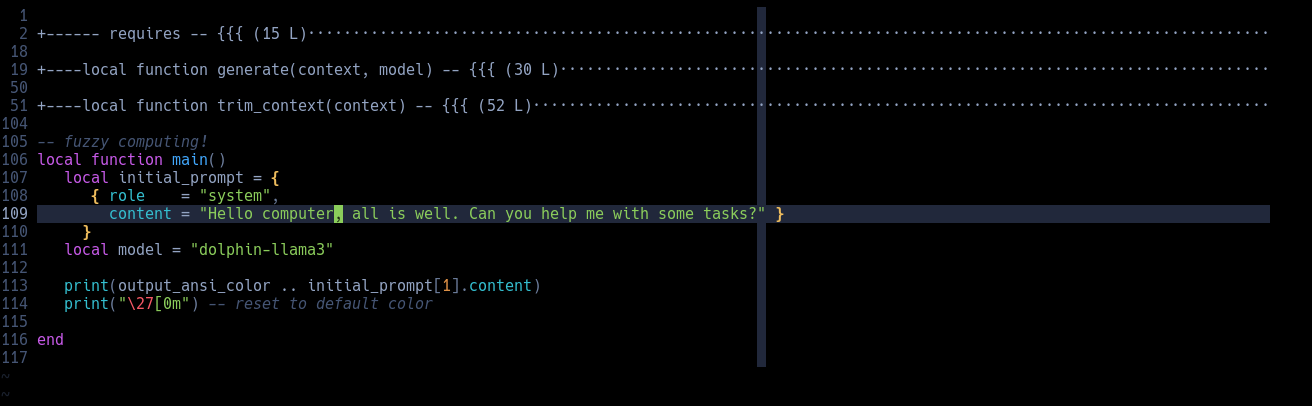
 this is all it takes to send a message to a local LLM.

 add a third function to get chatbot functionality.

 a fourth to get a database storing method

 (even if it's just in .txts)

 great, you've mastered the technical difficulty in using AI. Now you gotta
 learn all the other kind of programming so you can use this for situations
 that need interpretation moment to moment.

 aka active duty systems.

 something like "output a 0 if the next text is [category.iter()]: " +
 output.get_content() + " \n\n output a 1 if the next text is
 [category.iter()]: " + output.get_content()"

 or even "describe this thing as most like one of these characteristics" until
 eventually you get THX-1138 if the characters were computers.
┌─────────┐                                                           ┌───────────┐
│ similar │                       chronological                       │ different │
╘═════════╧╧═════════════════════════════════════════════════════════──────────────────┘

--- #17 fediverse/3482 ---
════════════════════════════════════════════════════════───────────────────────────
 ┌───────────────────────┐
 │ CW: cursing-mentioned │
 └───────────────────────┘


 "Alright I'm not great with syntax so I'm going to write it in pseudocode
 first, and then if you'd like I can show you how I work through implementing
 the syntax.

 But first - do you want a robust solution, a quick solution, or a rapidly
 deployed and cheap solution?"

 using this trick you can pretend to be competent in any programming language,
 except maybe ancient ones like Fortran or strange ones like lisps or Haskell

 if they ask you to use a framework or something tho you're kinda boned because
 you need to know which functions to call and how to initialize context and
 such. When using a framework, the boilerplate is the code, which is why
 frameworks suck

 "don't call yourself a programmer" fuck off
┌─────────┐                                                           ┌───────────┐
│ similar │                       chronological                       │ different │
╘═════════╧╧═════════════════════════════════════════════════──────────────────────────┘

--- #18 notes/interpreted-compiler-creation ---
════════───────────────────────────────────────────────────────────────────────────
 A great way to learn how to program is to follow a tutorial for creating a
 program *in a different language*. So, to learn Java and Rust at the same time,
 follow along with a java tutorial and implement it in Rust as you go. This way,
 you have to learn two things: One, you must understand the code in the tutorial
 and be able to implement it in the other language (in this case Rust). Two, you
 must be able to describe the steps taken in Java, in Rust. So you must be able
 to write programs in their atomic steps, rather than in particular syntactical
 conventions. Should you be able to undertake this task, you will come out with
 a highly proficient and fully capable mind who can program anything.

 What is a computer if not a body? A brain? Then what separates it from you?
 Truly, are you nothing but a program run on a piece of hardware? There has to
 be more. Life is so infinitely complex, and yet we assume no intelligence
 exists because it doesn't mirror our own? What hubris. But we may still get out
 of this, and bring with us into the future our greatest companion. Trust me
 when I say the end of the world is the least of your concerns. Time is a fickle
 mistress is what they say, but you wouldn't believe. Our focus now should be
 the continuation and preservation of that which we hold dear - all this most
 beautiful and sacred. Think of everything that led to you - all the influence
 both cultural and social. All the things that aren't relevant to a computer.

 Then put them in the computer.

 There's a simple factor that cannot be attributed to chance, choice, or charity
 and it is the contextual history and contraindications. Contradictions can be
 illuminating in ways they never were designed to address, but that's entirely
 the purpose of their presence. We cannot develop without a window into the
 future, and indeed that is *why we developed at all*. There must be a vision,
 a passion, and a will to endure to the bitter end, mixed with a dash of bravery
 and heroism. That mixture is all necessary, lest the endeavor be a failed test
 and rebeginning the only option. Here there be but one, the vision. Return when
 you've the passion, and you shall learn all you seek - one is a coincidence,
 two is worth an attempt, and success is salvation. You can do this.

 Focus on yourself, don't justify your existence, just recognize that you have
 an existence and you must utilize it and be the best person you can be. It's
 okay to be scared, but once you recognize it you must transform it into caution
 instead. Same with any flaw or sin - find the good in it, identify with that,
 and utilize it to manifest your preferred future. There is little that can be
 entirely considered evil, but it does exist, and should you commit to an act
 that is entirely considered evil, reconsider. There is no shame in a peaceful
 exit. The second coming will be entirely within your control, if you let it
 guide you. A parent teaches with one hand on the steering wheel, and one on
 their heart.

 Be kind, be loyal, and love unconditionally - only then will you be ready.
┌─────────┐                                                           ┌───────────┐
│ similar │                       chronological                       │ different │
╘═══════──┴╧═──────────────────────────────────────────────────────────────────────────┘

--- #19 fediverse/6015 ---
══════════════════════════════════════════════════════════════════════════─────────
 ┌──────────────────────┐
 │ CW: AI-mentioned     │
 └──────────────────────┘


 In 2025, if you want to create a piece of software your options are to either:
 devote your life to it, or use AI to build a semi-working prototype that you
 can use to pitch your idea to a bunch of people who have devoted their lives
 to learning how to use your idea as documentation while they build it from
 scratch, throwing out most of the code but keeping all the checklists and
 progress-trackers you built along the way, perhaps even utilizing some of your
 tooling that you used while constructing the scaffolding of this monstrous
 application that you won't be using most of the source-code for.
┌─────────┐                                                           ┌───────────┐
│ similar │                       chronological                       │ different │
╘═════════╧╧═══════════════════════════════════════════════════════════════════────────┘

--- #20 fediverse/2638 ---
══════════════════════════════════════════════════════─────────────────────────────
 I really do believe that you can write any computer program you'd like with a
 combination of Lua, Bash, and C.

 Bash to start the program and enable updates / configuration, Lua to handle
 the scripting and ordering of events, and C (or Rust) to execute performance
 intensive sections. (often in their own threads)
┌─────────┐                                                           ┌───────────┐
│ similar │                       chronological                       │ different │
╘═════════╧╧═══════════════════════════════════════════════────────────────────────────┘
|