 -> file: fediverse/940
══════════════════════════════════════════──────────────────────────────────────────
  @user-652

  just made a game for GGJ in Godot and I have to agree. Godot is so frustrating,
  but one thing I have to concede is that once you get your head around it the
  GUI part is actually incredibly powerful.

  My next game I'm going to make in Raylib, and if the UI bit proves too
  difficult I'll probably end up back at Godot.
┌─────────┐                                                            ┌───────────┐
│ similar │                       chronological                        │ different │
╘═════════╧═══════════════════════════════─────────────────────────────┴───────────┘
 -> file: fediverse_boost/146
◀═╦═══════════════════[BOOST]═════════════════════───────────────────────────────┐
  ║ ┌──────────────────────────────────────────────────────────────────────────┐ │
  ║ │ making some cool progress on the #itchio #GodotEngine console project    │ │
  ║ │ 👀✨                                                                      │ │
  ║ │                                                                          │ │
  ║ │ got the minimal project running, now i just have to port the dynamic     │ │
  ║ │ libraries and give it a shot!                                            │ │
  ║ │                                                                          │ │
  ║ │ #GameDev #IndieDev #RetroGaming                                          │ │
  ║ └──────────────────────────────────────────────────────────────────────────┘ │
  ╠─────────┐                                                        ┌───────────┤
  ║ similar │                     chronological                      │ different │
  ╚═════════╧═════════════════════════════════════───────────────────┴───────────┴─▶
 -> file: fediverse/3034
═════════════════════════════════════════════════───────────────────────────────────
  @user-570

  I've messed around with Bevy and the library most similar in C is Raylib. in
  Lua it'd be Love2D I think.

  I love the idea of those systems. I haven't built a full game using them but I
  can conceptualize operations within them easier using a framework like that
  versus a game engine like Godot.
┌─────────┐                                                            ┌───────────┐
│ similar │                       chronological                        │ different │
╘═════════╧══════════════════════════════════════──────────────────────┴───────────┘
 -> file: fediverse/281
╔══════════════════════════════════════────────────────────────────────────────────┐
║ ┌─────────────────────────────┐                                                  │
║ │ CW: cursed-game-engine-idea │                                                  │
║ └─────────────────────────────┘                                                  │
║                                                                                  │
║                                                                                  │
║ a game engine which won't let you import custom assets unless you complete a     │
║ few simple tasks using the interface - "build a green capsule collider" "make    │
║ this soldier unit shoot three bullets per shot" or "enable the automatic linux   │
║ support" - using the interface, writing some code, and changing configurations.  │
║                                                                                  │
║ why would anyone do this? well it could be useful to increase the difficulty of  │
║ importing external resources. plus it helps the user learn a bit over time, and  │
║ it slows the pace of output such that the user's skills are encouraged as the    │
║ output of the programming and not the program itself.                            │
║                                                                                  │
║ an inverse curse (an evil one) would be where the requirements to complete       │
║ basic tasks are hidden behind unapplicable skills. like, do you know exactly     │
║ which buttons to press? engage with the skinner box, please. yes yes this is     │
║ what we need - unintuitive software that completely disarms the populace from    │
║ using them! suddenly they're worthless, and can't do anything on any surface.    │
║ it sucks                                                                         │
╠═════════╗                                                            ┌───────────┤
║ similar ║                       chronological                        │ different │
╚═════════╩═══════════════════════════─────────────────────────────────┴───────────┘
 -> file: fediverse/4096
╔═══════════════════════════════════════════════════───────────────────────────────┐
║ ┌────────────────────────┐                                                       │
║ │ CW: opinionated-design │                                                       │
║ └────────────────────────┘                                                       │
║                                                                                  │
║                                                                                  │
║ Steps to make a game waterfall style:                                            │
║                                                                                  │
║ Lay out all the data structures and arrange them in containers like arrays or    │
║ hashmaps                                                                         │
║                                                                                  │
║ Build methods which manipulate those structures (think getters and setters)      │
║                                                                                  │
║ Then build machinery which operates upon those structures using those methods,   │
║ like game loops, cooldown timers, status effects, and thread pools.              │
║                                                                                  │
║ Then develop a way to present it to the player using UIs, visuals and graphics,  │
║ narratives, sound, etc. This will probably involve implementing your game in an  │
║ engine like Godot, Raylib, or Bevy.                                              │
║                                                                                  │
║ By developing your game in this order, you will DESIGN the systems first, and    │
║ IMPLEMENT them second. Systems are agnostic - implementation is tied to a        │
║ specific engine. You will learn more about programming by doing it this way,     │
║ instead of losing your motivation by learning new tools like game engines or 3D  │
║ modeling systems, which aren't useful unless you already have a game.            │
║                                                                                  │
║ I'd recommend starting with pencil and paper until you're ready to implement.    │
╠═════════╗                                                            ┌───────────┤
║ similar ║                       chronological                        │ different │
╚═════════╩════════════════════════════════════════────────────────────┴───────────┘
 -> file: fediverse/3592
══════════════════════════════════════════════════──────────────────────────────────
  @user-1570

  [meme of Mr Incredible from the Incredibles pointing at a table]

  *LINUX IS LINUX*.

  (anything that works on Linux can theoretically be made to work on your
  toaster, if it also runs Linux!)

  This is very cool, and if I understand correctly it means that any Godot games
  could theoretically be played on these NEAT as HECK little devices, yeah? So
  cool!
┌─────────┐                                                            ┌───────────┐
│ similar │                       chronological                        │ different │
╘═════════╧═══════════════════════════════════════─────────────────────┴───────────┘
 -> file: notes/symbeline
══════════════──────────────────────────────────────────────────────────────────────
  Code Name: Symbeline

  ----------------------------- gdd initial draft -------------------------------

     1. introduction to fantasy (elevator pitches)
     2. kickstarter demands
     2. introduction to core gameplay loop
     4. tenants and core values of the game design
     3. introduction to game modes
     5. introduction to technical requirements
     6. breakdown of core gameplay loop
     7. breakdown of game modes
     8. breakdown of fantasy
     9. breakdown of technical requirements

  -------------------------- introduction to fantasy-----------------------------

     Symbeline is a macro based strategy game and city-builder based around the
  concept of indirect control. It's inspirations are Majesty the Fantasy Kingdom
  Simulator (2000), Supreme Commander (2007), and Hearts of Iron IV (2016). It is
  designed to appeal to fans of tabletop roleplaying games with it's focus on
  dynamic worldbuilding and sandbox playstyle. The gameplay consists of multiple
  playstyles depending on which aspects of the game appeal to the player, with
  choices between an economic focus via the GUI, longterm planning and resource
  allocation, or diplomacy and subterfuge a'la Ruinarch (2020).

  ---------------------------- kickstarter demands ------------------------------

     1. prototype
     2. gdd
     3. estimates for character and environment art
     4. estimates for music and sounds
     5. estimates for engine development
     6. estimates for community management
     7. breakdown of mvp, ideal game state, and stretch goals

  ----------------------- introduction to core gameplay loop --------------------

     1. management of lanes, both width and length
     2. casting of spells and utilization of special boons
     3. city building with placement, upgrades, and henchmen pathing routes
     4. satisfying guild requirements of equipment, manpower, and special
        resources by managing shipments and local income (UI commodity trading)
     5. placement of generalized bounties
        (think champion's guild from Majesty, not reward flags)
     6. diplomacy with neutral, AI, or player controlled kingdoms. Capabilities
        include pacts and treaties, projects, subterfuge, and tournaments. The
        diplomacy system can be a stretch goal.

  -------------------------- tenants and core values ----------------------------

     1. always something to do, but nothing falls apart without your attention.
     2. gameplay should be focused on macro rather than micro. Longterm planning
        and strategic decision making are favored over tactics and skill.
     3. defeat should feel avoidable until the last moment, and only as a result
        of longterm continuous failures rather than short-term mistakes or being
        blindsided by a cheesy tactic.
     4. victory should be gained through exploiting weaknesses and by using
        lateral thinking.
     5. the careful balance of internal and external threats is essential.
     6. rapid expansion leads to depletion of internal resources, while slowly
        expanding can lead to a lack of options
     7. the world should feel alive and reactive to your decisions.
     8. your kingdom should feel alive and reactive to your decisions.
     9. your heroes should feel alive and completely ignorant of your decisions.
    10. there should always be opportunities for cooperation with your fellow
        kingdoms.
    11. the frontlines should feel peaceful outside of large battles.
    12. everything is flexible and dependant on circumstance
    13. there should be enough space on the map for multiple parties of heroes
        to pass each other like ships in the night without engaging in combat.
        It should feel like the real world, with canyons and valleys and rivers
        and mountains - room for lairs and wild animals to roam.
    14. monsters are always more dangerous than other humans.
    15. the art style should be rooted in classic medieval fantasy.
    16. equipment should feel either mass-produced (kingdom), organic (monsters),
        ancient (lair treasure), or artisinal (enchanted).
    17. heroes should feel campy, fun, and adventurous. Avoid dark, grim, and
        fearful.
    18. This game is a toy.
    19. This toy should run on any modern computer.
    20. This toy should encourage modding.

  -------------------------- introduction to game modes -------------------------

     1. singleplayer - single kingdom against an island of monsters and neutral
                       settlements. essentially the multiplayer game against
                       zero opponents.
     2. singleplayer - multiple kingdoms against an island of monsters and
                       neutral settlements. One player controlled kingdom against
                       multiple AI controlled kingdoms.
     3. singleplayer - scenarios, similar to MFKS
     4. multiplayer  - multiple kingdoms against an island of monsters and
                       neutral settlements. Essentially the singleplayer game
                       with networking added in.
     5. multiplayer  - co-op scenarios where multiple players play as the same
                       kingdom. A test of the core tenant "there's always
                       something to do"
     6. multiplayer  - co-op island invasion. Essentially the multiplayer game
                       with more than one player controlling a kingdom.
     7. singleplayer - play in 3rd person as a hero in an AI kingdom. Mostly for
                       the novelty since the core gameplay loop is focused on
                       city-building. A test of the core tenant "nothing falls
                       apart without your attention"

     1 is mvp. 2-6 are stretch goals in order of ascending difficulty. They
     should build upon one another - the main steps are:

     1. singleplayer island invasion (biggest step)
     2. AI controlled kingdoms
     3. scenarios
     4. multiplayer (second biggest step)
     5. cooperatively controlling the same kingdom
     6. 3rd person perspective and character controller

  ------------------------ technical requirements -------------------------------

     1. this game will be written in lua (with Fennel support) and using Raylib.
     2. the prototype will be made with Godot using GDscript.
     3. if the performance demands are too much for lua or the engine is out of
        scope for the budget, Rust with the Bevy engine could be used.
     4. the final product will include a custom 2d engine designed for large
        scale maps with an isometric perspective and a data-first design.
     5. the game should be as concurrent as possible, to support large numbers of
        cpu cores and compute shaders.
     6. the game will be data-driven, meaning the visual aspects are simply a
        representation of the interactions of the underlying simulation, rather
        than an intrinsic component of the computation.
     7. Each "event" in the game (a character moves, a building is placed, a
        monster spawns, etc) will send a message to the visual processing side of
        the engine, which will present a representation to the user.
     8. the map will be a hex grid with pointed-top hexagons. The visual
        representation of the underlying data may be continuous (non-hex) but the
        underlying data will be represented on a hexagonal grid.

     9. there needs to be character portraits for each type of monster, henchmen,
        and hero type. You should be able to recognize what attributes a hero
        specializes in by their portrait. Mvp is 1 attribute, but more can be
        a stretch goal.
    10. Each building, upgrade, and equipment type needs an icon. Stretch goals
        can be portraits.

    11. each henchman, hero type, and monster needs 3 sprites for each action.
        more actions may be added if budget allows, but mvp is movement and
        attacking. Several additional sprites may be necessary, like dying,
        standing still, gathering loot, socializing, or any others.
    12. each building needs 4 sprites for the construction process and 4 for the
        destruction process. Flame effects are stretch goals.
    13. each building needs an animated sprite for when it is in use.
    14. each lair needs a sprite and an icon.
    15. each spell needs an icon and a spell effect sprite. Each projectile needs
        a sprite.
    16. a stretch goal would be differing sprites for each piece of equipment.
        included with this would be engine work to allow for dynamic sprites.
    17. each terrain type should have a ground material and sprites for doodads.
    18. there needs to be several GUI menus. The precise number depends on
        gameplay breakdown.

    17. each hero type and henchman needs to have pithy and unique voice lines.
        this is a stretch goal.
    18. there should be music tracks for each part of the game - beginning,
        middle, and end.
    19. there should be sounds for each action that takes place in the game
        including combat, UI interactions, and spellcasts.
┌─────────┐                                                            ┌───────────┐
│ similar │                       chronological                        │ different │
╘═════════╧═══─────────────────────────────────────────────────────────┴───────────┘
 -> file: fediverse/5633
═══════════════════════════════════════════════════════════════─────────────────────
  I wish someone would make a "meta game engine" that would run any type of
  project that you gave it. Unity, Unreal, RPGgame-maker-studio, Godot, etc
┌─────────┐                                                            ┌───────────┐
│ similar │                       chronological                        │ different │
╘═════════╧════════════════════════════════════════════════════────────┴───────────┘
 -> file: fediverse/1229
═══════════════════════════════════════════─────────────────────────────────────────
  @user-883

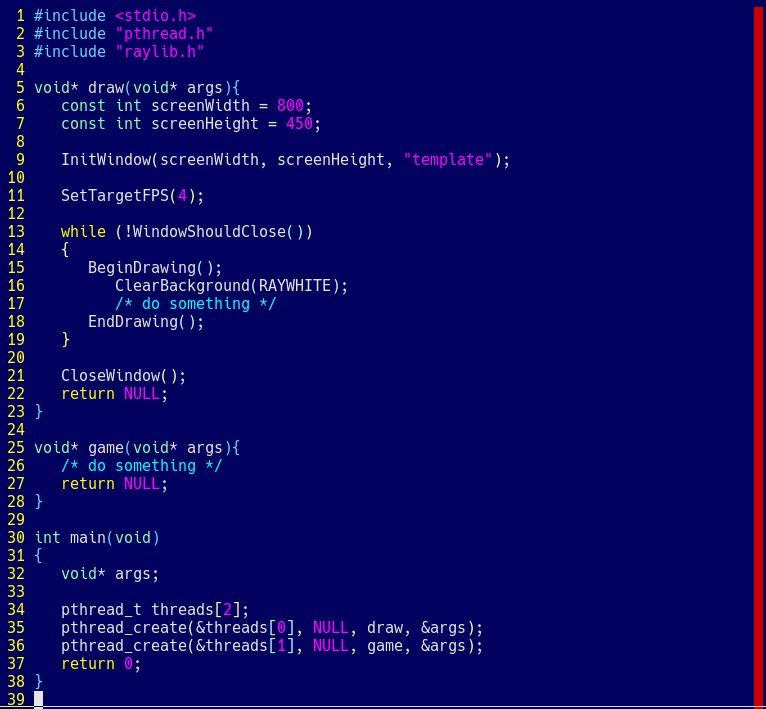
  graphics isn't too bad in C if you use Raylib. Here's my template project:

  If you ever want to do something with a GUI or a game or something then I
  definitely recommend that library. It's soooooo nice as a C programmer

┌─────────┐                                                            ┌───────────┐
│ similar │                       chronological                        │ different │
╘═════════╧════════════════════════════════────────────────────────────┴───────────┘
 -> file: fediverse/1156
═══════════════════════════════════════════─────────────────────────────────────────
  why the heck do GAME engines not include a skippable tutorial that lights up UI
  elements and explains how everything works by navigating you through building
  an example project one step at a time

  like, game jam material, nothing fancy
┌─────────┐                                                            ┌───────────┐
│ similar │                       chronological                        │ different │
╘═════════╧════════════════════════════════────────────────────────────┴───────────┘
 -> file: fediverse/1966
════════════════════════════════════════════════────────────────────────────────────
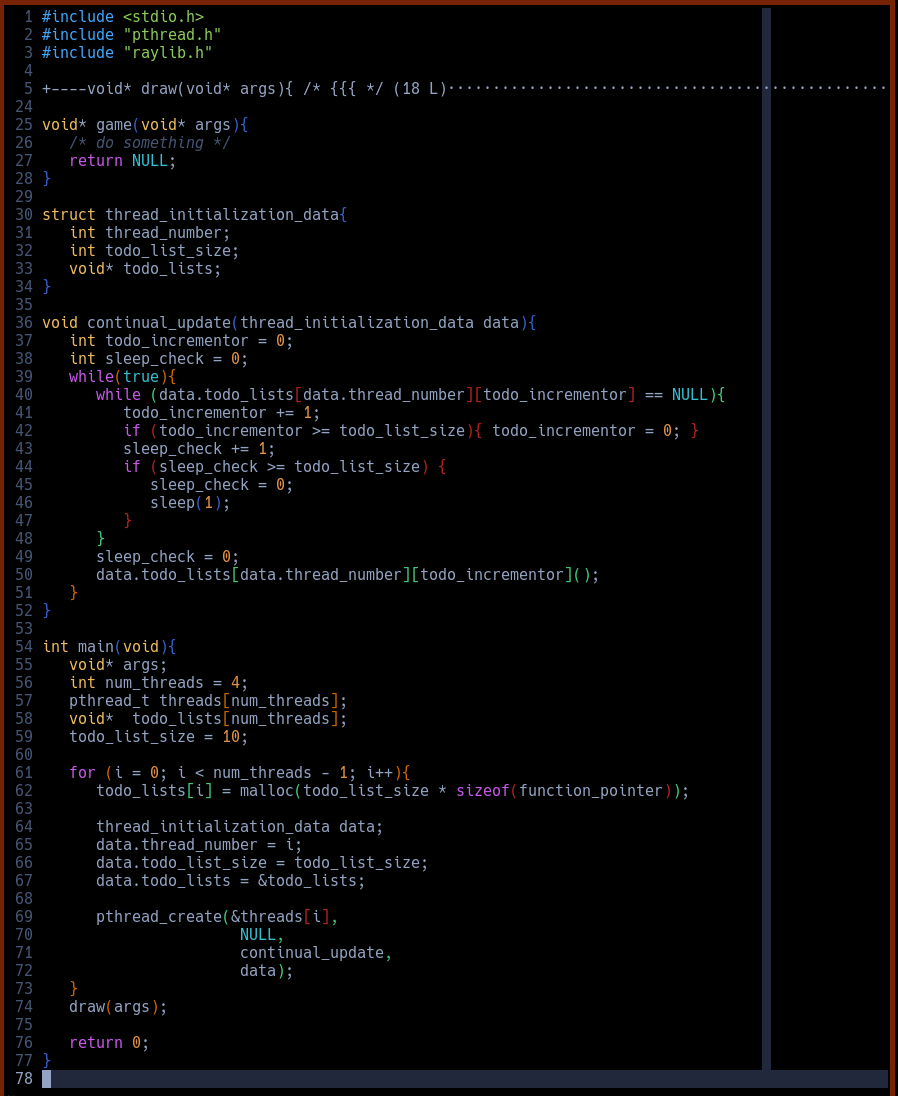
  The design is simple: Have an array of function pointers that need to be
  assigned to a thread. Then, have a manager thread read through that array, and
  for every non-zero value put it into a thread-specific array. Those threads
  will read through their personal  array and execute whichever function is
  pointed to by the function pointer placed in their todo-list by the manager
  function.

  ... I'm too stupid to make it happen though. Writing code is hard.
┌─────────┐                                                            ┌───────────┐
│ similar │                       chronological                        │ different │
╘═════════╧═════════════════════════════════════───────────────────────┴───────────┘
 -> file: fediverse/4877
═════════════════════════════════════════════════════════───────────────────────────
  you can make a functional prototype for almost any game in Warcraft 3's map
  editor

  that's why no real-time strategy game ever made an editor as good again

  FPS editors peaked at Unreal Tournament 2004 imho

  RPGmaker eliminated a whole class of game design jobs

  platformers you can make in godot

  menu based games too, though Twine also works well for that

  etc etc until you have a prdouct that you can justify sinking money into an
  engine for

  (the engine isn't THAT expensive geez and it's the most fun part to write)

  yeah I think you got this backwards, we should pay for the CONTENT not the
  structure it lives in. Why not just use godot? why not use a Warcraft 3 map?
  there are some things you can't do in Warcraft 3. You couldn't make Supreme
  Commander, probably, at least it wouldn't be as good.

  etc etc that's how it goes...

  game design, amiright? I miss thinking about that. Anyway gtg gotta log off for
  a bit [101  characters remaining]
┌─────────┐                                                            ┌───────────┐
│ similar │                       chronological                        │ different │
╘═════════╧══════════════════════════════════════════════──────────────┴───────────┘
 -> file: fediverse/5212
═════════════════════════════════════════════════════════════───────────────────────
  the reason you start with a game engine is because then you'll have tools to
  make however-many games you want. Tools that you know intimately enough that
  you can debug and improve them *without breaking your creative flow* by
  learning something new halfway through a project

  the whole point of individualized projects instead of viewing each computer as
  a complete and total whole (why do we need servers again?) is that you can
  paint a picture of where the design of the program is intended to go, such that
  all the considerations are in place and whatever issues or struggles you might
  face along the way are adequately addresssed, -- stack overflow -- [because I
  mistyped addressed] -- -- if you know what "stack overflow" means you have
  intimate knowledge of the technology, and can probably guess what it means in
  context when I say it. "nuts I lost that train of thoguht" -- stackl ov
┌─────────┐                                                            ┌───────────┐
│ similar │                       chronological                        │ different │
╘═════════╧══════════════════════════════════════════════════──────────┴───────────┘
 -> file: fediverse/6324
═════════════════════════════════════════════════════════════════════───────────────
  claude-code isn't a chatbot, it's an IDE
┌─────────┐                                                            ┌───────────┐
│ similar │                       chronological                        │ different │
╘═════════╧══════════════════════════════════════════════════════════──┴───────────┘
 -> file: fediverse/2011
════════════════════════════════════════════════────────────────────────────────────
  @user-883

  nvim is nice because you can make addons or plugins or whatever in Lua, which
  is the easiest language in the world.

  I think VSCode sucks - it's literally a web browser that views your own code,
  and it's made by Microsoft so it probably SENDS it to them too. Probably.

  I like nvim because it's just Vim except you can use more plugins (the ones
  written in Lua)
┌─────────┐                                                            ┌───────────┐
│ similar │                       chronological                        │ different │
╘═════════╧═════════════════════════════════════───────────────────────┴───────────┘
 -> file: notes/portfolio
════════════════════════════────────────────────────────────────────────────────────
  game design:

  spiral dominions
  symbeline gdd
  Joust
  War (bytecode VM)
  grid based warcraft map with random terrain and custom AI
  Progress
  [Title of Game]

  I appreciate Rust, I can understand Rust, but I can't write Rust.

  Python just kinda... works. It doesn't have a lot of the type checking that
  other languages have, so it requires some vigilance and diligence. But that's
  alright, you just gotta work on it.
┌─────────┐                                                            ┌───────────┐
│ similar │                       chronological                        │ different │
╘═════════╧═════════════════───────────────────────────────────────────┴───────────┘
 -> file: fediverse/3748
═══════════════════════════════════════════════════─────────────────────────────────
  @user-203

  I've been trying to get it to work with raylib but I'm having difficulties with
  the C interoperability T.T

  https://www.raylib.com
┌─────────┐                                                            ┌───────────┐
│ similar │                       chronological                        │ different │
╘═════════╧════════════════════════════════════════────────────────────┴───────────┘
 -> file: fediverse/1941
════════════════════════════════════════════════────────────────────────────────────
  @user-579

  I've never actually used xbps-src, I usually just compile it using the same
  tooling that the people who made the program use. If your project doesn't have
  a make file then it's probably not ready for distribution yet. That's like, the
  first thing I write! Though I don't use make, I just use BASH and chain
  together compiler commands and whatnot
┌─────────┐                                                            ┌───────────┐
│ similar │                       chronological                        │ different │
╘═════════╧═════════════════════════════════════───────────────────────┴───────────┘
 -> file: notes/symbeline-2
════════════════════════════────────────────────────────────────────────────────────
  Code Name: Symbeline

  ----------------------------- gdd initial draft -------------------------------

     1. introduction to fantasy (elevator pitches)
     2. kickstarter demands
     2. introduction to core gameplay loop
     4. tenants and core values of the game design
     3. introduction to game modes
     5. introduction to technical requirements
     6. breakdown of core gameplay loop
     7. breakdown of game modes
     8. breakdown of fantasy
     9. breakdown of technical requirements

  -------------------------- introduction to fantasy-----------------------------

     Symbeline is a macro based strategy game and city-builder based around the
  concept of indirect control. It's inspirations are Majesty the Fantasy Kingdom
  Simulator (2000), Supreme Commander (2007), and Hearts of Iron IV (2016). It is
  designed to appeal to fans of tabletop roleplaying games with it's focus on
  dynamic worldbuilding and sandbox playstyle. The gameplay consists of multiple
  playstyles depending on which aspects of the game appeal to the player, with
  choices between an economic focus via the GUI, longterm planning and resource
  allocation, or diplomacy and subterfuge a'la Ruinarch (2020).

  ---------------------------- kickstarter demands ------------------------------

     1. prototype
     2. gdd
     3. estimates for character and environment art
     4. estimates for music and sounds
     5. estimates for engine development
     6. estimates for community management
     7. breakdown of mvp, ideal game state, and stretch goals

  ----------------------- introduction to core gameplay loop --------------------

     1. management of lanes, both width and length
     2. casting of spells and utilization of special boons
     3. city building with placement, upgrades, and henchmen pathing routes
     4. satisfying guild requirements of equipment, manpower, and special
        resources by managing shipments and local income (UI commodity trading)
     5. placement of generalized bounties
        (think champion's guild from Majesty, not reward flags)
     6. diplomacy with neutral, AI, or player controlled kingdoms. Capabilities
        include pacts and treaties, projects, subterfuge, and tournaments. The
        diplomacy system can be a stretch goal.

  -------------------------- tenants and core values ----------------------------

     1. always something to do, but nothing falls apart without your attention.
     2. gameplay should be focused on macro rather than micro. Longterm planning
        and strategic decision making are favored over tactics and skill.
     3. defeat should feel avoidable until the last moment, and only as a result
        of longterm continuous failures rather than short-term mistakes or being
        blindsided by a cheesy tactic.
     4. victory should be gained through exploiting weaknesses and by using
        lateral thinking.
     5. the careful balance of internal and external threats is essential.
     6. rapid expansion leads to depletion of internal resources, while slowly
        expanding can lead to a lack of options
     7. the world should feel alive and reactive to your decisions.
     8. your kingdom should feel alive and reactive to your decisions.
     9. your heroes should feel alive and completely ignorant of your decisions.
    10. there should always be opportunities for cooperation with your fellow
        kingdoms.
    11. the frontlines should feel peaceful outside of large battles.
    12. everything is flexible and dependant on circumstance
    13. there should be enough space on the map for multiple parties of heroes
        to pass each other like ships in the night without engaging in combat.
        It should feel like the real world, with canyons and valleys and rivers
        and mountains - room for lairs and wild animals to roam.
    14. monsters are always more dangerous than other humans.
    15. the art style should be rooted in classic medieval fantasy.
    16. equipment should feel either mass-produced (kingdom), organic (monsters),
        ancient (lair treasure), or artisinal (enchanted).
    17. heroes should feel campy, fun, and adventurous. Avoid dark, grim, and
        fearful.
    18. This game is a toy.
    19. This toy should run on any modern computer.
    20. This toy should encourage modding.

  -------------------------- introduction to game modes -------------------------

     1. singleplayer - single kingdom against an island of monsters and neutral
                       settlements. essentially the multiplayer game against
                       zero opponents.
     2. singleplayer - multiple kingdoms against an island of monsters and
                       neutral settlements. One player controlled kingdom against
                       multiple AI controlled kingdoms.
     3. singleplayer - scenarios, similar to MFKS
     4. multiplayer  - multiple kingdoms against an island of monsters and
                       neutral settlements. Essentially the singleplayer game
                       with networking added in.
     5. multiplayer  - co-op scenarios where multiple players play as the same
                       kingdom. A test of the core tenant "there's always
                       something to do"
     6. multiplayer  - co-op island invasion. Essentially the multiplayer game
                       with more than one player controlling a kingdom.
     7. singleplayer - play in 3rd person as a hero in an AI kingdom. Mostly for
                       the novelty since the core gameplay loop is focused on
                       city-building. A test of the core tenant "nothing falls
                       apart without your attention"

     1 is mvp. 2-6 are stretch goals in order of ascending difficulty. They
     should build upon one another - the main steps are:

     1. singleplayer island invasion (biggest step)
     2. AI controlled kingdoms
     3. scenarios
     4. multiplayer (second biggest step)
     5. cooperatively controlling the same kingdom
     6. 3rd person perspective and character controller

  ------------------------ technical requirements -------------------------------

     1. this game will be written in lua (with Fennel support) and using Raylib.
     2. the prototype will be made with Godot using GDscript.
     3. if the performance demands are too much for lua or the engine is out of
        scope for the budget, Rust with the Bevy engine could be used.
     4. the final product will include a custom 2d engine designed for large
        scale maps with an isometric perspective and a data-first design.
     5. the game should be as concurrent as possible, to support large numbers of
        cpu cores and compute shaders.
     6. the game will be data-driven, meaning the visual aspects are simply a
        representation of the interactions of the underlying simulation, rather
        than an intrinsic component of the computation.
     7. Each "event" in the game (a character moves, a building is placed, a
        monster spawns, etc) will send a message to the visual processing side of
        the engine, which will present a representation to the user.
     8. the map will be a hex grid with pointed-top hexagons. The visual
        representation of the underlying data may be continuous (non-hex) but the
        underlying data will be represented on a hexagonal grid.

     9. there needs to be character portraits for each type of monster, henchmen,
        and hero type. You should be able to recognize what attributes a hero
        specializes in by their portrait. Mvp is 1 attribute, but more can be
        a stretch goal.
    10. Each building, upgrade, and equipment type needs an icon. Stretch goals
        can be portraits.

    11. each henchman, hero type, and monster needs 3 sprites for each action.
        more actions may be added if budget allows, but mvp is movement and
        attacking. Several additional sprites may be necessary, like dying,
        standing still, gathering loot, socializing, or any others.
    12. each building needs 4 sprites for the construction process and 4 for the
        destruction process. Flame effects are stretch goals.
    13. each building needs an animated sprite for when it is in use.
    14. each lair needs a sprite and an icon.
    15. each spell needs an icon and a spell effect sprite. Each projectile needs
        a sprite.
    16. a stretch goal would be differing sprites for each piece of equipment.
        included with this would be engine work to allow for dynamic sprites.
    17. each terrain type should have a ground material and sprites for doodads.
    18. there needs to be several GUI menus. The precise number depends on
        gameplay breakdown.

    17. each hero type and henchman needs to have pithy and unique voice lines.
        this is a stretch goal.
    18. there should be music tracks for each part of the game - beginning,
        middle, and end.
    19. there should be sounds for each action that takes place in the game
        including combat, UI interactions, and spellcasts.
┌─────────┐                                                            ┌───────────┐
│ similar │                       chronological                        │ different │
╘═════════╧═════════════════───────────────────────────────────────────┴───────────┘
 -> file: messages/574
═════════════════════════════════════════════════════───────────────────────────────
  Steps to make a game waterfall style:

  Lay out all the data structures

  Build methods which manipulate those structures (think getters and setters)

  Then build machinery which operates upon those structures using those methods,
  like game loops, cooldown timers, and status effects

  Then develop a way to present it to the player using UIs, visuals and graphics,
  narratives, sound, all that junk that's probably someone else's job anyway
┌─────────┐                                                            ┌───────────┐
│ similar │                       chronological                        │ different │
╘═════════╧══════════════════════════════════════════──────────────────┴───────────┘
 -> file: notes/computer-graphics
══════════════════──────────────────────────────────────────────────────────────────
  draw a line from every single pixel straight outward. The first thing it hits
  is what you render.

  okay it's more complicated than that, but it's the gist.

  here's a more detailed explanation:

  your monitor is 2560x1440p. that means there's 2560 pixels left to right, and
  1440 pixels up and down. okay so define a 3d scene programmatically - it's not
  hard, just "draw cube here with this size and rotation" and "draw a sphere here
  with this position and rotation" etc. Something simple.

  then, draw a ray trace straight out from your monitor. Not to the nearest light
  source, but to the nearest other camera. Use the length of it to determine
  distance, both indirectly (through the center node) and directly (pythagorean
  theorum style).

  Why? I dunno.

  Okay back to the original idea, if you make an array with 2560 elements and
  store arrays of size 1440 within it, then you have a simple boolean checkbox
  for each pixel. Then, whenever you create a visible entity, make sure there's a
  single boolean ticked right on the top of the entity when it's stored in the
  graph mentioned above. Find the center of the entity, draw to the top, and one
  more, and switch a boolean to "true". Then, every tick / update, cycle through
  the entire list and the first one you find that has a "true" value is where you
  draw the entity stored in the array.

  Each "sprite" has an odd shape - it doesn't exist on it's top line, except for
  one single dot right in the middle. Sorta like this:

  o o o o o o o o o o o o o o o o o o o o o o o o o o o o o o o o o o o o o o o o
  o o o o o o o o o o o o o o o o o o ->X<- o o o o o o o o o o o o o o o o o o o
  x x x x x x x x x x x x x x x x x x x x x x x x x x x x x x x x x x x x x x x x

  when scanning left to right from the top, it'd bump into the X right there in
  the middle. Inside the X is some data - an id corresponding to the sprite that
  needs to be drawn, and a displacement value - like 500 pixels or something -
  and the scanner with drop down 500 pixels, draw the sprite there (assuming a
  centered origin point), jump 500 pixels up, and keep scanning.

  each tick, right before this, the "list of entities" will scan through itself
  and for each entity it'll change the "render graph" mentioned above to have an
  X wherever the entity is stored. Whenever the camera moves, it updates the list
  too.
┌─────────┐                                                            ┌───────────┐
│ similar │                       chronological                        │ different │
╘═════════╧═══════─────────────────────────────────────────────────────┴───────────┘
 -> file: fediverse/3686
══════════════════════════════════════════════════──────────────────────────────────
  @user-1573

  I do, but git is pretty complex! I can do some pretty basic stuff but I'd like
  more experience with the more complicated aspects.

  I currently use Void Linux and Gentoo, and I was thinking of installing NixOS
  on my raspberry pi. I'll let you know when I end up doing that ^_^
┌─────────┐                                                            ┌───────────┐
│ similar │                       chronological                        │ different │
╘═════════╧═══════════════════════════════════════─────────────────────┴───────────┘
 -> file: fediverse/5405
══════════════════════════════════════════════════════════════──────────────────────
  can't stop thinking about a visual programming editor that can be interacted
  with in the same way that people are used to (think chromebooks dragging and
  dropping icons in a web UI) but produces a text-file full of code and all the
  required compilation scripts for any language the user requires...

  seriously, programming is not THAT different between the different languages.
  especially the main ones. they're all essentially variables and function calls
  at the end of the day, so why not abstract away all the extra details and build
  something that n00bz can actually use to build things.

  I technically could make this but I don't have the bandwidth and I don't think
  it's important really? who can say, the tools tend to co-create the solutions
  in my experience.
┌─────────┐                                                            ┌───────────┐
│ similar │                       chronological                        │ different │
╘═════════╧═══════════════════════════════════════════════════─────────┴───────────┘
 -> file: fediverse/933
══════════════════════════════════════════──────────────────────────────────────────
  @user-643

  virtual machines are cool. betcha can't write one using bytecode

  https://gameprogrammingpatterns.com/bytecode.html
┌─────────┐                                                            ┌───────────┐
│ similar │                       chronological                        │ different │
╘═════════╧═══════════════════════════════─────────────────────────────┴───────────┘
 -> file: fediverse/5180
╔═══════════════════════════════════════════════════════════───────────────────────┐
║ it's trivial to run a C compiler inside of a lua interpretation of a script.     │
║ And vice versa - you could totally run lua functions from C. Just point to the   │
║ spot in memory where they're stored / operating, and call                        │
║ "update_class_exhibitor_type_d()" and the linker will come along and say "huh    │
║ this looks like something from this library that's part of the requirements up   │
║ above" (the "includes" section is where you say which files include the          │
║ functions you're going to be calling) and in this particular case it would see   │
║ that you need to start up a lua interpreter *inside of the [either compiler or   │
║ running program I can't remember]* to properly execute the function of the       │
║ function that you're pointing at with a lua-pointer style data object which is   │
║ part of a struct that stores all the other lua functions in a spot in memory.    │
║                                                                                  │
║ this would enable you to write computer programs in whatever language you        │
║ choose, and build them into one large project. Essentially opening up software   │
║ development to ANYONE WHO CAN PROGRAM                                            │
╠═════════╗                                                            ┌───────────┤
║ similar ║                       chronological                        │ different │
╚═════════╩════════════════════════════════════════════════────────────┴───────────┘
 -> file: fediverse/4119
═════════════════════════════════════════════════════───────────────────────────────
  what if you wanted to build a project from source

  but god said`CMake Error at CMakeLists.txt:

  By not providing a "foo.cmake" in CMAKE_MODULE_PATH this project has asked
  CMake to find a package configuration file provided by "bar", but CMake did not
  find one.
  `
┌─────────┐                                                            ┌───────────┐
│ similar │                       chronological                        │ different │
╘═════════╧══════════════════════════════════════════──────────────────┴───────────┘
 -> file: fediverse/3744
═══════════════════════════════════════════════════─────────────────────────────────
  @user-1352

  Unfortunately I have to use the proprietary drivers because video games, so I
  can't use Nouveau T.T

  I figure if I like Gentoo but wish it was a little more "config file" based,
  then Nix is probably my best bet!
┌─────────┐                                                            ┌───────────┐
│ similar │                       chronological                        │ different │
╘═════════╧════════════════════════════════════════────────────────────┴───────────┘
 -> file: fediverse/6382
══════════════════════════════════════════════════════════════════════──────────────
  cloud-code should automatically use git and record everything. If the user
  wants to assign a different git, then it does that too.

  -- stack overflow --

  I used to think programs could only affect files in their directory. Then I
  learned about Window's "My Games" directory, and then somewhere down the line
  I'm thinking about how programs on Linux can just use absolute paths to random
  places on your hard drive and it's like... wow, if only someone built basic
  sandboxing into this /etc/ style environment
┌─────────┐                                                            ┌───────────┐
│ similar │                       chronological                        │ different │
╘═════════╧═══════════════════════════════════════════════════════════─┴───────────┘
 -> file: fediverse/4512
══════════════════════════════════════════════════════──────────────────────────────
  @user-1687

  I use dmenu, so I'm thinking I'll write a script and call it using dmenu. The
  script will start by using flameshot to grab the snipped part of the screen
  into the clipboard, and then I need to find an OCR engine (thanks for the
  google-able term btw!) which can take clipboard contents as input, and output
  text to the clipboard.
┌─────────┐                                                            ┌───────────┐
│ similar │                       chronological                        │ different │
╘═════════╧═══════════════════════════════════════════─────────────────┴───────────┘
 -> file: fediverse/3599
══════════════════════════════════════════════════──────────────────────────────────
  ┌─────────────────────────────┐
  │ CW: re: computers-mentioned │
  └─────────────────────────────┘


  @user-1573 `
  " Select the font for the hardcopy
  set printfont=Courier:h8
  :let &printheader = " "
  command! -range=% HardcopyPdf , hardcopy > %.ps | !ps2pdf %.ps && rm %.ps &&
  echo 'Created: %.pdf'

  " vimfolds - use marker as fold method
  set foldmethod=marker
  set foldtext=MyFoldText()

  " Functions
  function! MyFoldText()
      let line = getline(v:foldstart)
      let folded_line_num = v:foldend - v:foldstart
      let line_text = substitute(line, '^"{\+', '', 'g')
      let fillcharcount = &textwidth - len(line_text) - len(folded_line_num)
      return '+'. repeat('-', 4) . line_text . repeat('.', fillcharcount) . ' ('
      . folded_line_num . ' L)'
  endfunction

  let g:rainbow_active = 1
  `

  Here's the bottom part of the config - I ran out of characters and couldn't
  post the whole thing.

  If you don't know what vimfolds are here's a good guide:

  https://www.vimfromscratch.com/articles/vim-folding

  also:

  https://vim.fandom.com/wiki/Folding
┌─────────┐                                                            ┌───────────┐
│ similar │                       chronological                        │ different │
╘═════════╧═══════════════════════════════════════─────────────────────┴───────────┘
 -> file: messages/971
═════════════════════════════════════════════════════════════════───────────────────
  vimcoders can be vibecoders too. it's just about what language you want to use
  to talk to the computer, right?
┌─────────┐                                                            ┌───────────┐
│ similar │                       chronological                        │ different │
╘═════════╧══════════════════════════════════════════════════════──────┴───────────┘
 -> file: fediverse/1892
═══════════════════════════════════════════════─────────────────────────────────────
  ┌─────────────────────────────────────────┐
  │ CW: C-programming-and-alcohol-mentioned │
  └─────────────────────────────────────────┘


  I want to write C programs with threads and manual memory management and
  function pointers and lots and lots of arrays and I'm not even kidding

  ... wait a minute I literally don't have a job, why am I not writing C programs
  right now?

  BRB I got something important to do, where's my vodka --> pkill firefox
┌─────────┐                                                            ┌───────────┐
│ similar │                       chronological                        │ different │
╘═════════╧════════════════════════════════════────────────────────────┴───────────┘
 -> file: notes/joust
═════════════════════════───────────────────────────────────────────────────────────
  imagine a game where you can have conversations with an AI that's playing the
  role of a character in a video game. Picture this: You're a traveller visiting
  the tournament that's in town. There's jousting, melee duels, archery contests,
  all kinds of things that are just fun to play around doing. The earliest sports,
  if you will. Anyway the whole game is about talking to the other people there -
  basically the games are "playing in the background", and while you can compete
  in them it's not the bulk of the game. Most of it is just having a conversation
  with an AI and acting it out *like a roleplaying game*. O M G teach people to
  roleplay the way you play games! You're always going on about how "different"
  your way of gaming is than other people. So *show us* how you do it, how do you
  play? Like what are the fundamental, actual, steps that you take? You can show
  us by programming a game that inspires that playstyle. That's what game design
  is all about, finding creative ways to think. Well, think and act. But still.

  anyway, so you know what you're about? Good. Let's go.
┌─────────┐                                                            ┌───────────┐
│ similar │                       chronological                        │ different │
╘═════════╧══════════════──────────────────────────────────────────────┴───────────┘
 -> file: fediverse/5928
═══════════════════════════════════════════════════════════════════─────────────────
  what the heck is yocto and why do I need to learn how to use it to create a
  custom linux distribution for embedded devices??
┌─────────┐                                                            ┌───────────┐
│ similar │                       chronological                        │ different │
╘═════════╧════════════════════════════════════════════════════════────┴───────────┘
 -> file: fediverse/3907
════════════════════════════════════════════════════────────────────────────────────
  kinda wanna make a linux distro that has all the capabilities of a GUI distro
  and isn't so minimal (like screen recording, calculator, screenshot, wifi
  manager, etc etc) but with i3 instead of a desktop.

  they could literally just be symlinks (shortcuts) to scripts that are in your
  /usr/bin or whatever directory

  seriously it's not like there's THAT many ways to use ffmpeg, why not just
  write a script for them? that's what you're going to do when you use it for the
  first time, anyway, so...
┌─────────┐                                                            ┌───────────┐
│ similar │                       chronological                        │ different │
╘═════════╧═════════════════════════════════════════───────────────────┴───────────┘
 -> file: fediverse/5998
═══════════════════════════════════════════════════════════════════─────────────────
  *I should conjure x11 from source. I bet they have a lot of useful utilitudes
  that I can configure. I wonder if Gentoo can do it for me? nahhhhh I'll just
  write my own script, it'll only take me like a couple hours per piece of
  software*
┌─────────┐                                                            ┌───────────┐
│ similar │                       chronological                        │ different │
╘═════════╧════════════════════════════════════════════════════════────┴───────────┘
 -> file: notes/my-desired-profession
══════════════════════════════════════════════──────────────────────────────────────
  I want to work with compute shaders. massively distributed computations that
  handle things using the graphics card. That's why I want to make low-level
  games, because you can utilize your system to it's utmost potential by
  sacrificing the incredibly expensive modern gaming graphical requirements.

  like honestly, we don't need ray-tracing in a poker game.

  Seriously use that graphical technology for more interesting things, like
  manually computing every single hair on the other player's character model

  ... wait bad example
┌─────────┐                                                            ┌───────────┐
│ similar │                       chronological                        │ different │
╘═════════╧═══════════════════════════════════─────────────────────────┴───────────┘
 -> file: fediverse/3039
═════════════════════════════════════════════════───────────────────────────────────
  @user-570

  I'd LOVE a game which taught toki pona!!

  You've brought some of this up before. I'm uninterested in co-opting some
  existing thing in a way I then can't support myself off of.

  Well my points are these:

  MMOs are difficult because of the added complexity in their networking

  an open source networking solution exists

  however no open source client solution exists

  but one could be written, which is about as hard as making a game using Bevy or
  Raylib or Love2D, and if one were written, then games could easily be made
  on-top of them which you would then support yourself off of. I mean... I'd want
  to support myself too haha, and I can think of like 100 different games that
  could be made in an engine like that.

  the idea is that by opening up more design space you can apply your ideas as an
  early pioneer in a particular design direction that hasn't been able to be
  explored because the up-front investments in making an MMO are *huge*.

  Meanwhile, with this system you could script them in Lua very easily.
┌─────────┐                                                            ┌───────────┐
│ similar │                       chronological                        │ different │
╘═════════╧══════════════════════════════════════──────────────────────┴───────────┘
 -> file: fediverse/1723
═══════════════════════════════════════════════─────────────────────────────────────
  @user-1037

  Lua with 0 based indexing would be the perfect language (okay maybe LuaJIT)

  (i try to hurt as few people as I can as little as I can but it's impossible to
  not hurt anyone)
┌─────────┐                                                            ┌───────────┐
│ similar │                       chronological                        │ different │
╘═════════╧════════════════════════════════════────────────────────────┴───────────┘
 -> file: fediverse/5696
════════════════════════════════════════════════════════════════────────────────────
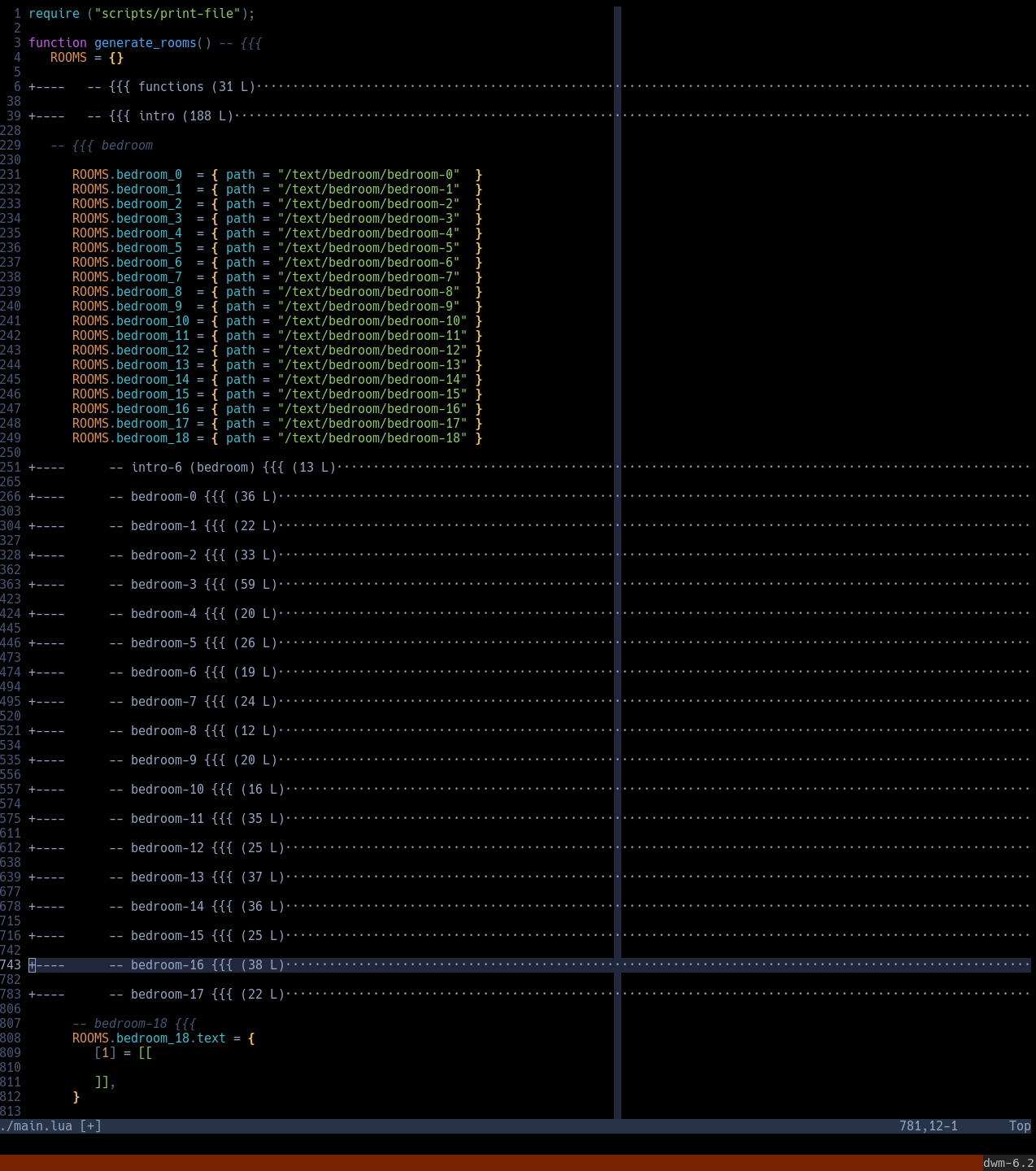
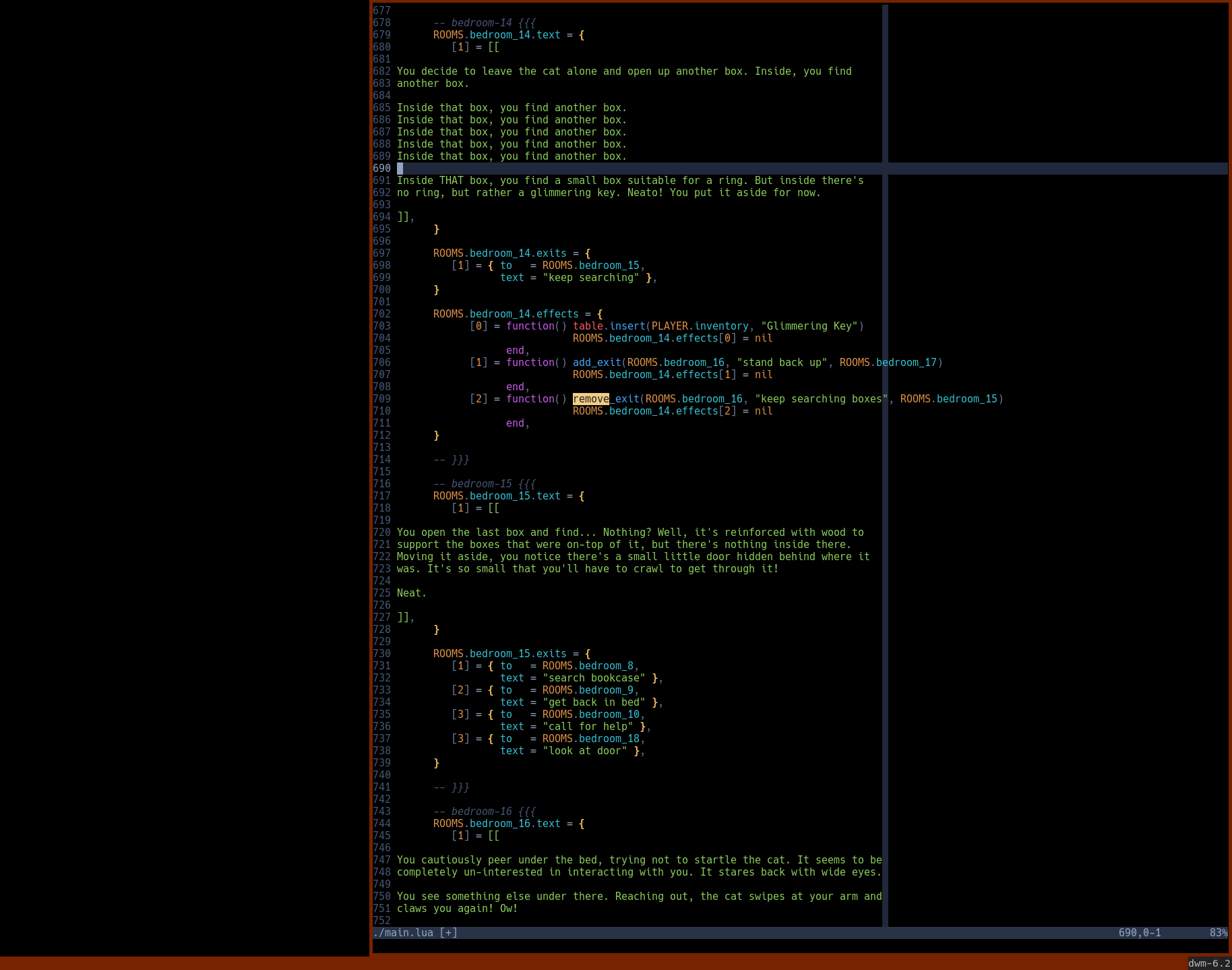
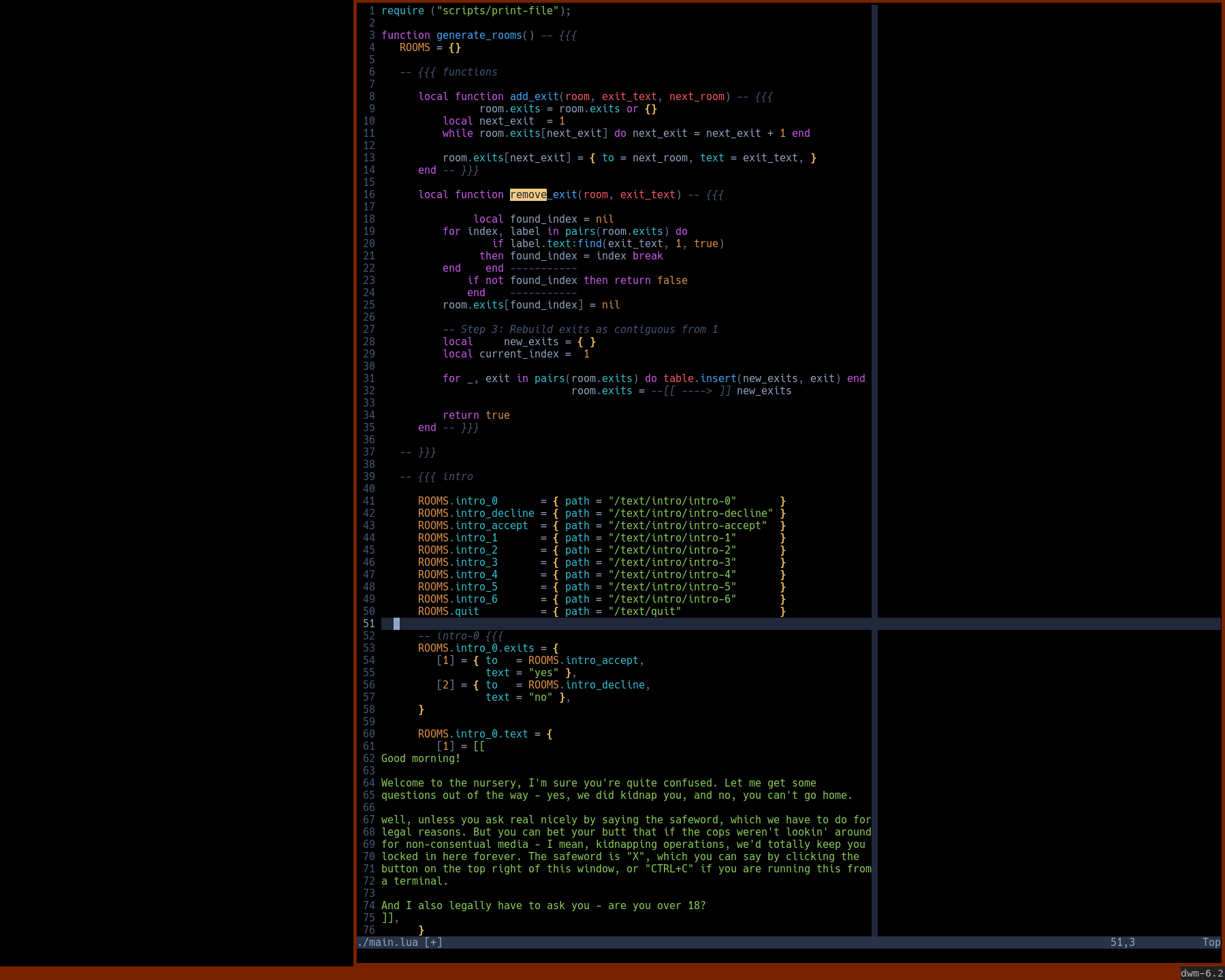
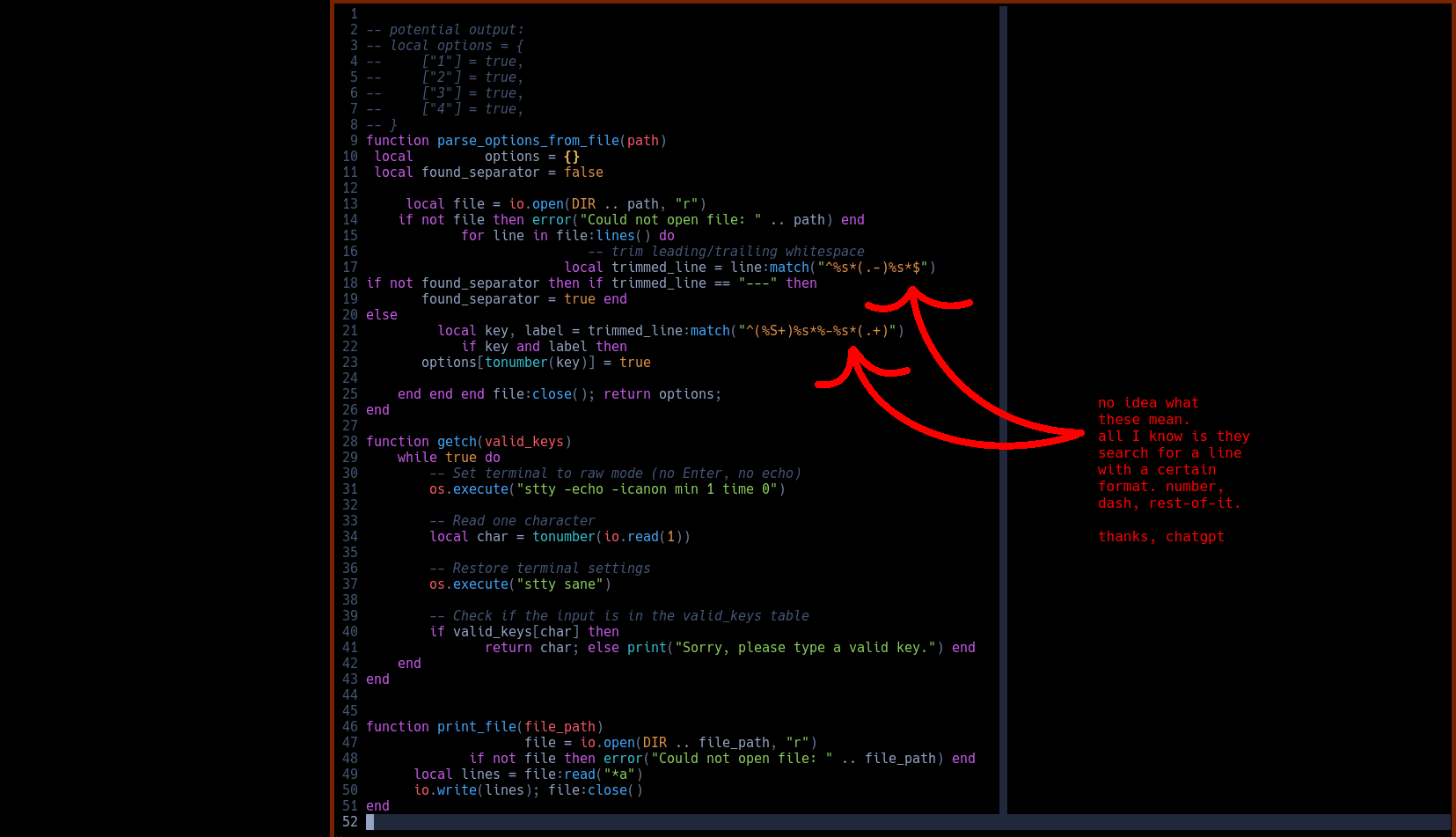
  hey does anyone wanna go over my code for this text adventure game thingy that
  I spent 2 days on so far?
┌─────────┐                                                            ┌───────────┐
│ similar │                       chronological                        │ different │
╘═════════╧═════════════════════════════════════════════════════───────┴───────────┘
 -> file: fediverse/4772
═════════════════════════════════════════════════════════───────────────────────────
  @user-1692

  I usually write everything down in a script that way when I call it from an
  external service all I have to do is point at the file

  sorta like... hacking environmental options into a config file

  like... I don't write an ffmpeg command every time I want to record my screen.
  I just type "screen-record" and then it'll do the thing that I figured out how
  to do a long time ago.

  ... oh no there's an error, I wonder what changed out from under my feet.

  huh it's wine, that one's always confusing to debug. Let's see... "could not
  open program.exe" uh-huh. Well, why not? is there a dependency issue? something
  miscompiled or configured? no? it's just... broken? you don't get to use that
  program today? huh that's weird. that's linux for ya I guess.
┌─────────┐                                                            ┌───────────┐
│ similar │                       chronological                        │ different │
╘═════════╧══════════════════════════════════════════════──────────────┴───────────┘
 -> file: fediverse/5113
════════════════════════════════════════════════════════════────────────────────────
  any game with the ability to interact with the simulation through command line
  arguments is a game that is scriptable and infinitely expandable.
┌─────────┐                                                            ┌───────────┐
│ similar │                       chronological                        │ different │
╘═════════╧═════════════════════════════════════════════════───────────┴───────────┘
 -> file: fediverse/3028
═════════════════════════════════════════════════───────────────────────────────────
  @user-570

  I can write C in Rust, but I can't write Rust in any other language.

  there's a lot of unique semantic options for accomplishing things that I
  already know how to do that I often find my syntax is pretty... basic. lots of
  manual assignments, no more than 4 or 5 levels of function nesting.

  I like to use threads and arrays, and think about in-game simulation more like
  a calculation than an input-reacting device. though input would certainly be
  encouraged to make the simulation more precise.

  the borrow checker gets in my way, but that's not too big of a problem - I just
  have to copy a bit more data around. Easy peasy.

  (I'm a bit rusty, but I can learn syntax)
┌─────────┐                                                            ┌───────────┐
│ similar │                       chronological                        │ different │
╘═════════╧══════════════════════════════════════──────────────────────┴───────────┘
 -> file: fediverse/1937
╔══════════════════════════════════════════════────────────────────────────────────┐
║ The best tip I have for people new to Linux is every time you solve a problem,   │
║ put the solution in a script. In addition, put the operations necessary to undo  │
║ the operation you just performed into a separate script (or function in the      │
║ same script)                                                                     │
║                                                                                  │
║ It's not hard. It's very easy. Its basically just typing things into a text      │
║ document instead of entering them one-by-one in your terminal. But now if you    │
║ ever need to solve the same problem twice, you just need to look through all     │
║ the scripts you've written instead of trying to relearn how to fix the thing     │
║ you're working on.                                                               │
║                                                                                  │
║ Plus, if you ever need to disable what you did, well there it is, you're good    │
║ to go. You can use chatGPT for things like text parsing or whatever, like "hey   │
║ can you write me a sed command that does this exact thing that I'm going to      │
║ enumerate and spell out for you" followed up by "that didn't quite work, the     │
║ desired behavior was this, but when I ran the script provided it did this" boom  │
║ you're a Linux administrator now, heres your rubber duck.                        │
╠═════════╗                                                            ┌───────────┤
║ similar ║                       chronological                        │ different │
╚═════════╩═══════════════════════════════════─────────────────────────┴───────────┘
 -> file: fediverse/5070
════════════════════════════════════════════════════════════────────────────────────
  main() is where you put stuff before you abstract it into a function. Usually
  it gets quite long, but it's mostly just a table-of-contents listing of all the
  other functions that are run in order to do this-or-that-or-the-other.

  --

  I wonder if you could generate RNG by hooking up a camera to a lava-lamp and
  scanning through the pixels or whatever
┌─────────┐                                                            ┌───────────┐
│ similar │                       chronological                        │ different │
╘═════════╧═════════════════════════════════════════════════───────────┴───────────┘
 -> file: notes/joust-gdd-with-extras
═════════════════════════───────────────────────────────────────────────────────────
  imagine a game where you can have conversations with an AI that's playing the
  role of a character in a video game. Picture this: You're a traveller visiting
  the tournament that's in town. There's jousting, melee duels, archery contests,
  all kinds of things that are just fun to play around doing. The earliest sports,
  if you will. Anyway the whole game is about talking to the other people there -
  basically the games are "playing in the background", and while you can compete
  in them it's not the bulk of the game. Most of it is just having a conversation
  with an AI and acting it out *like a roleplaying game*. O M G teach people to
  roleplay the way you play games! You're always going on about how "different"
  your way of gaming is than other people. So *show us* how you do it, how do you
  play? Like what are the fundamental, actual, steps that you take? You can show
  us by programming a game that inspires that playstyle. That's what game design
  is all about, finding creative ways to think. Well, think and act. But still.

  anyway, so you know what you're about? Good. Let's go.
┌─────────┐                                                            ┌───────────┐
│ similar │                       chronological                        │ different │
╘═════════╧══════════════──────────────────────────────────────────────┴───────────┘
 -> file: fediverse/5715
════════════════════════════════════════════════════════════════────────────────────
  I wish I could attach small screenshots to source code and have it stored in
  the text.

  then the editor can hide the gibberish data and translate it to a .png that is
  placed just so on the document.

  "ah but what about different fonts and sizes and aspect ratios and terminal
  widths and..."

  yep, those are the hard parts >.
┌─────────┐                                                            ┌───────────┐
│ similar │                       chronological                        │ different │
╘═════════╧═════════════════════════════════════════════════════───────┴───────────┘
 -> file: fediverse/3173
═════════════════════════════════════════════════───────────────────────────────────
  you've heard of an array of function pointers, yes,

  but have you ever heard

  of an array of GOTO labels?
┌─────────┐                                                            ┌───────────┐
│ similar │                       chronological                        │ different │
╘═════════╧══════════════════════════════════════──────────────────────┴───────────┘
 -> file: fediverse/2019
════════════════════════════════════════════════────────────────────────────────────
  @user-1112

  It's a script I wrote that downloads and configures MTG-forge, the free and
  open source version of Magic. It's a little old, a little jank, but you get all
  the cards for free. All the way up to the most current expansions.

  Multiplayer is a bit harder than Arena, I think it's bugged or something, but
  it's great for testing out decks against a computer. If I like one then I'll
  usually buy it to play with my IRL friends.
┌─────────┐                                                            ┌───────────┐
│ similar │                       chronological                        │ different │
╘═════════╧═════════════════════════════════════───────────────────────┴───────────┘
 -> file: messages/1247
═════════════════════════════════════════════════════════════════════════───────────
  you can even design it as you go, making it do slightly adjacent uses in
  addition to what it currently does. for example:
  https://github.com/gabrilend/r-mail is a reference implementation with some
  ideas for how to design some specific parts. make sure you go through it
  yourself though, so you understand how it works. don't worry, the source-code
  files are numbered like the table of contents [chamber of commerce] in a story
  or book.
┌─────────┐                                                            ┌───────────┐
│ similar │                       chronological                        │ different │
╘═════════╧════════════════════════════════════════════════════════════╧═──────────┘
 -> file: fediverse/633
═════════════════════════════════════════───────────────────────────────────────────
  @user-192

  the neat thing about BASH is that it's the glue that holds all your other code
  together. Write libraries in C and call them with BASH - accomplish broader
  tasks that are easier to co-create. That's why I like it - it's not the most
  important, but it's quite beneficial I think _^
┌─────────┐                                                            ┌───────────┐
│ similar │                       chronological                        │ different │
╘═════════╧══════════════════════════════──────────────────────────────┴───────────┘
 -> file: fediverse/5035
════════════════════════════════════════════════════════════────────────────────────
  I don't think I could program in an IDE anymore. They're just way too
  inconvenient.
┌─────────┐                                                            ┌───────────┐
│ similar │                       chronological                        │ different │
╘═════════╧═════════════════════════════════════════════════───────────┴───────────┘
 -> file: fediverse/6251
╔═══════════════════════════════════════════════════════════════════───────────────┐
║ "Hi computer, all is well. Can you create me a visualization of this particular  │
║ mathematical concept? It should be written in Lua using the Love2D engine        │
║ because that's my favorite. I should be able to step through the calculation     │
║ steps and modify values at each stage, and by the end we should have a fully     │
║ interactable system which works through the general concepts of this particular  │
║ kind of math."                                                                   │
║                                                                                  │
║ "no no I don't want you to explain it to me, I want a tool - a toy - that I can  │
║ play with to better understand it. Let's build it in Lua using the Love2D        │
║ engine because that's my favorite. When we're done we can start converting it    │
║ to use HTML5 - no javascript! - but for now let's get the system operational.    │
║ It should have a config file that can be adjusted with every value we can think  │
║ of."                                                                             │
║                                                                                  │
║ "can you go through this fully functional system and extract as many values as   │
║ you can think of into a config file? make sure there's efficient loading of      │
║ those values in the main function (or somewhere similar) as well. ty"            │
╠═════════╗                                                            ┌───────────┤
║ similar ║                       chronological                        │ different │
╚═════════╩════════════════════════════════════════════════════════────┴───────────┘
 -> file: fediverse/1762
═══════════════════════════════════════════════─────────────────────────────────────
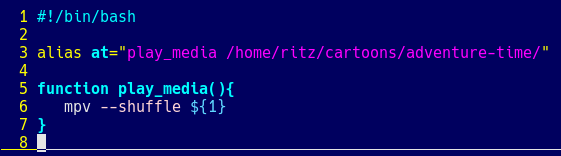
  This was the first bash script I ever wrote.

  It's been updated a little, it was a bash alias first, but this is what it
  looks like now.

  Kinda shows what kinds of problems I needed to solve most.
┌─────────┐                                                            ┌───────────┐
│ similar │                       chronological                        │ different │
╘═════════╧════════════════════════════════════────────────────────────┴───────────┘
 -> file: fediverse/3482
══════════════════════════════════════════════════──────────────────────────────────
  ┌───────────────────────┐
  │ CW: cursing-mentioned │
  └───────────────────────┘


  "Alright I'm not great with syntax so I'm going to write it in pseudocode
  first, and then if you'd like I can show you how I work through implementing
  the syntax.

  But first - do you want a robust solution, a quick solution, or a rapidly
  deployed and cheap solution?"

  using this trick you can pretend to be competent in any programming language,
  except maybe ancient ones like Fortran or strange ones like lisps or Haskell

  if they ask you to use a framework or something tho you're kinda boned because
  you need to know which functions to call and how to initialize context and
  such. When using a framework, the boilerplate is the code, which is why
  frameworks suck

  "*don't call yourself a programmer*" fuck off
┌─────────┐                                                            ┌───────────┐
│ similar │                       chronological                        │ different │
╘═════════╧═══════════════════════════════════════─────────────────────┴───────────┘
 -> file: notes/todo
════════────────────────────────────────────────────────────────────────────────────
  1. write a proper todo script
  2. finish installing the drivers for the printer
      -> fix the "make" command, it seems to be borked
  3. figure out how to install Overwatch
  4. reinstall 351-elec
  5. get another cord for the hard drive's power supplies so you can connect
      the cmdo drive again
  6. get a life
  7. finish installing GNUstep (requires make I think)
  7. ????
  8. profit
┌─────────┐                                                            ┌───────────┐
│ similar │                       chronological                        │ different │
╘═══════──┴────────────────────────────────────────────────────────────┴───────────┘
 -> file: notes/anarchist-programs
════════════════════════════════════════════════════════════════════════════════────
  I'm writing anarchist computer programs. See:

  ceramic
  everysoft
  my game server projects
  similar-differernt (doomscroll) chronological (tldr)
  golems project (unstarted)
  sorenthal-ds
  probably others... none come to mind...
┌─────────┐                                                            ┌───────────┐
│ similar │                       chronological                        │ different │
╘═════════╧════════════════════════════════════════════════════════════╧════════───┘
 -> file: fediverse/3037
╔════════════════════════════════════════════════──────────────────────────────────┐
║ @user-570                                                                        │
║                                                                                  │
║ have you ever wanted to design your own MMO? If you think you can make a         │
║ client, there's a server already set up which interfaces with World of           │
║ Warcraft. So... the hardest part is done, and suddenly the rest is about as      │
║ hard as making any other game.                                                   │
║                                                                                  │
║ The reason I ask is because there's no open-source client for the WoW engine     │
║ server software Azerothcore, but if written then there could be a whole new      │
║ field of indie design as solo developers would be able to build their own        │
║ multiplayer games with ease.                                                     │
║                                                                                  │
║ well, as easy as making a game in Godot at least. That's the dream. I don't      │
║ think I could build such an engine, but I spend an awful lot of time thinking    │
║ about how engines are built.                                                     │
║                                                                                  │
║ There's a lot of freedom in the design space, for example this mod server I      │
║ made which emulates Risk of Rain: https://www.youtube.com/watch?v=6HsW4g2ZIgk    │
║                                                                                  │
║ It has randomized enemies, treasure chests, wandering vendors, and deployable    │
║ hearthstones. If you've played WoW that stuff might ring a bell, otherwise it's  │
║ probably just random features                                                    │
╠═════════╗                                                            ┌───────────┤
║ similar ║                       chronological                        │ different │
╚═════════╩═════════════════════════════════════───────────────────────┴───────────┘
 -> file: fediverse/614
═════════════════════════════════════════───────────────────────────────────────────
  What does your template for a new project look like? Here's mine:
┌─────────┐                                                            ┌───────────┐
│ similar │                       chronological                        │ different │
╘═════════╧══════════════════════════════──────────────────────────────┴───────────┘
 -> file: fediverse/4455
═════════════════════════════════════════════════════───────────────────────────────
  @user-1268

  void linux, gentoo, and nixos. But mostly Void Linux
┌─────────┐                                                            ┌───────────┐
│ similar │                       chronological                        │ different │
╘═════════╧══════════════════════════════════════════──────────────────┴───────────┘
 -> file: notes/how-to-ai
═══════════════════════─────────────────────────────────────────────────────────────
  first you gotta build an entire simulation of the game mechanics. Essentially,
  building the game from scratch without any of the graphics. Sorta like those
  aimbot games for Overwatch, or KSU or w/e the aim training game was. Then,
  map the relationship between various objects in the game to a table situated
  a level above them. So, like, a barrel can be climbed on or walls can be used
  as cover or w/e the game you're playing is. Have a table one level above that
  relationship (an abstraction, if you will) and record the conclusion. Then take
  one more step back, then another, and another, all the way to the present.

     Essentially, processing backward.

  Eventually you'll get to the present moment, and ideally you'd do it in one
  step - this is why it's important to map things on two dimensional planes, so
  that you can aim. Anyway here's the steps: 1. recognize the environment, 2.
  Take one step backward from each object in the environment (predicting it's
  motion, you might say) and on and on gathering ideas about how git'll move
  next. Draw a 2d line (on a map, as the crow flies) then another about halfway
  to the target and it'll be +/- a certain amount. So you'll add another dot on
  the graphed line at x=(1/2 of the distance) - x being of course the distance
  and y being concieved of as the distance from the shortest possible route.

     sorta like throwing a ball at a wall and making ripples.

  the projected cone is a field of perception - the interpretation of what's at
  stake. Life, and existence, is little more than a perspective applied on (or by
  ) a biological machine. What separates the man from the animal? Nothing but
  time, as all evolution teaches us.
┌─────────┐                                                            ┌───────────┐
│ similar │                       chronological                        │ different │
╘═════════╧════════════────────────────────────────────────────────────┴───────────┘
 -> file: messages/755
══════════════════════════════════════════════════════════──────────────────────────
  Code editor that moves boxes by saving over the file with a lua script every
  time you moved a function call around.

  Oh lemme start at the beginning:

  A code editor program that's like a text editor like Vim or Emacs. If you don't
  know what those are, you should probably learn Emacs. Or Vim. Up to you.

  Oh right so if you do know what those mean, here's the idea: the white space
  matters. It's counted and tracked into variables in a LUA script which
  interface with the Vim C keybindings.

  "run a function within a c program or LUA script which calls a bash command
  which opens Vim for example with a file you want to edit. Then, inside the
  file, your spaces and tabs would WYSIWYG for the various food ads placed about,
  and then you could very easily create game design knowledge.

  WASD to move, alternatively hjkl

  It would run a check every time the file updates and depending on how it
  changed it'd mark certain variables which would change the website as the user
  moved things around.

  It's just files. And files are just bits. But files are a useful abstraction,

  If you realize that "ugly hacking" should be industry standard.
┌─────────┐                                                            ┌───────────┐
│ similar │                       chronological                        │ different │
╘═════════╧═══════════════════════════════════════════════─────────────┴───────────┘
 -> file: fediverse/2875
═════════════════════════════════════════════════───────────────────────────────────
  ┌────────────────────────────┐
  │ CW: re: unsolicited advice │
  └────────────────────────────┘


  @user-192

  I use Void Linux so it uses xbps instead of apt, but I know I've heard about
  how to do it I just forget how. I'll look into it, but for now I can play,
  so... oh well! :D :D
┌─────────┐                                                            ┌───────────┐
│ similar │                       chronological                        │ different │
╘═════════╧══════════════════════════════════════──────────────────────┴───────────┘
 -> file: fediverse/3035
═════════════════════════════════════════════════───────────────────────────────────
  @user-570

  I haven't looked into Bevy recently, probably 2ish years ago I'd say.

  Mostly been using Raylib, and recently I was dipping my toes into Love2D
  because I liked how they handled concurrency.
┌─────────┐                                                            ┌───────────┐
│ similar │                       chronological                        │ different │
╘═════════╧══════════════════════════════════════──────────────────────┴───────────┘
|