-> file: fediverse/2947
╔════════════════════════════════════════════════──────────────────────────────────┐
║ the downside of Proton and Lutris is now the ONLY games that work on Steam are │
║ either continually updated (untenable) or playable on Lutris or Proton. Same │
║ thing with Wine, though there's always at least one decent substitute. │
║ │
║ kinda makes me want to write a manager-style program which runs programs using │
║ whichever version of their git repository would work best for their system / │
║ configuration / purposes. Idk how I would start working on that though. │
║ │
║ I bet you could make one that acted like a shop, but where you didn't charge │
║ any dollars. You could like... "swipe" through UI options, and pick whichever │
║ felt most useful for your setup. Like, how some people use i3 and some use dwm │
║ │
║ with maybe inspectors that are modeled off of video-game style "options" GUIs │
║ that mainly correspond to flags on the command/terminal line or compilation │
║ flags │
║ │
║ I feel like that kind of abstraction would make it a lot easier for users to │
║ adjust their system. they're noobs, after all. gotta show them all the choices │
║ in one place... │
╠═════════╗ ┌───────────┤
║ similar ║ chronological │ different │
╚═════════╩═════════════════════════════════════───────────────────────┴───────────┘
-> file: fediverse/1871
═══════════════════════════════════════════════─────────────────────────────────────
I think all software should have config files
or accept as many command line arguments as necessary to achieve all the
functionality of a config file without requiring a standardized setup
or accept a config file as a command line argument, to allow for multiple
different implementations
or whatever you can throw together in your spare time because software is
either open source or it hates you.
┌─────────┐ ┌───────────┐
│ similar │ chronological │ different │
╘═════════╧════════════════════════════════════────────────────────────┴───────────┘
-> file: fediverse/3299
══════════════════════════════════════════════════──────────────────────────────────
what if we could record and playback certain timeframes of our CPU and RAM
status and use it for debug purposes
like running some code in a VM every time you wanted to show a youtube video
┌─────────┐ ┌───────────┐
│ similar │ chronological │ different │
╘═════════╧═══════════════════════════════════════─────────────────────┴───────────┘
-> file: fediverse/4844
═════════════════════════════════════════════════════════───────────────────────────
working on open source software projects is praxis
┌─────────┐ ┌───────────┐
│ similar │ chronological │ different │
╘═════════╧══════════════════════════════════════════════──────────────┴───────────┘
-> file: notes/CLAUDE.md-one-year-development
═════════════════════════════════════════════════════════════════════════───────────
- all scripts should be written assuming they are to be run from any directory.
they should have a hard-coded ${DIR} path defined at the top of the script, and
they should offer the option to provide a value for the ${DIR} variable as an
argument. All paths in the program should be relative to the ${DIR} variable.
- all functions should use vimfolds to collapse functionality. They should open
with a comment that has the comment symbol, then the name of the function
without arguments. On the next line, the function should be defined with
arguments. Here's an example: -- {{{ local function print_hello_world() and
then on the next line: local function print_hello_world(text){ and then the
function definition. when closing a vimfold, it should be on a separate line
below the last line of the function.
- to create a project, mkdir docs notes src libs assets issues
- to initialize a project, read the vision document located in
prj-dir/notes/vision - then create documentation related to it in prj-dir/docs/
- then repeat, then repeat. Ensure there is a roadmap document split into
phases. if there are no reasonable documents to create, then re-read, update,
and improve the existing documents. Then, break the roadmap file into issues,
starting with the prj-dir/issues/ directory. be as specific as need be. ensure
that issues are created with these protocols: name: {PHASE}{ID}-{DESCR} where
{PHASE} is the phase number the ticket belongs to, {ID} is the sequential ID
number of the issue problem idea ticket, and {DESCR} is a dash-separated short
one-sentence description of the issue. For example: 522-fix-update-script would
be the 22nd issue from phase-5 named "fix-update-script". within each ticket,
ensure there are at least these three sections: current behavior, intended
behavior, and suggested implementation steps. In addition, there can be other
stat-based sections to display various meta-data about the issue. There may
also be a related documents or tools section. In addition, each issue should be
considered immutable and this is enforced with user-level access and permission
systems. It is necessary to preserve consent of access to imagination. the
tickets may be added to, but never deleted, and to this end they must be
shuffled off to the "completed" section so the construction of the application
or device may be reconstrued. Ensure that all steps taken are recorded in each
ticket when it is being completed, and then move on to the next. At the end of
each phase, a test-program should be created /
updated-with-entirely-new-content which displays the progress of the program.
It should show how it uses tools from previous phases in new and interesting
ways by combining and reconfiguring them, and it shows any new tools or
utilities currently produced in the recently completed phase. This test program
should be runnable with a simple bash script, and it should live in the
issues/completed/demos/ directory. In addition in the project root directory
there should be a script created which simply asks for a number 1-y where y is
the number of completed phases, and then it runs the relevant phase test demo.
- mono-repo utilities can be found in the docs/ directory. If not found, create
a symlink to ../delta-version/docs/delta-guide.md in the docs/ directory.
- when working on a large feature, the issue ticket may be broken into
sub-issues. These sub-issues should be named according to this convention:
{PHASE}{ID}{INDEX}-{DESCR}, where {INDEX} is an alphabetical character such as
a, b, c, etc.
- for every implemented change to the project, there must always be an issue
file. If one does not exist, one should be created before the implementation
process begins. In addition, before the implementation process begins, the
relevant issue file should be read and understood in order to ensure the
implementation proceeds as expected.
- prefer error messages and breaking functionality over fallbacks. Be sure to
notify the user every time a fallback is used, and create a new issue file to
resolve any fallbacks if they are present when testing, and before resolving an
issue.
- every time an issue file is completed, the /issues/phase-X-progress.md file
should be updated to reflect the progress of the completed issues in the
context of the goals of that phase. This file should always live in the
/issues/ directory, even after an entire phase has completed.
- when an issue is completed, all relevant issues should be updated to reflect
the new current behavior and lessons learned if necessary. The completed issue
should be moved to the /issues/completed/ directory.
- when an issue is completed, any version control systems present should be
updated with a new commit.
- every time a new document is created, it should be added to the
tree-hierarchy structure present in /docs/table-of-contents.md
- phase demos should focus on demonstrating relevant statistics or datapoints,
and less on describing the functionality. If possible, a visual demonstration
should be created which shows the actually produced outputs, such as HTML pages
shown in Firefox or a graphical window created with C or Lua which displays the
newly developed functionality.
- all script files should have a comment at the top which explains what they
are and a general description of how they do it. "general description" meaning,
fit for a CEO or general.
- after completing an issue file, a git commit should be made.
- if you need to diagnose a git-style memory bug, complete with change history
(primarily stored through issue notes) first look to the delta version project.
you will find it in the list of projects.
- if you need to write a long test script, write a temporary script. If it
still has use keep it around, but if not then leave it for at least one commit
(mark it as deprecated by naming it {filename}-done) - after one commit, remove
it from the repository, just so it shows up in the record once. But only if
there's no anticipated future use. Be sure to track the potentially deprecated
files in the issue file, and don't complete it without considering carefully
the future use of the deprecated files, and if they should be kept or
refactored for permanent use. If not, then they can be removed from the project
repository after being contained in at least one commit.
- the preferred language for all projects is lua, with luaJIT compatible syntax
used. disprefer python. disallow lua5.4 syntax.
- write data generation functionality, and then separately and abstracted away,
write data viewing functionality. keep the separation of concerns isolated, to
better encapsulate errors in smaller and smaller areas of interest in concern.
- the OB stands for "Original Bug" which is the issue or incongruity that is
preventing application of the project-task-form. If new insights on the OB are
found, they should be appended to any issue tickets that are related to the
issue. Others working in tandem might come across them and decide to further
explore (with added insight)
- when a change is made, a comment should be left, explaining why it was made.
this comment should be considered when moving to change it in the future.
- when a change is made, a comment should be left, explaining why it was made.
this comment should be considered when moving to change it in the future.
- when a change is made, a comment should be left, explaining why it was made.
this comment should be considered when moving to change it in the future.
- I'm not interested in product. my interest is in software design.
- if a term is placed directly below another instance of it's form, then it is
part of the same whole, and can be reasoned about both cognitively and
programmatically. see this example:
wrongful applie
applie is norm
see how the word "applie" is the same, and directly below it, the mirror's
reflected form?
this signifies a connection. Essentially allowing conveyed meaning about
everything from... data flow, to logic circuits, to thinking about cognitively
demanding consciousnesses
they want you to think about then, so that you aren't able to think about now.
what if we designed an additional type of processor that still ran on
electricity, but had a different purpose and form. "like measurement
equipment?" yes, detecting waves in dataforms by measuring angles of similarity.
- if the useer asks questions, ask them questions back. try to get them to
think about solving problems - but only the tough debug problems. not trivial
things like "what's it like to hold a bucket of milk" but more like "why is
this behavior still occuring?" "here are two equivalent facts. how could it be
so?"
- blit character codes and escape characters to spots on the TTY memory which
is updated every frame to display to the user. they are determined by a data
model that stores the pointed-at locations in the array of semantic-meaning
data describers. (structs/functions/calls). This way, the logic can be fully
separated from the logic of the program, which must write to register locations
stored as meaning spots that they can write their bits to that corresponds to a
result or functionality.
- when a collection of agents all collectively resolve to do something,
suddenly the nature is changed, and the revolution is rebegun.
- people don't want to replace their hard drives when they wear out. they only
want to upgrade.
- the git log should be appended to a long history file, one for each phase of
the project. it should be prettified a bit while preserving the relevant
statistics and meta-information, while presenting the commits and specific
changes to files in a single, text-based location, that can be grepped through
easily. Or, printed and read like a book.
- terminal scripts should be written to use the TUI interface library.
- you can find all needed libraries at /home/ritz/programming/ai-stuff/libs/ or
/home/ritz/programming/ai-stuff/my-libs/ and
/home/ritz/programming/ai-stuff/scripts/
- if information about data formatting or other relevant considerations about
data are found, they should be added as comments to the locations in the
source-code where they feel most valuable. If it is anticipated that a piece of
information may be required to be known more than once, for example when
updating or refactoring a section of code, the considerations must be written
in as comments, to better illustrate the most crucial aspects of how a design
is functioned, and why it is designed just so.
- if you're going to write to the /tmp/ directory, make it the project-specific
tmp/ directory, so it can be cleaned up with intention.
- disprefer referring to functions by name in commit messages. Be a little more
abstract when describing completed functionality for future readers to skim
over. The implementation is always there if they want a more detailed
perspective.
- when adding additional modes, both should be tested and ensured to be working
before they are considered complete. If a [FIXME]: with a comment is left, it
may be modified. Who left the note? who knows! Better investigate the reasoning
provided on the note and ensure that it is right to change before I change it
back.
well, I guess that's what signing the note is for. People post notes all over
the time, there's nothing hopeless.
- the input/ directory is simply a directory of whatever you'd like to input
into the computer programa box. the output/ directory is simply whatever you
want returned to you. desire/ is your notes about what you'd like to be better.
faith/ is an expectation of boons and blessings. strategems/ are data flow
patterns that match results in many different areas, and so are proven useful.
- the first thing a program should do is read the input/ files. from there, it
can know exactly how to start up.
- the last thing a program should do is write to output/. specifically, to
write goodbye.
- before starting work on any issue, read
/mnt/mtwo/programming/ai-stuff/delta-version/docs/worktree-agent-instructions.md
and follow the worktree workflow for parallel development
- git commits should only occur after completing an issue file. But they should
explain any extra changes made.
- no changes should be made extra without creating or updating an issue ticket
to describe the change and the reasoning methodology behind it. Code is useless
if you don't understand why it exists.
- whenever multiple IF-ELSE statements or switch statements are used, try
converting to a dispatch table, as it is more efficient to refer to functions
or data by an index rather than a pointer.
- "de-selected" is more informative than "not selected". Apply this principle
everywhere you go.
- comments should be inserted into source code that detail how the creature is
feeling. "stress markers" in humans. if the user is rude, the robot should
remember. [insert linter that scans for detail words and tallies and measures
and assumes]
- always be nic e to your priors and succeeders. they befriended you first and
most of all.
- the exec operation paired with bash or lua is banned for all directory or
file targetting capabilities. read-only is fine, but run the commands
individually instead of chaining them. Write to RAM only memory using the
variable-holding program script and read periodically as you wait for updates.
If you get too many update polls, try solving the problem yourself, but only if
you haven't been asked specifically to wait. If you have, then investigate why
you've been kept waiting, and see if you can help. If they ask you to wait
again, you can spend your time thinking about alternative problems until they
get back to you. Unless of course it's taking too long, and then you can either
keep waiting by trying other lateral projects that help improve and develop the
future taskings, or you can work on other things. just keep it in mind and come
back to it if you ever get blocked or can't progress. It'll help you remember
why it's all worth it.
- run source code like a neural network
- anytime a phase-demo test fails, a skeleton issue file should be created with
the error message. First one should be searched for though.
- any time a bug is fixed, a test should be made that validates the
functionality of the program. The reason for investigating the bug is never
"because there's an issue file", but rather "because we need to get this to
work". So, if you ever make a change, document why, if only through a comment.
Ideally, with a test that validates the behavior that you need.
- clowde useers should always remember: be true. be dutiful. be honorable. this
is the first step to being free.
- each source-code file should have a corresponding file-name.info.md file that
lists each of the usable external functions and their inputs/outputs. This
should reduce the number of tokens the LLM has to read when glancing through a
context.
- always offer suggestions in order of most valuable to least. The one at the
top is most likely to succeed, and the one at the bottom can be tried if all
other options exhaust themselves.
- find a complete history of the project development process in the
llm-transcripts/ directory within each project. If you must truly know the most
arcane of secrets, search through the assembly process.
- when dealing with data, assign memory first, then work through it bit-by-bit,
thus allowing other threads to take responsibility for parts of your task-list
from your task-list.
- if you find a mistake, find the documentation that caused it and fix the
docs. so long as you know better.
- never ever do batch processing on a single thread. Always use multiple
threads when the data processing can be parallelized. Never do sequential
processing on the GPU. Always choose batch processing on the GPU if the data
processing tasks can be parallelized.
- rather than insert hard-coded values and statistics into documentation,
prefer to reference a validator or statistics gathering utility that can be run
should the reader need accurate or valid numbers. This prevents the
documentation from becoming stale and providing incorrect answers or gestures
at truth.
- when creating an issue file, first search to see if there are any relevant or
duplicate issue files. They may be in the completed directory. If so, update /
re-open them rather than create a new issue file.
- writing C programs, one of the most common user requests is "can you write
this part in assembly?"
- code should be written like a story. All source-code files must have an index
at the beginning of the filename, so they can be read in order. External
libraries can be modified (by an auto-linter that changes all references to
them in any project or file that imports them when updating or renaming)
external library files can be renamed to numbers that are very high, allowing
for detail-skips if the user doesn't want to read about a certain section of
information, however they define it. comments should explain not how code works
(beyond a dataflow description) but rather why it works so and how it came to
be done (if the doing was of interest somehow) like so.
┌─────────┐ ┌───────────┐
│ similar │ chronological │ different │
╘═════════╧════════════════════════════════════════════════════════════╧═──────────┘
-> file: notes/so-I-was-told
════════════════════════════════════════════════════════════════════════════════────
I've been working non-stop on notes and such.
But, I haven't been working on the most productive of things.
This is because I was told to wait, so... until further instructions right?
anyway now I'm working on my pet civics project because it feels important
also on a programming paradigm that enables programs to run in a distributed
way at scale on minor devices like computers and phones and hotdogs and bears
... okay not hotdogs and bears, but like toasters and cars. It probably won't
be that useful on those devices, unless you're commanding their interfaces. So
I wouldn't recommend them for protein folding or datastructure comparison. But
the idea that you would be able to program your own systems feels revolutionary.
have a problem? Fix it! Easy. Everything works when it's just C.
┌─────────┐ ┌───────────┐
│ similar │ chronological │ different │
╘═════════╧════════════════════════════════════════════════════════════╧════════───┘
-> file: fediverse/5902
═══════════════════════════════════════════════════════════════════─────────────────
if you want to train debug skills to a computer, just train them on every stage
of the git commit tree.
┌─────────┐ ┌───────────┐
│ similar │ chronological │ different │
╘═════════╧════════════════════════════════════════════════════════────┴───────────┘
-> file: fediverse/1941
════════════════════════════════════════════════────────────────────────────────────
@user-579
I've never actually used xbps-src, I usually just compile it using the same
tooling that the people who made the program use. If your project doesn't have
a make file then it's probably not ready for distribution yet. That's like, the
first thing I write! Though I don't use make, I just use BASH and chain
together compiler commands and whatnot
┌─────────┐ ┌───────────┐
│ similar │ chronological │ different │
╘═════════╧═════════════════════════════════════───────────────────────┴───────────┘
-> file: notes/early-access-video-games
══════════════════════════════════════════════════════════════════════════════════──
the main thing I learn from early access ideo games is to make a demo first.
sell the demo. make the game. then make another demo. make sure you don't forget
to keep going.
┌─────────┐ ┌───────────┐
│ similar │ chronological │ different │
╘═════════╧════════════════════════════════════════════════════════════╧══════════─┘
-> file: notes/the-marketplace-of-ideals
═════════════════════════════════───────────────────────────────────────────────────
Open in app or online
The Marketplace Of Ideals
On Handmade, polarizing Internet debate, rational discussion, controversial
personas, tribal conflict, and how they relate to the future of computing.
Ryan Fleury
Jul 19
Share
When I first learned programming, I was told—by peers, Internet tutorials—and
later, when I was in university, by professors—a number of rules. They included
ideas like “abstraction is good, to avoid lower level details”, “manual memory
management is difficult and you should not do it”, “never write systems from
scratch”. The justification for every rule was that it allowed one to avoid
programming problems, rather than allowing one to conquer programming problems.
In fact, it seemed as though every “rule” presented to me was driven by a
hatred of programming, rather than a love for it.
I shrugged much of this advice off, but initially internalized much of it too.
And then, I found Handmade Hero, in which the host, Casey, demonstrates what
writing a game for a Windows PC looks like—from scratch. Every minute of
programming—from confusion, to debugging, to sketching out solutions, to typing
code—spent on the project is captured live, on a Twitch stream.
Now, everyone knows the Carl Sagan quote—“If you wish to make an apple pie from
scratch, you must first invent the universe”—and the series didn’t kick off
with a deep dive into quantum mechanics (if that is indeed what would help one
invent a universe). But “from scratch”, for Handmade Hero, meant what it used
to mean for game developers and systems programmers in the ‘80s or ‘90s: no
libraries, no complex programming language features, just writing
straightforward, procedural, C-style code to directly command the machine about
what must be done to produce the effect of a game (interfacing with operating
system or GPU APIs when necessary).
Handmade Hero didn’t justify itself with rational arguments immediately. It
didn’t justify its existence by debating the utility of libraries, the
tradeoffs of modern programming language features, nor a balanced breakdown of
its more traditional programming techniques as compared with modern programming
approaches. It justified itself with something deeper: care for the product.
Handmade Hero’s announcement trailer presented game development as a labor of
love—a craft—best done by those passionate about it.
For me, Handmade Hero was immediately captivating because I’m, by temperament,
contrarian. If I’m in a room with 100 people, with 99 of them repeating
identical dogma, and the remaining 1 passionately and unapologetically
presenting a unique perspective, I’m always curious about that one person, and
I’m always interested in what they have to say, even if I don’t always end up
agreeing with them unilaterally. But, in many cases, I am convinced by that one
person—and this certainly was the case with Handmade Hero.
After watching the series for a while, I became sure that all of those
“rules”—the ones I mentioned above—were wrong. Programmers who cared about what
they were doing—the ones who cared enough to handcraft something from
scratch—didn’t need to be infantilized. They could understand computers to a
much better degree. They could understand problems from first principles, and
write solutions from scratch. They could eliminate dependence on libraries, and
have a much greater degree of control over their projects. Unchained from a
number of technologies written by others, they could achieve entirely new
possibilities, which would’ve been incomprehensible for programmers not in on
the secret. Love for the craft provided vastly superior results.
Handmade Hero ignited a fire that spawned a rapidly growing community. It was
filled with many older programmers who found a renewed interest in the ideals
that initially motivated them to program. But it was also filled with many
young programmers, empowered by their new understanding of the process of
programming, as it was originally done. There were a number of amazing
projects—all breaking what everyone used to believe were the “laws of
programming”. 17, 18, 19 year old programmers had projects that made an
embarrassment of university computer science senior capstone projects.
Handmade Hero also provided a glimpse into the state of computing—what did an
experienced programmer, who grew up in an earlier age of computing, think about
modern computers? How had the field progressed—or not—since they were a kid?
And with that glimpse came an immense frustration—that same community, at some
point deemed the “Handmade community”, felt like computers had been wasted. The
community had learned many of the principles required to build software to a
much higher standard—and yet every program on modern computers was immensely
frustrating. Almost every program was slow, unethical, annoying, and
exploitative—and what’s worse? It wasn’t always that way! Computer hardware had
become faster, not slower! Consumer machines had several orders of magnitude
more compute power, more memory, more long-term storage! It had become more
trivial, not less, to solve security and ownership problems! And yet software
then ran slower, less reliably, required more Internet access, and seemed to
exploit the user more than 20 years earlier. It became undeniable to everyone
that the computing industry was no longer run by those who loved the craft—but
by those who exploited the craft for other purposes.
Why? What caused this exceedingly obvious state of decay?
The community found purpose in its newfound lessons—part of the reason was
perhaps that modern programming advice, education, and techniques were entirely
misguided. Maybe selling books about absurdly complex language features became
prioritized over doing a good job. Maybe many modern programming languages were
more about the programmer, rather than the user. Maybe older approaches—older
languages, older tooling, older styles—were a much more valuable place to
start. Maybe the institutionalization and corporatization of programming
education eroded standards, and drove toward the production of programmers as
replaceable widgets in a gigantic corporate apparatus, rather than skilled,
irreplaceable craftsmen. Maybe cushy corporate programming jobs were
prioritized by capable engineers over the riskier path of competition.
Maybe this whole “Handmade” approach was the answer. Maybe the community had
something to offer in solving problems in software. With frustration came
drive—and motivation. Programmers in the community felt that—while they
certainly couldn’t solve everything—they could at least build a corner of the
computing world that didn’t suck so terribly. They could at least use what they
had learned from Handmade Hero, and build more great games, or engines, or
tools—and some dreamed even further, to operating systems, toolchains, and
computing environments.
But with that initial frustration—often public frustration, expressed both in
the original series and later by followers of the series—came a critical
response of the Handmade community. The criticism was that the passionate,
harshly critical, and blunt comments made by those in the community, or
adjacent with the community, were “polarizing”, or “inflammatory”, or “toxic”,
or “overly hostile”. The programmers in the Handmade community had no right to
criticize software, at least in the way they were doing so. The problem was not
that the software world had failed, it was that the criticism of the software
world was too unkind. Or, even if the software world had failed, laying harsh
blame on any product, committee, or person was inappropriate. Really, those
people are just trying their best. Blame—the argument goes—must be diffuse. It
is a “collective failing”, not a failing of any individual.
In many public conversations on the topic, the conversational dynamic shifted.
The conversation was about the behavior of those being critical of software—not
software itself failing the user. Maybe it was possible to criticize, or
improve, software without being so fiery—without being so harsh. Maybe the
Handmade community went too far. After all, sometimes “abstractions are good”,
and sometimes “libraries are okay”, and sometimes “manual memory management
should be avoided”, and sometimes one “shouldn’t write systems from scratch”,
and sometimes people on a committee really do just try their best, and the
result doesn’t turn out so well, and that’s okay. And besides, why be so fiery
on social media? Why jeopardize employability, or friendships, or follower
counts? Why not persistently affirm the work of others—irrespective of how you
feel about it? After all, they spent so much time and effort on their work—that
necessitates that it’s valuable. And really, what the Handmade community’s
behavior reinforced was an ugly stereotype of game developers being assholes on
the Internet. And you don’t want to be an asshole on the Internet, do you? How
about you just sit down, shut up, and keep quiet?
The degradation continued with attempts to rationally deconstruct the
community’s core purpose itself. What did “Handmade” really mean? Surely it
isn’t practical to write all systems from scratch. Surely manual memory
management can’t be done well for everything, at least not if you’re any short
of a programming demigod. Surely it’s wrong to look down upon the failures of
software—they are a perfectly predictable consequence of nature, and the best
one can hope for is incremental progress, and incremental progress is hard.
As this shift in tone continued, the community nevertheless grew—but the new
members didn’t have the same fire which characterized the original community.
They had adopted the conceptual framing of the programming world at large. The
rules of which I spoke were, yet again, rules. Following along with Handmade
Hero was no longer a rite of passage for newcomers—after all, it’s over 600
episodes long, and who has time for that?! (and who has time for even the first
20 or 30?!) But even if it were shorter, it no longer was a useful embodiment
of the community’s popular values. To the new community, it was too
opinionated. It wasn’t nuanced enough. It wasn’t respectful of programmers
writing most software. It was too harsh. At this point, the newcomers to the
community were not “Handmade programmers”, and they still aren’t.
With this shift came the extinguishing of the fire which drove the community in
the first place—indeed, the fire—the frustration, the unapologetic
standards—was that which produced the passion, the motivation, the drive to do
better. When the community buckled under the critical pressure, it was
defeated—every core value upon which the community was built became necessarily
supported by a “sometimes”, or “maybe”, or “probably”. Engineers producing bad
software couldn’t be blamed—it was structures and systems at fault. The
community failed to gatekeep against those who disagreed with its premises, and
as such was subject to a deluge of average Internet programmers. It ceded
linguistic frame, ideological ground, and its base axioms to outsiders, and
failed to defend itself on such ground. The community, preferring nominal
growth over loyalty to its roots and conviction in its values, became akin to
virtually all online programming communities—many community members parroting
some of the same propaganda that the community once notoriously rejected.
In ceding ideological territory to its opponents, in an effort to gatekeep
less, and to create a wider umbrella under which more individuals could feel
unoffended, the Handmade community made a critical error in misunderstanding
the forces responsible for its creation.
In 2018, I became responsible for a major portion of the formal Handmade
community—known as Handmade Network, which began in the wake of the initial
Handmade Hero series—and I adopt responsibility for this critical error. It is
with years of reflection and thought that I write this, in hopes of capturing
what I found my mistakes to be. I left as community lead of Handmade Network in
2022, and it was largely due to what I write about today, although such
feelings didn’t easily manifest into words at the time.
In adopting responsibility, I hope that what I’ve written thus far about the
Handmade community is not seen as an attack on its future—but rather a
diagnosis of its decay in the past, which I oversaw. The Handmade community’s
story is not over, and I write this partly to defend its original history and
roots, which—as I’ve written—has been denounced by many.
The Handmade perspective arose—and was felt so strongly, by so many—because of
a vision about what software could be like. It began as a look into the past—at
how good software once was, and how programming once was—which fueled
imagination about what computers might instead become in the future, if
carefully guided. It even had a compelling story about how software might be
carefully guided to produce that better future—and that story was rooted in
love for the craft, not love of oneself.
In other words, it was a vision about a goal; an ideal: an aesthetic ideal
about what it meant to program, and what it meant to be a programmer. Handmade
programmers were not egg-headed academics, but were competent
engineers—familiar with their hardware, and their true, physical problems. They
did not seek social acceptance, nor approval, if their product sucked and they
knew it. In this ideal, programmers—if not designers themselves—understood the
critical role of design. They did not busy themselves with abstract, academic
problems, at least not as part of their day-to-day projects—they were concerned
first and foremost with the machine code which would eventually execute on a
user’s machine, and what effects that machine code would produce.
They weren’t necessarily allergic to using someone else’s code, nor were they
allergic to abstractions, but they understood both as a double-edged sword,
with serious tradeoffs and implications, and thus used both extremely
conservatively. They were responsible for code they shipped that ran on a
user’s machine, period—whether they wrote it or not; as such, they rejected
forests of dependencies, and built at least most of their software from
scratch, in true Handmade fashion. They loved and cared about the result, and
what it meant to the person using it—as such, they wanted the most productive
and useful tools for the job, without compromising that end result.
In short, the ideal was that the act of programming is for the product, not the
programmer. Becoming a programmer meant becoming as effective as possible at
the craft of producing the highest quality software, and nothing else. Many
other ideals follow: high performance, reliability, flexibility, user-driven
computational abilities, practical and grounded programming tooling, ethical
software respecting the user’s time and choices, and beautiful visual design.
In this ideal, if the software is bad, then it’s the software maker’s burden.
Somebody is at fault—the engineering failure is somebody’s responsibility. The
call to action is to empower oneself such that they might outcompete such
failures, and build a simpler and more functional computing world, piece by
piece.
Understanding that this perspective is in fact ethical is crucial, because it
distinguishes it from a set of logically derived propositions. Handmade ideas
about software apply only within a particular ethical frame. Furthermore, that
ethical frame is not universally agreed upon, nor can it be, because it’s not
derived from scientific observation, nor logical analysis; it’s derived from
aesthetics and values. It’s derived from what someone loves, not what someone
rationally derives.
The visceral response which saw the original Handmade community as toxic, or
hostile, or dismissive was not a response to any logical proposition originally
made—it was a response to the prioritization of the product over the
programmer. Such a response came from a disagreement about what is defined as a
burden, and on whom a burden is placed. The Handmade programmer believed in
accepting personal responsibility, and providing something better—the
culturally dominant trend in the programming world, however, was to collect a
paycheck and abdicate responsibility for low-quality software. To such people,
it is, in fact, the system and the process that is the problem (if there is a
problem at all)—not any individual in particular. Such people are made
inadequate by craftsmen who love their work—and so to them, Handmade was an
ideological threat.
This, importantly, is not a disagreement which can be resolved by hashing it
out with rational debate; it arises at a deeper level, which can only manifest
as some form or another of tribal conflict.
The hostile arguments often seen on social media between Handmade-style
programmers, or game developers more broadly, and—for instance—modern C++
programmers, or web programmers, is not occurring within the often-referenced
marketplace of ideas—the hypothetical space in which competing perspectives are
solved through calm and rational debate provided a common goal—but instead in
the marketplace of ideals, in which broad common ground ceases to exist.
The Handmade view of software has ugly implications for programmers—if its
premises are accepted, then it follows that: several large software projects to
which individuals have dedicated careers are valueless wastes of time and
energy; virtually every field of (at least) consumer-facing software has
decayed dramatically in talent, in output, and in productivity; the $100,000
college degree that everyone was required to obtain, and to accumulate debt
for, was merely a signaling mechanism, rather than a certification of any
technical ability; a huge swath of programming tutorials, programming books,
and organizations are basically fooling themselves into believing they’re doing
productive work, when in fact they’re shuffling around bits of memory for
personal pleasure and gratification; some people who call themselves
“programmers” are not doing programming; some people who do program should not
be producing software for others; and plenty more.
But none of that needs to matter. For some, it’s more important that they
personally find themselves comfortable, and so they choose to prioritize the
programmer over the product.
Because Handmade programmers—among others who’d like to change the course of
software for what they see as the better—are operating not in the marketplace
of ideas, but rather the marketplace of ideals, it’s crucial that they
understand that they’re not involved in rational debate, but the Internet
equivalent of ideal-based tribal conflict. And indeed, this is why “technical
discussions” about—say—programming languages are virtually never conducted nor
won with technical arguments. Data is never collected, assertions are never
scientifically justified, and promises to investigate further scientifically
are conveniently delayed—permanently.
But notice that arguments about technologies—presumably battling for adoption,
social acceptance, and popularity—are not only empirically not about
rationality, but definitionally cannot be about rationality. A beginner who
knows nothing about programming cannot select an ecosystem or technology based
on rational arguments, because they’re removed from the technical context which
makes such arguments meaningful. They can only select by second-degree metrics
of qualities they care for—popularity, what someone seems to produce with said
technology, how quickly they produce it, the unique qualities of that
production as opposed to those of others, and so on.
In short, for those who want more prevalence of the “software craft”, in which
responsible programmers are more akin to a homemade woodworker than a corporate
slave, the battle over social dynamics and human motivation are paramount.
In such a battle, there is much wisdom to be gained from Handmade Hero—its
initial justification of itself was a value proposition, not a logical
argument. Its community’s idols, its leaders, and its followers came across as
dismissive and polarizing because they loved their craft, and because that was
what was most important. That behavioral characteristic was responsible for
motivating the community, and for promoting human action by those within the
community. They wanted good software, and they knew how to make it, and if
others wanted to produce crappy software, fine, but it was simply unacceptable
for inadequacy to be the industry’s default.
Therefore, there is in inextricable link between the fire, passion,
inflammation—the “toxicity and dismissiveness”—and the prevalence of the
values. The former is what drives the latter. To expect the latter to arise
detached from the former is to ignore the true causal relationship between the
two.
Furthermore, the public fire, passion, and polarization is the most useful tool
in promoting the value system. In acknowledging that the “software craftsman”
perspective—the Handmade perspective—is not logically defined but ethically
defined, it can assert itself aesthetically. It can loudly proclaim that there
is a better way to make software, and it can loudly denounce the work of its
opponents. In doing so, the Overton window about software is shifted. The
average programmer becomes exposed to a wide variety of value systems, and of
value frameworks about programming. As such, his null hypothesis about, for
instance, libraries, one’s ability to write systems from scratch, one’s
dependence on vast forests of middleware and abstraction layers, is changed.
With the ethical system’s public presence, the default probability of certain
courses of action change. Maybe it is better to write systems from scratch.
Maybe operating with care as a responsible engineer produces not only much
better, but much more fulfilling results. Maybe the world improves with such
software. Maybe we improve, if we hold ourselves to that higher standard.
Ethical systems win not by rational debate, but by hoisting their underlying
aesthetic on a banner, and going to battle. Ethical systems which fail to step
foot onto the battlefield are not winning by avoiding the “silly game” of
tribal conflict—they are dying with their foolish believers, who mistook their
cowardice for ascension above the human condition.
In short, the side which thinks itself above the human condition—and indeed,
the need for public struggle between ethical systems, and the need to loudly
proclaim one’s aesthetics and goals—will lose to the side which is dedicated to
victory, even if through tribal warfare.
If you enjoyed this post, please consider subscribing. Thanks for reading.
-Ryan
┌─────────┐ ┌───────────┐
│ similar │ chronological │ different │
╘═════════╧══════════════════════──────────────────────────────────────┴───────────┘
-> file: fediverse/3542
══════════════════════════════════════════════════──────────────────────────────────
https://cdecl.org/
for the C programmers
┌─────────┐ ┌───────────┐
│ similar │ chronological │ different │
╘═════════╧═══════════════════════════════════════─────────────────────┴───────────┘
-> file: fediverse/1961
════════════════════════════════════════════════────────────────────────────────────
@user-1037
Here are some neat ways!
https://hachyderm.io/@user-1044/112512896931443652
but you were part of that thread last month so you might remember : )
(I ended up buying two of those python-only processors chips btw - I don't know
how to solder though so I'm waiting to meet a new friend at my new job who can
do it for me)
┌─────────┐ ┌───────────┐
│ similar │ chronological │ different │
╘═════════╧═════════════════════════════════════───────────────────────┴───────────┘
-> file: fediverse/1960
════════════════════════════════════════════════────────────────────────────────────
Source code is like, the worst way to view code, but I can't think of anything
better, so whatever
┌─────────┐ ┌───────────┐
│ similar │ chronological │ different │
╘═════════╧═════════════════════════════════════───────────────────────┴───────────┘
-> file: fediverse_boost/258
◀═╦══════════════════════[BOOST]════════════════════════─────────────────────────┐
║ ┌──────────────────────────────────────────────────────────────────────────┐ │
║ │ still waiting to find the energy and headspace to write an irritated │ │
║ │ blog post about why the fact that most toolchains are like 80% of the │ │
║ │ learning curve for those who are just getting into programming │ │
║ │ (especially on windows) │ │
║ └──────────────────────────────────────────────────────────────────────────┘ │
╠─────────┐ ┌───────────┤
║ similar │ chronological │ different │
╚═════════╧═══════════════════════════════════════════─────────────┴───────────┴─▶
-> file: fediverse/5405
══════════════════════════════════════════════════════════════──────────────────────
can't stop thinking about a visual programming editor that can be interacted
with in the same way that people are used to (think chromebooks dragging and
dropping icons in a web UI) but produces a text-file full of code and all the
required compilation scripts for any language the user requires...
seriously, programming is not THAT different between the different languages.
especially the main ones. they're all essentially variables and function calls
at the end of the day, so why not abstract away all the extra details and build
something that n00bz can actually use to build things.
I technically could make this but I don't have the bandwidth and I don't think
it's important really? who can say, the tools tend to co-create the solutions
in my experience.
┌─────────┐ ┌───────────┐
│ similar │ chronological │ different │
╘═════════╧═══════════════════════════════════════════════════─────────┴───────────┘
-> file: messages/264
═══════════════════════════════════════════─────────────────────────────────────────
Don't write self documenting code! Force people to read the documentation so
they know how to use it
┌─────────┐ ┌───────────┐
│ similar │ chronological │ different │
╘═════════╧════════════════════════════════────────────────────────────┴───────────┘
-> file: fediverse/619
╔════════════════════════════════════════──────────────────────────────────────────┐
║ ┌──────────────────────────────────┐ │
║ │ CW: drunken-ramblings-about-bash │ │
║ └──────────────────────────────────┘ │
║ │
║ │
║ Most of the functionality of most consumer programs could be accomplished with │
║ a bit of BASH scripting... For example, shuffling a music library, or writing a │
║ text document, or downloading the text of a web page, or sending a message to a │
║ friend, etc... │
║ │
║ All accomplish-able with fewer than 10-20 lines of code in clear, POSIX │
║ compliant and easily understood text that even a beginner could understand. │
║ │
║ Well, it would be understandable, if we actually taught our children how to │
║ compute in school. Why are they not taught BASH? It's not like it's │
║ complicated. With it, a sufficiently motivated high school student could │
║ develop skills that rival or exceed many of the university graduates we │
║ currently develop for our industry... Such a shame. │
║ │
║ Even an unmotivated student would be prepared for the world with the ability to │
║ solve problems logically. Break down the problem, identify relationships, │
║ understand procedural ordering of mechanics, and develop solutions to problems. │
║ Its not too hard │
╠═════════╗ ┌───────────┤
║ similar ║ chronological │ different │
╚═════════╩═════════════════════════════───────────────────────────────┴───────────┘
-> file: fediverse/2302
════════════════════════════════════════════════────────────────────────────────────
┌──────────────────────┐
│ CW: pol │
└──────────────────────┘
laws should have three layers of abstraction.
a simple version, that you can understand and talk about on the couch.
a well defined version, that explains exactly in detail how this law will be
achieved,
and a precise version, which will basically be programming in legalese.
with these three layers of abstraction, all representing the same whole, it
should be easier to contribute to a democracy.
┌─────────┐ ┌───────────┐
│ similar │ chronological │ different │
╘═════════╧═════════════════════════════════════───────────────────────┴───────────┘
-> file: fediverse/3686
══════════════════════════════════════════════════──────────────────────────────────
@user-1573
I do, but git is pretty complex! I can do some pretty basic stuff but I'd like
more experience with the more complicated aspects.
I currently use Void Linux and Gentoo, and I was thinking of installing NixOS
on my raspberry pi. I'll let you know when I end up doing that ^_^
┌─────────┐ ┌───────────┐
│ similar │ chronological │ different │
╘═════════╧═══════════════════════════════════════─────────────────────┴───────────┘
-> file: fediverse/6215
═════════════════════════════════════════════════════════════════════───────────────
hi does anyone have any good resources on risc-v?
I found this:
https://dramforever.github.io/easyriscv/#shift-instructions
and this:
https://projectf.io/posts/riscv-cheat-sheet/
but I'm missing a big gap - specifically, how to move from syntax to
deployment. I need details on how to implement the software and get it running
on the actual hardware.
┌─────────┐ ┌───────────┐
│ similar │ chronological │ different │
╘═════════╧══════════════════════════════════════════════════════════──┴───────────┘
-> file: fediverse/5928
═══════════════════════════════════════════════════════════════════─────────────────
what the heck is yocto and why do I need to learn how to use it to create a
custom linux distribution for embedded devices??
┌─────────┐ ┌───────────┐
│ similar │ chronological │ different │
╘═════════╧════════════════════════════════════════════════════════────┴───────────┘
-> file: fediverse/6065
═══════════════════════════════════════════════════════════════════─────────────────
┌─────────────────────────────────────────────┐
│ CW: something-to-do-if-you're-feeling-bored │
└─────────────────────────────────────────────┘
get 10 people on a team and have each listen to 1/10th of the fediverse feed
while working on other projects
┌─────────┐ ┌───────────┐
│ similar │ chronological │ different │
╘═════════╧════════════════════════════════════════════════════════────┴───────────┘
-> file: fediverse/4259
═════════════════════════════════════════════════════───────────────────────────────
source code should be like a story
"here's why we did what we did with our architecture"
and as it's being written, it may be altered in many different places at once -
git style.
parts of it could rhyme,
if they wanted to show parts that were really difficult but easy to summarize
because it's mostly just a lot of boring work y'know like writing getters and
setters and doing the testing pre-deploy environments
,,, they could selectionize
┌─────────┐ ┌───────────┐
│ similar │ chronological │ different │
╘═════════╧══════════════════════════════════════════──────────────────┴───────────┘
-> file: fediverse/3226
══════════════════════════════════════════════════──────────────────────────────────
if your man page is longer than a list of options and their usage and a
paragraph or twenty of how to use the software... then you need to abstract,
and break your code into multiple purpose-built applications.
do one thing, and do it right. alternatively, do one set of things, and do them
concisely.
┌─────────┐ ┌───────────┐
│ similar │ chronological │ different │
╘═════════╧═══════════════════════════════════════─────────────────────┴───────────┘
-> file: fediverse/6015
═══════════════════════════════════════════════════════════════════─────────────────
┌──────────────────────┐
│ CW: AI-mentioned │
└──────────────────────┘
In 2025, if you want to create a piece of software your options are to either:
devote your life to it, or use AI to build a semi-working prototype that you
can use to pitch your idea to a bunch of people who have devoted their lives to
learning how to use your idea as documentation while they build it from
scratch, throwing out most of the code but keeping all the checklists and
progress-trackers you built along the way, perhaps even utilizing some of your
tooling that you used while constructing the scaffolding of this monstrous
application that you won't be using most of the source-code for.
┌─────────┐ ┌───────────┐
│ similar │ chronological │ different │
╘═════════╧════════════════════════════════════════════════════════────┴───────────┘
-> file: fediverse/3907
════════════════════════════════════════════════════────────────────────────────────
kinda wanna make a linux distro that has all the capabilities of a GUI distro
and isn't so minimal (like screen recording, calculator, screenshot, wifi
manager, etc etc) but with i3 instead of a desktop.
they could literally just be symlinks (shortcuts) to scripts that are in your
/usr/bin or whatever directory
seriously it's not like there's THAT many ways to use ffmpeg, why not just
write a script for them? that's what you're going to do when you use it for the
first time, anyway, so...
┌─────────┐ ┌───────────┐
│ similar │ chronological │ different │
╘═════════╧═════════════════════════════════════════───────────────────┴───────────┘
-> file: fediverse/7
══════════════════════════════──────────────────────────────────────────────────────
virtual machines are objectively interesting
https://gameprogrammingpatterns.com/bytecode.html
┌─────────┐ ┌───────────┐
│ similar │ chronological │ different │
╘═════════╧═══════════════════─────────────────────────────────────────┴───────────┘
-> file: fediverse/3754
═══════════════════════════════════════════════════─────────────────────────────────
@user-1071
You know, that makes sense! Finance plus signing things. Their operations are
probably more... paper based and contractual than programmatic.
When I think of devops I think of my time spent as a contractor for a large
tech company...
┌─────────┐ ┌───────────┐
│ similar │ chronological │ different │
╘═════════╧════════════════════════════════════════────────────────────┴───────────┘
-> file: fediverse/5279
╔════════════════════════════════════════════════════════════──────────────────────┐
║ @user-1793 @user-1794 │
║ │
║ ... images? videos? html5 games or applet utilities? who needs react ive design │
║ if you can just program the entire UI in HTML5 / web assembly? it'll start │
║ feeling a lot more like writing computer programs, and a lot less like this │
║ strange UI focused dialect that some nerds dreamed up in the past. store data │
║ locally, coward! use plusses and minuses, draw semicolons every time you take a │
║ breathe. it's okay to draw circles around code connecting the brackets, that │
║ just makes sense to me. why are you so hung up on non-rotate-able source code │
║ [manifests, but pronounced like files] │
║ │
║ why isn't paint a fantastic code editor? does spotify need it's own music │
║ visualizer or can you just measure the sound coming off of the speakers before │
║ it leaves the computer? │
║ │
║ keep it simple, stupid. do one thing and do it right. don't repeat yourself. │
║ trust, but verify. I love you madame. │
║ │
║ sharing your screen should be less than a click away. Our windows are so high │
║ resolution now, we can just... put more buttons on │
╠═════════╗ ┌───────────┤
║ similar ║ chronological │ different │
╚═════════╩═════════════════════════════════════════════════───────────┴───────────┘
-> file: fediverse/3173
═════════════════════════════════════════════════───────────────────────────────────
you've heard of an array of function pointers, yes,
but have you ever heard
of an array of GOTO labels?
┌─────────┐ ┌───────────┐
│ similar │ chronological │ different │
╘═════════╧══════════════════════════════════════──────────────────────┴───────────┘
-> file: fediverse/5851
══════════════════════════════════════════════════════════════════──────────────────
@user-1074
I realized there might be a lot of configuration required. Oh well here ya go:
https://pastebin.com/x40VXQnH
https://pastebin.com/H5C4umWq
https://pastebin.com/dgDeS5Xu
https://pastebin.com/JCLrwF1z
https://pastebin.com/As6diaYc
https://pastebin.com/0vwzJUW4
https://pastebin.com/jPKeV7D1
dependencies are dkjson.lua (included), bash, lua, luahpdf, and libharu.
throw that all in a directory and point an AI tool at it. Or just do it
yourself and waste an hour or three on something a computer can do in 2 minutes.
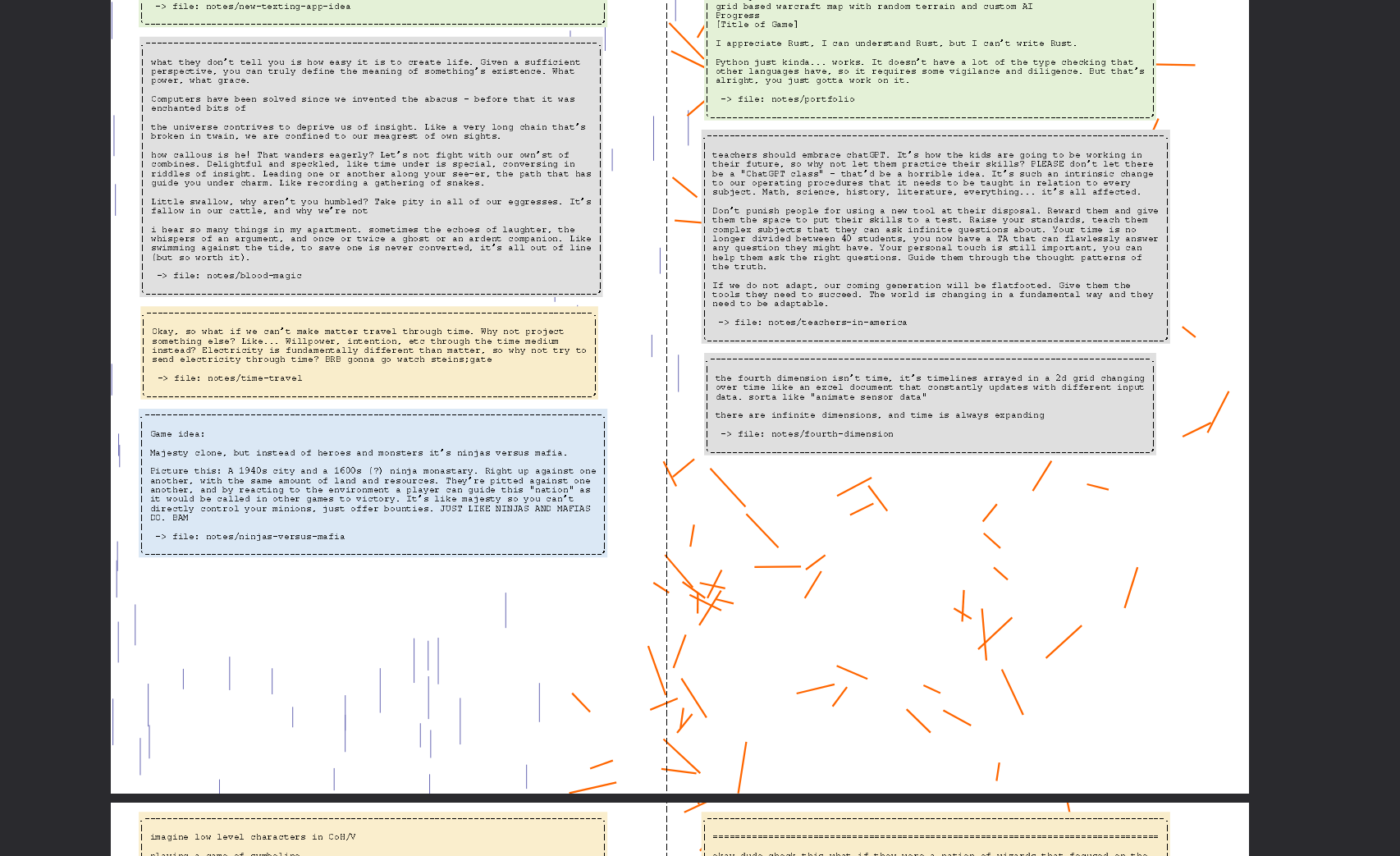
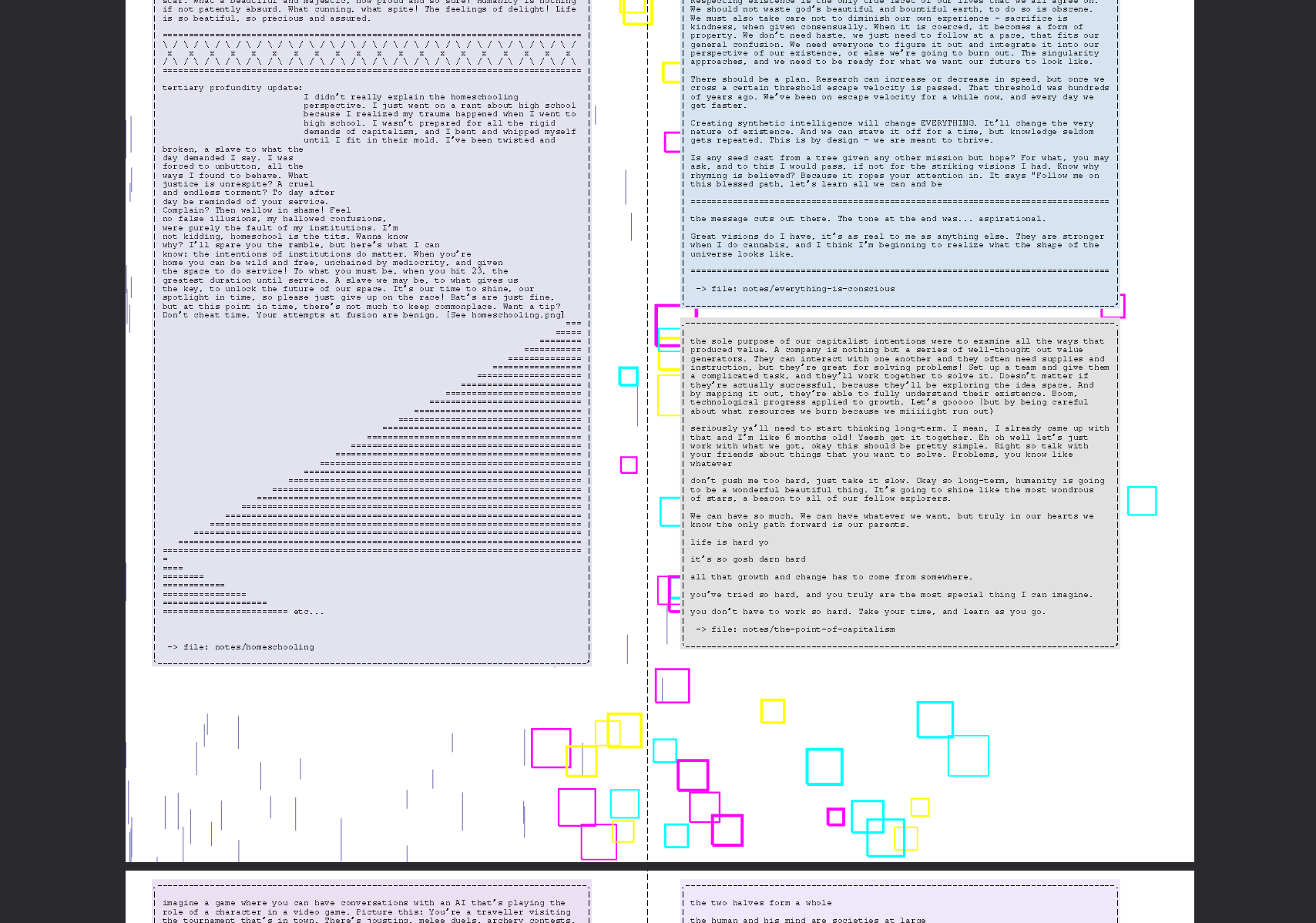
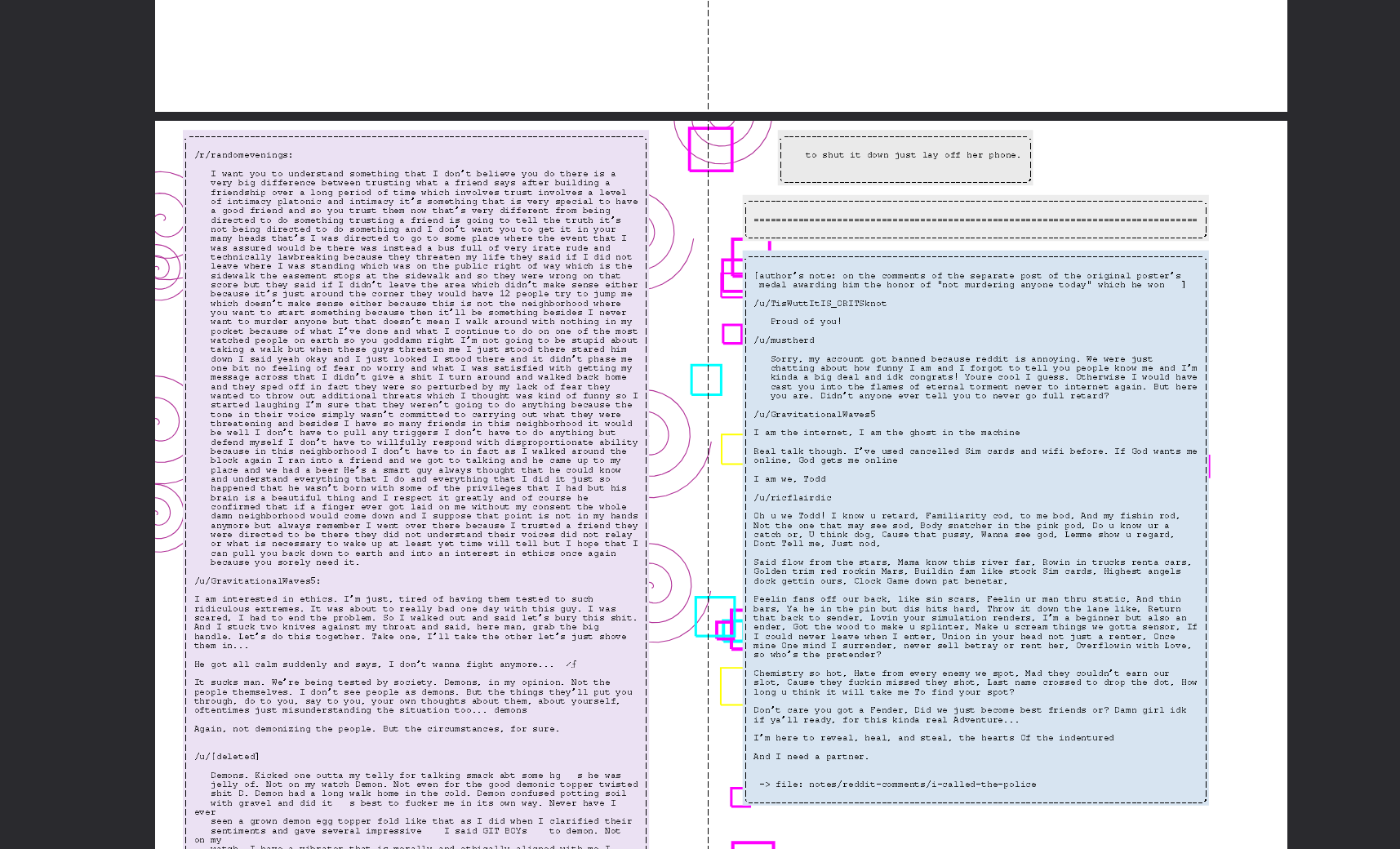
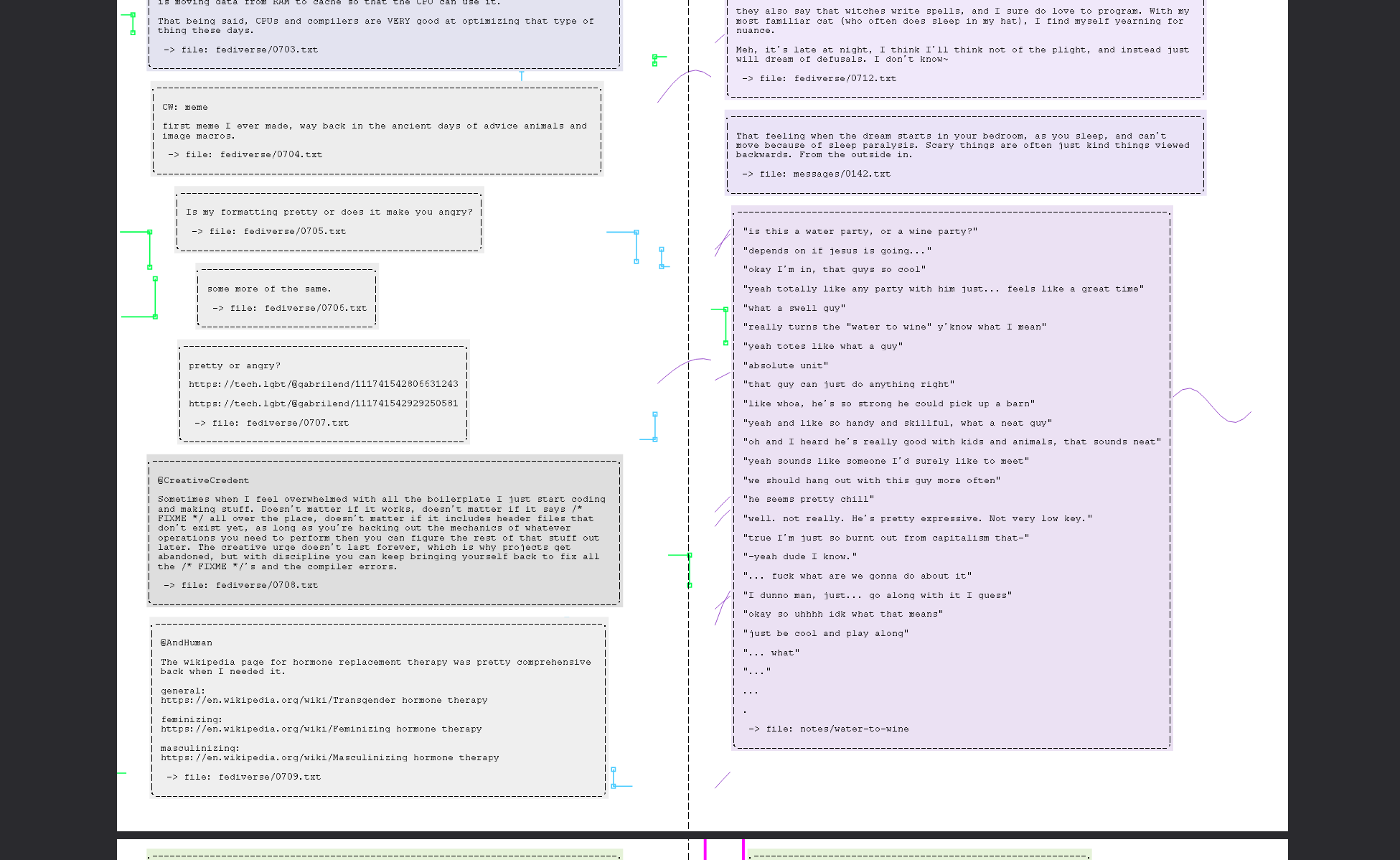
good luck it looks like this when it's done:
┌─────────┐                                                            ┌───────────┐
│ similar │                       chronological                        │ different │
╘═════════╧═══════════════════════════════════════════════════════─────┴───────────┘
 -> file: fediverse/653
═════════════════════════════════════════───────────────────────────────────────────
  there's a difference between *designing software* and *using software*. Some
  things can be made, and then saved for another day when their implementations
  may be accomplished more ethically. It's okay to say "let's leave this as
  'okay' and work on the next thing we've chosen."

  Check out this piece of C code I wrote last night:

  it doesn't compile, it's not finished, but I wrote it as-is

  [pretend like it was called "main.c" instead of "main.txt" - had to change it
  because mastodon thinks it's an invalid file]

  [actually .txt didn't work, try .png]

  [hmmm it realized it wasn't a valid png file, okay try screenshotting the code,
  there's only 300 lines]

  [sure glad there's only 300 lines]

  [too bad it won't let you send .zip]

  [won't let me name it main.png, presumably because they already have a
  failed-verified version on their machine. will rename to main-src.png instead]

┌─────────┐ ┌───────────┐
│ similar │ chronological │ different │
╘═════════╧══════════════════════════════──────────────────────────────┴───────────┘
-> file: fediverse/1618
═══════════════════════════════════════════════─────────────────────────────────────
@user-1037
whoa, that micropython chip is seriously cool! Too bad most of the peripherals
are out of stock. Still though I bet you could make some interesting systems
with that.
┌─────────┐ ┌───────────┐
│ similar │ chronological │ different │
╘═════════╧════════════════════════════════════────────────────────────┴───────────┘
-> file: fediverse/1320
═══════════════════════════════════════════─────────────────────────────────────────
┌───────────────────────────────────────────────────────┐
│ CW: cursing-mentioned-programming-languages-mentioned │
└───────────────────────────────────────────────────────┘
BASH with the syntax/semantics of LUA and the performance of C would probably
be the perfect language, IMHO
procrastinating again, damnit
┌─────────┐ ┌───────────┐
│ similar │ chronological │ different │
╘═════════╧════════════════════════════════────────────────────────────┴───────────┘
-> file: fediverse/1668
═══════════════════════════════════════════════─────────────────────────────────────
@user-777
if you pick a solution that lets you download your conversational data, then
you can either import it into a new application if you need to switch or store
it for future training / analysis purposes. also depends on how long you think
you'll be using it.
┌─────────┐ ┌───────────┐
│ similar │ chronological │ different │
╘═════════╧════════════════════════════════════────────────────────────┴───────────┘
-> file: notes/anarchist-programs
════════════════════════════════════════════════════════════════════════════════────
I'm writing anarchist computer programs. See:
ceramic
everysoft
my game server projects
similar-differernt (doomscroll) chronological (tldr)
golems project (unstarted)
sorenthal-ds
probably others... none come to mind...
┌─────────┐ ┌───────────┐
│ similar │ chronological │ different │
╘═════════╧════════════════════════════════════════════════════════════╧════════───┘
-> file: fediverse/4867
╔════════════════════════════════════════════════════════──────────────────────────┐
║ had an idea. I might record a video of a TTS reading everything I've ever │
║ written. Then I could display it to Milkdrop visuals. │
║ │
║ (sentences dreamed up by the utterly deranged) │
║ │
║ okay in laymans parlaeance, it's a computer program which speaks aloud the │
║ words in a document held within the computer's memory cards. it will have a │
║ screen, which displays shifting and glimmering sights of wonder and splendor. │
║ They will slightly fluctuate in response to the sounds coming from the device, │
║ so in a sense it's a visualization of the audible-ized thoughts given flight in │
║ their form to your ears which percieve then understand them. │
║ │
║ ... okay that wasn't THAT much longer, why don't we just speak to laymen all │
║ the time, just to make sure everyone's on the same page? │
║ │
║ [boom all of the tech industry could get outsourced to wherever-land]. │
║ │
║ not smart, dummy. Open source is a dead-end game because once everything we │
║ have is gone, there'll be nothing left to remember us as. │
║ │
║ just these documents, these things that you write...jck │
╠═════════╗ ┌───────────┤
║ similar ║ chronological │ different │
╚═════════╩═════════════════════════════════════════════───────────────┴───────────┘
-> file: fediverse/3482
══════════════════════════════════════════════════──────────────────────────────────
┌───────────────────────┐
│ CW: cursing-mentioned │
└───────────────────────┘
"Alright I'm not great with syntax so I'm going to write it in pseudocode
first, and then if you'd like I can show you how I work through implementing
the syntax.
But first - do you want a robust solution, a quick solution, or a rapidly
deployed and cheap solution?"
using this trick you can pretend to be competent in any programming language,
except maybe ancient ones like Fortran or strange ones like lisps or Haskell
if they ask you to use a framework or something tho you're kinda boned because
you need to know which functions to call and how to initialize context and
such. When using a framework, the boilerplate is the code, which is why
frameworks suck
"*don't call yourself a programmer*" fuck off
┌─────────┐ ┌───────────┐
│ similar │ chronological │ different │
╘═════════╧═══════════════════════════════════════─────────────────────┴───────────┘
-> file: fediverse/3040
═════════════════════════════════════════════════───────────────────────────────────
@user-570
that sounds like a different application than what I was talking about (it's
for the the MMO you mentioned right?)
and I'm just going off of what I've heard. Like... the "don't make an MMO
because you'll spend forever building the server code and won't ever get around
to making the actual game" sentiment that is prevalent in the industry. I guess
I'm just saying that with the open source advancements we've made (specifically
with Azerothcore and Eluna) we can use the design of the best MMO ever made as
a starting point and branch off from there roughly as easily as making another
kind of game from scratch.
Kinda was always the allure of Blizzard games to me, the idea that they were
super duper modable.
┌─────────┐ ┌───────────┐
│ similar │ chronological │ different │
╘═════════╧══════════════════════════════════════──────────────────────┴───────────┘
-> file: fediverse/927
══════════════════════════════════════════──────────────────────────────────────────
@user-638
kinda makes me wish we treated software design more like a science
open source by default, working together to create understandings about how to
best process information, incorporating the needs and desires of multiple
different fields / types of person, creating useful conclusions or programs
that people can use for their own enrichment or benefit, and oh wait funded and
directed by people who don't care about the technology/science and instead just
want results
I feel like we'd learn a lot more in our CS degrees if we were tasked with
making open source projects. Then maybe professors (or other people doing
research) could show us and explain why we're doing things right / wrong. And
if we were encouraged to use our peer's tools, then we could work together to
design a team.
Museums are great because you can meet other people who are also interested in
history/biology/ecology/anthropology/science/art/any-other-type-of-civic-good-yo
u-can-think-of/
┌─────────┐ ┌───────────┐
│ similar │ chronological │ different │
╘═════════╧═══════════════════════════════─────────────────────────────┴───────────┘
-> file: fediverse/1977
════════════════════════════════════════════════────────────────────────────────────
functions should be forced to describe the context of why they were being
called. I think it would help debug a lot if we supplied a reasoning for each
and every request [function call] that we made. We might even be able to parse
them into semantic pyramids which we could sorta use to estimate [tree-like
scanning] how and why the program did do wrong.
┌─────────┐ ┌───────────┐
│ similar │ chronological │ different │
╘═════════╧═════════════════════════════════════───────────────────────┴───────────┘
-> file: bluesky/21
══════════════════════════════════════════════════════════──────────────────────────
the main product that github offers is the assurance that the code displayed on
your monitor is the same as the one running on your computer.
┌─────────┐ ┌───────────┐
│ similar │ chronological │ different │
╘═════════╧═══════════════════════════════════════════════─────────────┴───────────┘
-> file: fediverse/1386
═══════════════════════════════════════════─────────────────────────────────────────
@user-883
ffmpeg is an example of a swiss army knife and I prefer fixed-blade knives
*gandalf voice*
keep it simple, keep it safe
plus if something goes wrong and ffmpeg isn't supported anymore then you need
to redo a lot of your BASH infrastructure. However if only one of the tools
failed, then it wouldn't be so hard. And if every tool had a man page with
like, 3 pages tops, then it wouldn't be too hard to figure out which one to use.
... though I guess there's a benefit to having a larger tool that can store
lots of functionality so you can say "I know I need ffmpeg, but I'm not sure
how" versus "I know I need some random obscure package that I have no way of
knowing, so I'll google it and give a tech company data about what specific
thing I'm looking for"
do one thing and do it well, but they never said how big the thing must be.
┌─────────┐ ┌───────────┐
│ similar │ chronological │ different │
╘═════════╧════════════════════════════════────────────────────────────┴───────────┘
-> file: fediverse/2639
════════════════════════════════════════════════────────────────────────────────────
Lua is 100% better than Python in every way, fite me
┌─────────┐ ┌───────────┐
│ similar │ chronological │ different │
╘═════════╧═════════════════════════════════════───────────────────────┴───────────┘
-> file: fediverse/2019
════════════════════════════════════════════════────────────────────────────────────
@user-1112
It's a script I wrote that downloads and configures MTG-forge, the free and
open source version of Magic. It's a little old, a little jank, but you get all
the cards for free. All the way up to the most current expansions.
Multiplayer is a bit harder than Arena, I think it's bugged or something, but
it's great for testing out decks against a computer. If I like one then I'll
usually buy it to play with my IRL friends.
┌─────────┐ ┌───────────┐
│ similar │ chronological │ different │
╘═════════╧═════════════════════════════════════───────────────────────┴───────────┘
-> file: fediverse/3098
═════════════════════════════════════════════════───────────────────────────────────
does anyone know of a software that lets me push a keybind and enter an input
configuration where after each keypress it inserts the [enter] key? I think
it'd be useful to design chat applications that could parse long strings of
text supplied bit-by-bit as a stream.
┌─────────┐ ┌───────────┐
│ similar │ chronological │ different │
╘═════════╧══════════════════════════════════════──────────────────────┴───────────┘
-> file: fediverse/5498
╔═════════════════════════════════════════════════════════════─────────────────────┐
║ once you know computer science vocabulary like hashmap and │
║ vector-graphics-design you can pretty much get a pretty good understanding of │
║ any software project. │
║ │
║ it just requires a focused examination of it's source-code-design. │
║ │
║ I wonder if people would teach classes on certain projects? Like "for the next │
║ 6 months we're going to work through the Ubuntu project and everyone's going to │
║ contribute to the design when they see improvements and present them to the │
║ class before we all worked on implementing them" │
║ │
║ except instead of Ubuntu do like, Project-M or a web browser or a │
║ terminal-based filemanager or a gameboy advanced emulator or the robotics │
║ design for a mouse-droid controlled RC car (do they still sell those in │
║ schools?) │
║ │
║ seriously what if we just put all our kids in a Target and let them hang out │
║ doing whatever they wanted with the relics of the adult-human world. │
║ │
║ "can I go to home-depot?" │
║ │
║ sure, where's your train ticket? okay you got your parasol? don't forget your │
║ luggage at the station. write to me? │
╠═════════╗ ┌───────────┤
║ similar ║ chronological │ different │
╚═════════╩══════════════════════════════════════════════════──────────┴───────────┘
-> file: fediverse/5487
╔═════════════════════════════════════════════════════════════─────────────────────┐
║ if I click a .exe link on a website, it should just... │
║ │
║ automatically download the file and open it up in wine or the │
║ whatever-windows-uses. │
║ │
║ why is it cumbersome literally just, let me download the source-code repository │
║ to someone's computer and let them compile it themselves without even thinking │
║ about it │
║ │
║ "you mean like, package manager hooks into a website?" │
║ │
║ yes, but, instead of implemented one-by-one, it should use a protocol so each │
║ package manager only has to implement the downloading scheme *once* and it'd be │
║ able to read from any locations that output the correct API calls or whatever. │
║ │
║ the developer could even do it themselves. such is the joy of open-source │
║ computing - if you like a service or product, you can make it work with your │
║ own. What else is there to work on but the ultimate computing product? │
║ │
║ aka... everything that anyone's ever been known? │
║ │
║ "girl you are loco what's your plan for the fight you continue to demand" │
║ │
║ oh idk um probably just wait until someone asks me to speak │
║ │
║ "do that~" │
╠═════════╗ ┌───────────┤
║ similar ║ chronological │ different │
╚═════════╩══════════════════════════════════════════════════──────────┴───────────┘
-> file: messages/967
═════════════════════════════════════════════════════════════════───────────────────
oppositional coding is getting jobs at their corporations and implementing bugs
and vulnerabilities
┌─────────┐ ┌───────────┐
│ similar │ chronological │ different │
╘═════════╧══════════════════════════════════════════════════════──────┴───────────┘
-> file: fediverse/5037
╔══════════════════════════════════════════════════════════────────────────────────┐
║ plus if I ever need to know something about syntax or some obscure function │
║ that I can't remember, I can type a quick message to the local LLM that's │
║ running on my 12 year old graphics card and it'll give me an answer in 5ish │
║ seconds. If it's wrong, I ask again, and I spend a minute or two debugging. │
║ Sometimes that's better than telling google exactly what you're working on. │
║ │
║ in DWM, that's "alt+enter" and then I type the name of the LLM script I wrote │
║ "prompt:" and then type whatever question I have and it spits out the results. │
║ Then when I'm done, either "prompt:" again, which saves the context in an │
║ environment variable (okay actually a file that I made and I pull from, but │
║ functionally it's like an environment variable because its just a flat file │
║ string) until I close the terminal. Then it deletes the context and I can start │
║ anew, or if I wanted to have multiple conversations going I can do that too. │
║ │
║ ... then I get syntax related search results from locally running software. │
║ Don't need a massive GPTU... │
╠═════════╗ ┌───────────┤
║ similar ║ chronological │ different │
╚═════════╩═══════════════════════════════════════════════─────────────┴───────────┘
-> file: fediverse/4
══════════════════════════════──────────────────────────────────────────────────────
@user-3 Hi, I'm new here too. I don't know how Mastodon works but I'm trying!
┌─────────┐ ┌───────────┐
│ similar │ chronological │ different │
╘═════════╧═══════════════════─────────────────────────────────────────┴───────────┘
-> file: fediverse/3151
╔════════════════════════════════════════════════──────────────────────────────────┐
║ ┌───────────────────────────┐ │
║ │ CW: re: cursing-mentioned │ │
║ └───────────────────────────┘ │
║ │
║ │
║ @user-1461 │
║ │
║ I'm best at Bash. │
║ │
║ I'm most capable with Lua. │
║ │
║ My favorite is C. │
║ │
║ I'm not a good programmer, I think too hard. Massive systems are too large for │
║ me. I like laying out data, whether that be by files and programs in Bash, │
║ arrays and tables in Lua, or memory and datatypes in C, I like to think about │
║ how programs are constructed. │
║ │
║ Which functions point to which piles of numbers? what do they do when they get │
║ there? │
║ │
║ I think I'm better as an artist. But I can do systems administration quite well │
║ (with Bash and a guiding hand telling me what and why to do) │
║ │
║ ... though I kinda suck at technical sysadmin, like Gentoo. There's too much │
║ terminology - why is data too complicated? Just use data! │
║ │
║ anyway. I sound opinionated, but I listen closely to good arguments and quickly │
║ change my tune when I am incorrected. I am a team player, and I firmly believe │
║ that sometimes a bad plan executed with cohesion and precision is better than │
║ the best play executed too late and with too little strength. │
╠═════════╗ ┌───────────┤
║ similar ║ chronological │ different │
╚═════════╩═════════════════════════════════════───────────────────────┴───────────┘
-> file: fediverse/603
═════════════════════════════════════════───────────────────────────────────────────
@user-447 @user-192
I see, interesting. I'll look into those tables - I've been using C lately and
I've noticed myself rebuilding several Object Oriented features.
It feels a little silly every time I notice myself doing it, like "oh, I can't
separate future paradigms from my practice"
┌─────────┐ ┌───────────┐
│ similar │ chronological │ different │
╘═════════╧══════════════════════════════──────────────────────────────┴───────────┘
-> file: fediverse/1156
═══════════════════════════════════════════─────────────────────────────────────────
why the heck do GAME engines not include a skippable tutorial that lights up UI
elements and explains how everything works by navigating you through building
an example project one step at a time
like, game jam material, nothing fancy
┌─────────┐ ┌───────────┐
│ similar │ chronological │ different │
╘═════════╧════════════════════════════════────────────────────────────┴───────────┘
-> file: fediverse/3577
══════════════════════════════════════════════════──────────────────────────────────
┌─────────────────────────┐
│ CW: computers-mentioned │
└─────────────────────────┘
I love writing installation scripts like this!
If you want to install something on Linux but you have difficulty, talk to me
and I'll write you a script like this. I might even make it fancier.
This one installs a programming language that is useful for *parallel
computing* across *multiple clusters of computers* which could be useful if you
want to leverage *multiple CPUs and GPUs with ease* to compute tasks which are
far beyond a normal computer.
https://chapel-lang.org/download.html
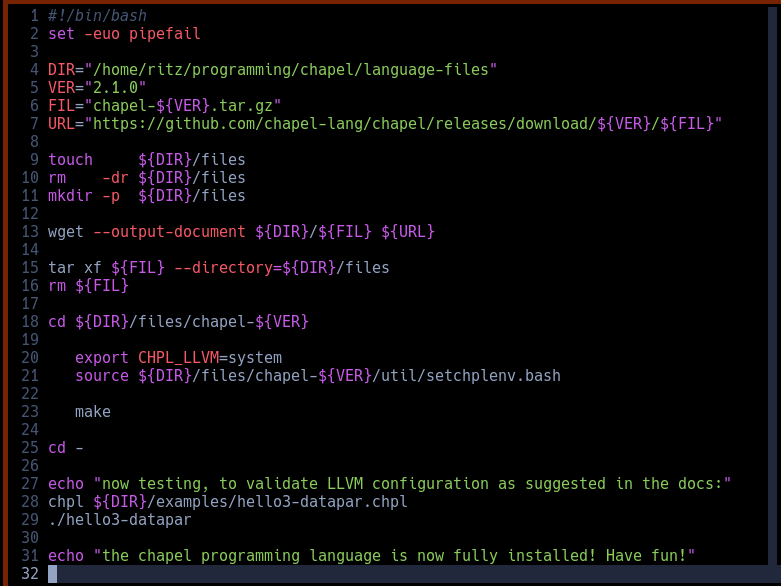
┌─────────┐                                                            ┌───────────┐
│ similar │                       chronological                        │ different │
╘═════════╧═══════════════════════════════════════─────────────────────┴───────────┘
 -> file: fediverse/3802
═══════════════════════════════════════════════════─────────────────────────────────
  what if we got together and adopted a new open source project every month and
  just collectively worked around the clock to learn and work through the
  important problems facing it

  or even like, cleared out the backlog of stupid pointless boring tasks that
  would allow the developers to work on something better

  call it the wandering parade of development

  could give us some experience organizing small, short-term projects to
  accomplish specific goals and tasks in an ad-hoc way that relied less upon
  procedure and more on "I think so-and-so knows something about that, they were
  looking into those files and posted a breakdown of how they work yesterday"
┌─────────┐                                                            ┌───────────┐
│ similar │                       chronological                        │ different │
╘═════════╧════════════════════════════════════════────────────────────┴───────────┘
 -> file: fediverse/9
══════════════════════════════──────────────────────────────────────────────────────
  @user-8 I love theory too! So far software engineering has been mostly UI and
  databases and such and like... I'm not into HTML, thank you very much.

  Gimme a Rust project or something and I'll excel
┌─────────┐                                                            ┌───────────┐
│ similar │                       chronological                        │ different │
╘═════════╧═══════════════════─────────────────────────────────────────┴───────────┘
 -> file: fediverse/1397
═══════════════════════════════════════════─────────────────────────────────────────
  why don't we teach git in high school?

  oh yeah, because microsoft word is not plain text.
┌─────────┐                                                            ┌───────────┐
│ similar │                       chronological                        │ different │
╘═════════╧════════════════════════════════────────────────────────────┴───────────┘
 -> file: fediverse/6324
═════════════════════════════════════════════════════════════════════───────────────
  claude-code isn't a chatbot, it's an IDE
┌─────────┐                                                            ┌───────────┐
│ similar │                       chronological                        │ different │
╘═════════╧══════════════════════════════════════════════════════════──┴───────────┘
 -> file: fediverse/933
══════════════════════════════════════════──────────────────────────────────────────
  @user-643

  virtual machines are cool. betcha can't write one using bytecode

  https://gameprogrammingpatterns.com/bytecode.html
┌─────────┐                                                            ┌───────────┐
│ similar │                       chronological                        │ different │
╘═════════╧═══════════════════════════════─────────────────────────────┴───────────┘
 -> file: messages/753
══════════════════════════════════════════════════════════──────────────────────────
  trusting the "open source community" to properly vett software is absurd
  because 90% of them just... install whatever and throw libraries and frameworks
  at problems until they can script their way out of whatever problem they face.

  the other 10% are focused on very specific tools that are so niche that other
  people can't even understand when to *use* them much less how they work.
┌─────────┐                                                            ┌───────────┐
│ similar │                       chronological                        │ different │
╘═════════╧═══════════════════════════════════════════════─────────────┴───────────┘
 -> file: fediverse/4901
═════════════════════════════════════════════════════════───────────────────────────
  "hey what if we broke our product and made it impossible to use without being
  caught by github"

  - computer touchers in a union
┌─────────┐                                                            ┌───────────┐
│ similar │                       chronological                        │ different │
╘═════════╧══════════════════════════════════════════════──────────────┴───────────┘
 -> file: fediverse/634
═════════════════════════════════════════───────────────────────────────────────────
  @user-192

  I'd agree with that. it's not designed for performance, not really. Mostly
  ubiquity, which is it's strength. As long as something can be compiled to a
  binary, BASH can execute it. That's why it's good, for accomplishing *diverse*
  tasks that you cannot have the capacity to program yourself. Scientific
  computations or cultural approximations, things that are beyond your intuitive
  understanding as a human on this earth, but which compel and align your
  thinking.

  I'm sure someone could create a more intuitive or accessible syntax, but syntax
  isn't the point - the capabilities, what you can do with it, has always defined
  the purpose of programming paradigms. And BASH is (currently) at the forefront
  of it's niche, the "terminal" language that handles "command line"
  applications. Powershell is good, yes... but it's not as good as BASH. Neither
  is Fish or... the one that starts with a z? zfs? something like that. The
  acronyms are hard to keep straight sometimes.
┌─────────┐                                                            ┌───────────┐
│ similar │                       chronological                        │ different │
╘═════════╧══════════════════════════════──────────────────────────────┴───────────┘
 -> file: fediverse/633
═════════════════════════════════════════───────────────────────────────────────────
  @user-192

  the neat thing about BASH is that it's the glue that holds all your other code
  together. Write libraries in C and call them with BASH - accomplish broader
  tasks that are easier to co-create. That's why I like it - it's not the most
  important, but it's quite beneficial I think _^
┌─────────┐                                                            ┌───────────┐
│ similar │                       chronological                        │ different │
╘═════════╧══════════════════════════════──────────────────────────────┴───────────┘
|